
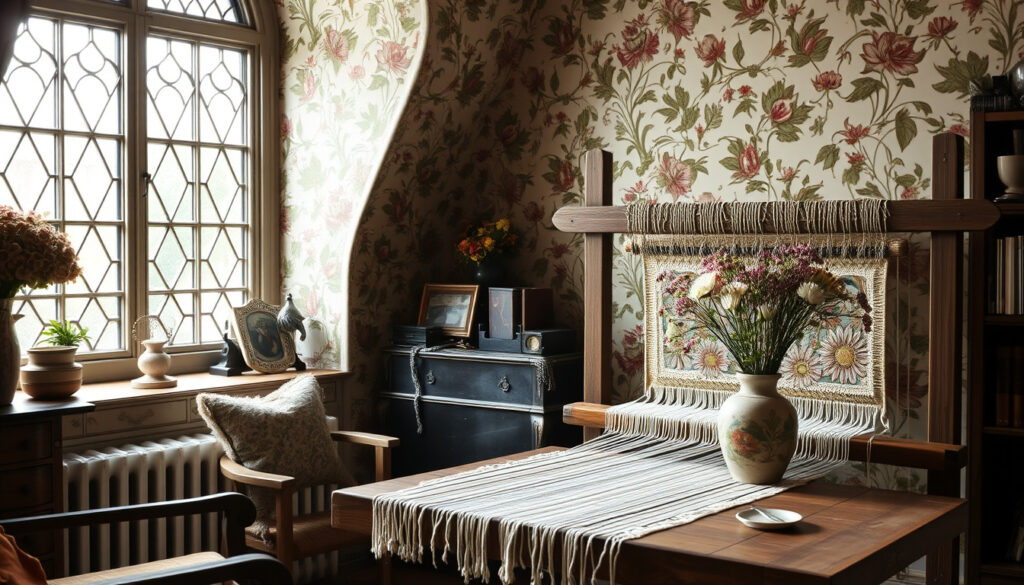
You’ve probably seen a William Morris wallpaper in a Victorian house, a museum gift shop, or even on a contemporary fabric cushion, but behind those intricate floral patterns was a man who believed that art, work, and politics could not be separated. Here’s the full story of the designer, poet, socialist, and the ideas that made him one of the most influential figures of the 19th century.
Born: 24 March 1834 ·
Died: 3 October 1896 ·
Occupation: Textile designer, poet, artist, writer, socialist activist ·
Known for: Arts and Crafts movement, wallpaper designs, socialist writings ·
Notable design: Strawberry Thief ·
Spouse: Jane Burden
Quick snapshot
- Born 24 March 1834 in Walthamstow, England (Encyclopædia Britannica)
- Died of pulmonary tuberculosis on 3 October 1896 (Encyclopædia Britannica)
- Designed Strawberry Thief wallpaper in 1883 (Victoria and Albert Museum)
- Founded Morris & Co. in 1861 (Morris & Co.)
- Claims that Morris lost a leg are unsubstantiated and likely false (Wikipedia)
- Exact details of his final illness are sometimes conflated with overwork, but medical records confirm tuberculosis (Oxford Dictionary of National Biography)
- 1834: Born in Walthamstow (National Trust)
- 1861: Founds Morris, Marshall, Faulkner & Co. (Victoria and Albert Museum)
- 1883: Joins the Social Democratic Federation (Tate)
- 1890: Founds Kelmscott Press (British Library)
- Morris’s designs remain in production and are sold worldwide (Morris & Co.)
- His legacy influences modern sustainable design and environmental movements (The Guardian)
Nine key facts, one pattern: William Morris’s life was a tightly woven fabric of art, industry, and ideology — each strand supporting the others.
| Attribute | Detail |
|---|---|
| Full name | William Morris |
| Born | 24 March 1834, Walthamstow, England |
| Died | 3 October 1896, Hammersmith, England |
| Cause of death | Pulmonary tuberculosis |
| Occupation | Textile designer, poet, novelist, socialist activist |
| Spouse | Jane Burden (married 1859) |
| Children | Two daughters: Jenny and May |
| Famous design | Strawberry Thief wallpaper |
| Notable quote | “Have nothing in your house that you do not know to be useful, or believe to be beautiful.” |
What was William Morris most known for?
Overview of his career
- Morris was a leading figure in the Arts and Crafts movement (Encyclopædia Britannica).
- He is best known for his textile patterns and wallpaper designs (Victoria and Albert Museum).
- He was also a poet, novelist, and socialist activist (William Morris Gallery).
- His philosophy emphasized craftsmanship and a return to medieval artistic ideals (Grove Art Online).
What this means: Morris’s designs weren’t just decorative — they were a protest. Every hand-printed flower on a roll of wallpaper was a statement against mass production and soulless industrial work.
Distinct contributions to the Arts and Crafts movement
- Morris founded the interior design firm Morris, Marshall, Faulkner & Co. (later Morris & Co.) in 1861 (Morris & Co.).
- He championed the revival of traditional textile arts such as weaving, dyeing, and embroidery (Victoria and Albert Museum).
- His 1880 lecture “The Beauty of Life” laid out the moral purpose of art (Marxists Internet Archive).
Morris’s handcrafted goods were too expensive for the working class he wanted to help — a contradiction he acknowledged but never fully resolved.
The implication: The movement he started reshaped how we think about furniture, wallpaper, and even architecture, but its ideals of accessible beauty remain an aspiration, not a reality.
What was William Morris’ cause of death?
Medical details
- Morris died of pulmonary tuberculosis on 3 October 1896 (Encyclopædia Britannica).
- He had been diagnosed with inflammation of the lungs in the months before his death (Oxford Dictionary of National Biography).
- He was 62 years old (William Morris Gallery).
Myths and misconceptions
- Rumors that he lost a leg before death are unfounded and do not appear in any reliable biography (Wikipedia).
- Some accounts attribute his failing health to overwork, but the direct cause was tuberculosis (British Library).
A persistent myth about Morris losing his leg has circulated online. No primary source from his physicians or family supports it — treat such claims with skepticism.
The pattern: Morris’s death is sometimes mythologized, but the medical records are clear.
What was William Morris’s famous quote?
Most cited sayings
- His most famous quote: “Have nothing in your house that you do not know to be useful, or believe to be beautiful.” (William Morris Gallery)
- Another known quote: “The true secret of happiness lies in taking a genuine interest in all the details of daily life.” (Marxists Internet Archive)
Context of the quotes
- The first quote comes from his 1880 lecture “The Beauty of Life” and encapsulates his design philosophy (Encyclopædia Britannica).
- The second appears in his essay “The Aims of Art” (1887), linking aesthetic pleasure to political and personal well-being (Oxford Scholarship Online).
The pattern: Both quotes insist that beauty isn’t a luxury — it’s a requirement for a good life, and its absence is a political failing.
What is the most famous William Morris design?
Strawberry Thief
- The “Strawberry Thief” design, created in 1883, is widely considered his most famous wallpaper pattern (Victoria and Albert Museum).
- It features thrushes stealing strawberries, inspired by birds in his garden at Kelmscott Manor (William Morris Gallery).
- Morris used an intricate indigo discharge technique to achieve the pattern’s depth (Victoria and Albert Museum).
Other iconic patterns
- Willow Boughs (1874) — a delicate pattern of willow leaves (Morris & Co.).
- Acanthus (1875) — a bold, large-scale leaf pattern (Victoria and Albert Museum).
- Dove and Rose (1879) — a repeating design of doves and roses (William Morris Gallery).
For a modern buyer or designer, Morris’s patterns are still in production — Morris & Co. continues to sell wallpaper and fabric using his original blocks. The designs have remained continuously available for over 130 years, a rare feat for any decorative art.
The implication: Morris’s patterns outlasted his era, proving that well-crafted design defies fashion cycles.
What are 5 facts about William Morris?
Early life
- Fact 1: He founded the interior design firm Morris & Co. in 1861 (Morris & Co.).
- Fact 2: He was a key member of the Pre-Raphaelite Brotherhood alongside Dante Gabriel Rossetti and Edward Burne-Jones (Tate).
Artistic achievements
- Fact 3: He established the Kelmscott Press in 1890, which produced beautifully printed books including the Kelmscott Chaucer (British Library).
Political activism
- Fact 4: He was a committed socialist who gave speeches and wrote political tracts, joining the Social Democratic Federation in 1883 (Marxists Internet Archive).
- Fact 5: His novel “News from Nowhere” (1890) depicted a utopian socialist society (Oxford Bibliographies).
The catch: Morris’s revolutionary politics sit uneasily with his status as a luxury goods designer — a tension that makes him endlessly fascinating and ambiguous.
Confirmed facts
- Born 24 March 1834 in Walthamstow (William Morris Gallery).
- Died 3 October 1896 of pulmonary tuberculosis (Encyclopædia Britannica).
- Married Jane Burden in 1859 (Tate).
- Designed the Strawberry Thief wallpaper in 1883 (Victoria and Albert Museum).
- Founded Kelmscott Press in 1890 (British Library).
What’s unclear
- Claims that William Morris lost a leg are unsubstantiated and likely false (Wikipedia).
- Exact circumstances around his final illness are sometimes conflated with overwork, but medical records confirm tuberculosis (Oxford Dictionary of National Biography).
Key quotes from William Morris
Have nothing in your house that you do not know to be useful, or believe to be beautiful.
— William Morris, from the lecture “The Beauty of Life” (1880) (William Morris Gallery)
The true secret of happiness lies in taking a genuine interest in all the details of daily life.
— William Morris, from the essay “The Aims of Art” (1887) (Marxists Internet Archive)
For designers and homeowners today, the choice is clear: embrace Morris’s philosophy of mindful craft — or accept the disposable aesthetics that he spent his life fighting. For anyone serious about sustainable design, Morris’s lesson is that beauty and ethics must be woven together, not sold separately.
opusproject.eu, checkbox.com, buzzfeed.com, springernature.com, kadence.com, prb.org, academia.edu, nngroup.com, classpop.com, oprs.research.illinois.edu, aytm.com, facebook.com, schweizzeit.ch
Frequently asked questions
What was William Morris’s occupation?
He was a textile designer, poet, novelist, and socialist activist (Encyclopædia Britannica).
What is the Kelmscott Press?
The Kelmscott Press was a private press founded by Morris in 1890, known for producing finely crafted books using medieval-style printing and design (British Library).
What is the Red House?
The Red House in Bexleyheath was the family home designed for Morris by Philip Webb in 1859. It is considered a landmark of the Arts and Crafts movement (National Trust).
Who was Jane Morris?
Jane Burden (later Jane Morris) was William Morris’s wife and a noted muse of the Pre-Raphaelite painters, particularly Dante Gabriel Rossetti (Tate).
What is the connection between William Morris and the Pre-Raphaelites?
Morris met Dante Gabriel Rossetti and Edward Burne-Jones while at Oxford and became a key associate of the Pre-Raphaelite Brotherhood, sharing their interest in medieval themes and naturalistic detail (Tate).
What is Morris & Co.?
Morris & Co. (originally Morris, Marshall, Faulkner & Co.) was the decorative arts firm founded by Morris in 1861, producing furniture, stained glass, wallpaper, and textiles (Morris & Co.).
Where can I see William Morris’s original works?
The William Morris Gallery in Walthamstow, London, and the Victoria and Albert Museum both hold major collections (William Morris Gallery; Victoria and Albert Museum).
What is William Morris’s most famous book?
“News from Nowhere” (1890) is his best-known literary work, a utopian romance that imagines a socialist future (Oxford Bibliographies).
Related stories





Craig Newton is Senior Reporter at ScopePress.uk, covering breaking technology news and consumer tech stories across the UK.