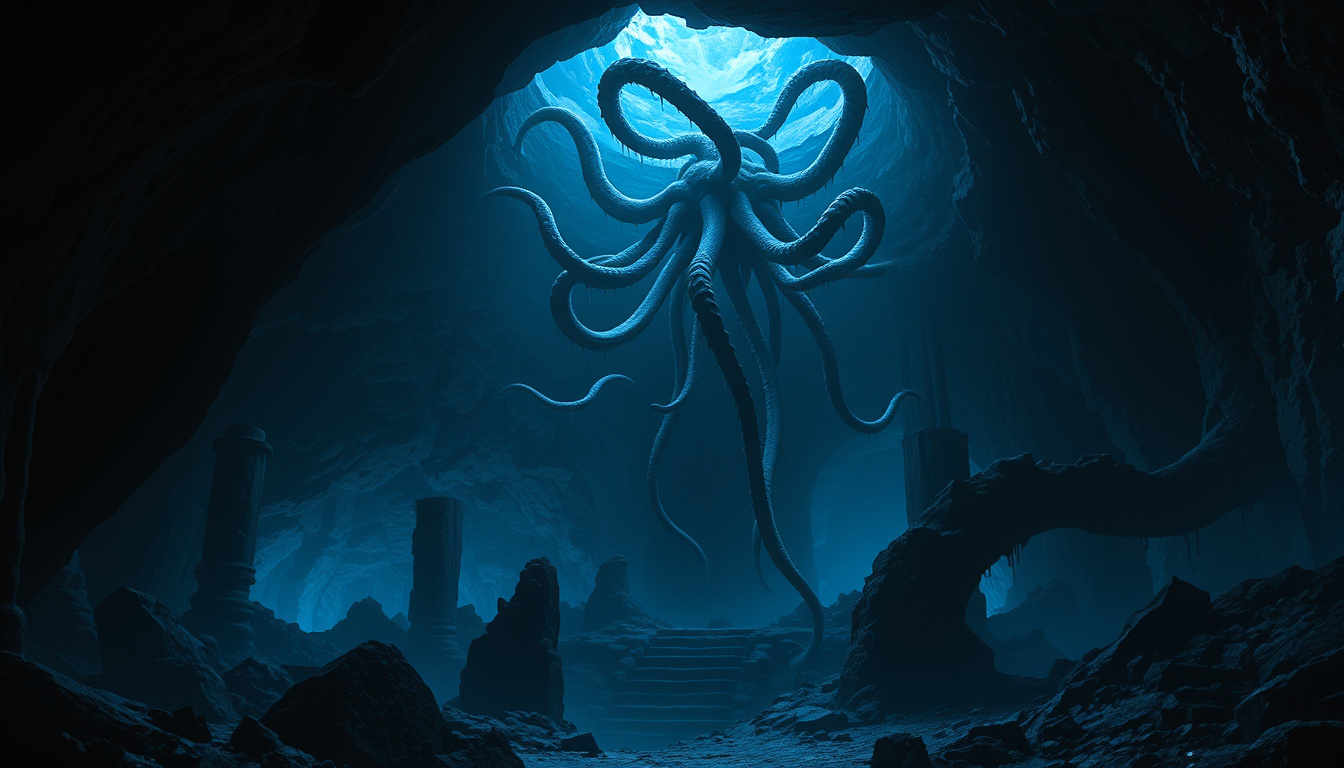
The Mind Flayer conjures two radically different images: a towering, spider-like shadow monster from Stranger Things that controls the Upside Down, and a tentacled, brain-eating aberration from Dungeons & Dragons that lurks in the Underdark. Both share the same name, but the creature’s story diverges sharply depending on which world you’re in.
First appearance: 1975 (The Strategic Review #1) ·
Stranger Things debut: Season 2 (2017) ·
Creature type (D&D): Aberration ·
Alignment (D&D): Lawful evil ·
Signature ability: Psionic mind blast ·
Number of Stranger Things seasons featured: 3 (S2–S4)
Quick snapshot
- First D&D mind flayer appeared in Spring 1975 (Great Library of Greyhawk (community lore wiki))
- Stranger Things Mind Flayer is a group intelligence of particles (Winter Is Coming (entertainment news))
- Vecna controls the Mind Flayer in the show (Winter Is Coming)
- Whether the Mind Flayer had its own consciousness before Vecna (Stranger Things Wiki (fan resource))
- The exact nature of the entity in the Upside Down before Season 4 retcon (Stranger Things Wiki (fan resource))
- If the Mind Flayer is permanently destroyed or can reappear (Stranger Things Wiki (fan resource))
- 1975: First mind flayer appears in D&D (Great Library of Greyhawk)
- 2017: Stranger Things Season 2 introduces the Mind Flayer ((Great Library of Greyhawk))
- 2022: Season 4 reveals Vecna as its creator ((Great Library of Greyhawk))
- Season 5 likely to resolve the Mind Flayer’s fate
- D&D players continue to encounter illithids in campaigns
- Baldur’s Gate 3 cements mind flayers in modern gaming
Seven key facts about the Mind Flayer in both universes, side by side:
| Attribute | Value |
|---|---|
| D&D name | Illithid (Dungeons & Dragons Lore Wiki (fan wiki)) |
| Stranger Things name | The Mind Flayer (Stranger Things Wiki) |
| Leader (D&D) | Elder Brain (D&D Beyond Forums (player discussion)) |
| Master (Stranger Things) | Vecna (Winter Is Coming) |
| Home plane (D&D) | Underdark |
| Home dimension (Stranger Things) | Upside Down |
| Diet | Brains (both universes) |
What truly is the mind flayer?
Illithid origins in Dungeons & Dragons
- The mind flayer first appeared in TSR’s The Strategic Review #1 in Spring 1975, according to the Great Library of Greyhawk (community lore wiki).
- The creature later became known as an “illithid” in official D&D usage (same source).
- D&D lore has long treated mind flayers as an alien psionic humanoid species with tentacles and brain-eating behavior (Dungeons & Dragons Lore Wiki).
The implication: the D&D mind flayer is a species, not a single entity. It has a society, a hierarchy, and multiple origin traditions—some say they come from the distant future, others that they were created by a corrupted daelkyr (D&D Beyond Forums). That’s a far cry from the lone shadow monster of Hawkins.
Hive mind and the Elder Brain
- Mind flayers are a hive mind species led by an Elder Brain (D&D Beyond Forums).
- The Elder Brain controls the colony and absorbs the memories of consumed brains.
- Some D&D traditions claim mind flayers used time travel to escape the heat death of the universe (same forum).
The pattern: D&D offers a rich, contradictory mythology. The Stranger Things version, by contrast, is a single creature—reportedly a manifestation of Vecna’s will (Winter Is Coming).
Physical appearance and abilities
- In D&D, the mind flayer is a humanoid with a squid-like head, four tentacles, and psionic powers like Mind Blast and Plane Shift (Dungeons & Dragons Lore Wiki).
- The Stranger Things Mind Flayer is visually a cloud of particles that can form a giant spider-like shape (Winter Is Coming).
- Both versions are psionic and can control other beings, but the mechanics differ.
Who is the mind flayer in Stranger Things?
Introduction in Season 2
- The Mind Flayer first appears in Season 2 as a black, spider-like entity made of silver-black particles (Stranger Things Wiki).
- It stalks the characters and attempts to take over Hawkins.
- The Hawkins kids—using their D&D knowledge—name it the Mind Flayer (Stranger Things Wiki).
The catch: the name is an in-universe label, not a confirmed identity. The show itself draws from D&D as a storytelling device, not a literal crossover.
Forms and control via particles
- The entity can possess humans by entering through wounds or mouths (Winter Is Coming).
- In Season 3, it uses a harvested human biomass to build a physical body (the “Meat Flayer”).
- Its weakness is heat—fire and high temperatures can drive it away.
Why this matters: the show establishes a consistent set of rules for its monster—rules that have nothing to do with D&D illithid biology.
Connection to Vecna
- Season 4 reveals that Vecna (Henry Creel) created and controls the Mind Flayer (Winter Is Coming).
- The Mind Flayer is effectively a tool of Vecna’s will, not an independent ancient being.
- Some commentary suggests the entity is a manifestation of Vecna’s rage (Winter Is Coming).
The trade-off: this retroactively changes the Mind Flayer from a mysterious alien threat to a servant of a more human villain. Fans have debated whether this diminishes the creature’s impact.
The Stranger Things Mind Flayer started as a terrifying unknown, but Season 4 recast it as a projection of Vecna’s hatred. For viewers, the mystery of an ancient evil was replaced by the story of a scorned psychic. That’s a creative choice—but one that divides the fanbase.
Is Vecna the mind flayer?
Vecna’s true identity
- Vecna is Henry Creel, a human with psychic powers who was sent to the Upside Down by Eleven in 1979 (Winter Is Coming).
- In D&D, Vecna is a lich god of secrets, entirely unrelated to mind flayers (Dungeons & Dragons Lore Wiki).
- The show borrows the name “Vecna” from D&D but applies it to a different character.
The pattern: Stranger Things uses D&D terminology as a mythic naming device rather than a literal adaptation.
Mind Flayer as a tool of Vecna
- According to show canon, the Mind Flayer is not Vecna—it is a cloud of particles that Vecna shapes and commands (Winter Is Coming).
- Vecna uses the Mind Flayer to spy on the real world and carry out his plans.
- The entity has no apparent will of its own; it acts only on Vecna’s orders.
What this means: the Mind Flayer is a puppet, not a player. Vecna is the mastermind.
Differences in origin
- In D&D, mind flayers are a species with a long history, multiple origin stories, and no connection to Vecna (D&D Beyond Forums).
- In Stranger Things, the Mind Flayer is a singular entity born from the Upside Down and shaped by Vecna.
- The two share a name, but their origins are completely different.
The catch: if you’re looking for a direct adaptation of the D&D illithid in the show, you won’t find it. The show uses the name as a homage, not a translation.
Who is higher, Vecna or Mind Flayer?
Hierarchy in Stranger Things
- Vecna is the top of the hierarchy: he created and commands the Mind Flayer (Winter Is Coming).
- The Mind Flayer is subordinate to Vecna and acts as his proxy.
- Eleven’s battle with Vecna in Season 4 reinforces that defeating him is the key to stopping the Upside Down.
Why this matters: for fans who expected the Mind Flayer to be the final boss, the reveal that Vecna is the true threat changes the stakes entirely.
Vecna commands the Mind Flayer
- The Season 4 finale shows Vecna using the Mind Flayer to attack the Hawkins crew.
- Vecna’s psychic connection to the hive mind allows him to control every creature in the Upside Down, including the Demogorgons and the Mind Flayer.
- Some speculation suggests the Mind Flayer existed in the Upside Down before Vecna and that Vecna merely harnessed it (Reddit community discussion).
But the show’s canon appears to say Vecna created it. The exact nature before his arrival remains unclear.
D&D context: separate entities
- In D&D, Vecna and mind flayers are independent powers with no direct hierarchy (Dungeons & Dragons Lore Wiki).
- A mind flayer colony would serve an Elder Brain, not a lich god.
- Vecna is a major villain in D&D lore, but he has no inherent connection to illithids.
The implication: the show created a new relationship that doesn’t exist in the source material.
For viewers who know D&D, the hierarchy confusion is understandable: the show uses two D&D names—Vecna and Mind Flayer—but combines them into a single narrative arc. In the game, they’re unrelated. In Hawkins, the Mind Flayer is Vecna’s weapon.
Is the Mind Flayer still alive?
Defeat in Season 3
- The Mind Flayer was seemingly destroyed in Season 3 when the Russians’ gate was closed and its physical body melted (Stranger Things Wiki).
- The gate closure cut off the connection to the Upside Down.
- But the particles are not a physical organism—they are a psychic manifestation.
The trade-off: physical destruction doesn’t mean permanent death for a hive-mind entity.
Resurgence in Season 4
- In Season 4, the Mind Flayer reappears, now clearly under Vecna’s control (Winter Is Coming).
- It assists Vecna in his attacks and serves as his eyes across the Upside Down.
- Its return confirms that as long as Vecna lives, the Mind Flayer can be recreated.
Why this matters: the Mind Flayer is effectively an extension of Vecna. Kill Vecna, and the Mind Flayer likely ceases to exist.
Current state in the Upside Down
- At the end of Season 4, Vecna is injured but alive, and the Upside Down is bleeding into Hawkins.
- The Mind Flayer has not been seen since the finale, but logically it can still manifest.
- Season 5 will likely resolve whether the entity has any independent existence.
The pattern: the Mind Flayer’s “alive or dead” status hinges entirely on Vecna. It’s not a creature with its own life cycle.
Mind Flayer: D&D vs. Stranger Things comparison
Five major differences that show how the two versions diverge:
| Aspect | Dungeons & Dragons | Stranger Things |
|---|---|---|
| What it is | A biological species (D&D Lore Wiki) | A psychic cloud of particles (Winter Is Coming) |
| Intelligence | Individual, psionic, evil | Hive intelligence controlled by Vecna |
| Leader | Elder Brain (D&D Beyond Forums) | Vecna |
| Reproduction | Tadpoles that undergo ceremorphosis (Reddit lore discussion) | Does not reproduce; created by Vecna |
| Home plane | Underdark (material plane) | Upside Down (alternate dimension) |
D&D Mind Flayer: key specs
Six essential stats for the D&D 5e illithid, according to official lore:
| Attribute | Value |
|---|---|
| Creature type | Aberration (Dungeons & Dragons Lore Wiki) |
| Alignment | Lawful evil (same source) |
| Intelligence | Very high (genius-level psionics) |
| Psionic power | Mind Blast (stuns targets in cone) |
| Diet | Brains (extract via tentacles) |
| Weakness | Sunlight (disadvantage in bright light in earlier editions) |
Timeline of the Mind Flayer across franchises
- 1975 (Spring): First mind flayer appears in D&D’s The Strategic Review #1 (Great Library of Greyhawk).
- 1977: Illithid officially named and expanded in the Monster Manual (first official core rulebook).
- 1979 (in Stranger Things universe): Henry Creel murders his family and is taken to Hawkins Lab.
- 1984: Eleven opens the first gate to the Upside Down.
- 2017 (real world): Stranger Things Season 2 introduces the Mind Flayer.
- 2019: Season 3 shows the Mind Flayer’s physical defeat.
- 2022: Season 4 reveals Vecna as the creator of the Mind Flayer (Winter Is Coming).
What’s confirmed and what’s still unclear
Confirmed facts
- The Mind Flayer in Stranger Things is a group intelligence made of particles (Winter Is Coming).
- It can shapeshift into giant monsters (Stranger Things Wiki).
- Vecna is its creator and controller (Winter Is Coming).
- In D&D, mind flayers are humanoid aberrations with psionic powers (Dungeons & Dragons Lore Wiki).
- The Hawkins kids borrowed the name from D&D as an in-universe label (Stranger Things Wiki).
What’s rumored or unclear
- Whether the Mind Flayer had its own consciousness before Vecna, or if it’s entirely his puppet (Reddit fan theory).
- The exact nature of the Mind Flayer in the Upside Down before Season 4’s retcon.
- If the Mind Flayer seen in the finale is permanently destroyed or can reappear.
- How much of the D&D illithid’s reproduction cycle (ceremorphosis) applies—if at all—to the show’s version.
Perspectives from different sources
“The Mind Flayer is a group intelligence made of silver-black particles that can take many physical forms.”
— Stranger Things Wiki (fan resource)
“Some fans think the Mind Flayer existed before the Upside Down and gave Henry his powers, but Season 4 suggests otherwise.”
— Reddit community discussion
“The Dungeons & Dragons mind flayer is an aberration—a psionic humanoid with a squid-like head and tentacles that feeds on brains.”
— Dungeons & Dragons Lore Wiki (fan wiki)
What it all means for fans and players
The Mind Flayer exists in two separate realities: one in the Underdark, where it’s a species with ancient origins and a hive mind; the other in the Upside Down, where it’s a single creature—a projection of Vecna’s hatred. The show uses D&D names as narrative shorthand, not as a literal crossover. For viewers waiting for Season 5, the question isn’t whether the Mind Flayer will return—it’s whether Vecna can be stopped. For D&D players, the illithid remains a classic antagonist, unchanged by Netflix. The two versions share a name, but little else. The trade-off is clear: the show traded a rich, independent monster for a personal villain’s weapon. For fans of the show, the Mind Flayer’s fate is tied to Vecna’s. For fans of the game, the illithid is eternal.
Related reading: Sid the Sloth: Species, Ethnicity, and Ice Age Facts · Poison Ivy: Identification, Treatment, and Geographic Myths
thedmlair.com, youtube.com, dungeonsdragons.fandom.com, reddit.com, youtube.com, greyhawkonline.com, youtube.com, reddit.com, youtube.com, bestecasino.org
For a deeper look at the creature’s roots, check out this breakdown of the Mind Flayers D&D origins and how they compare to the Netflix version.
Frequently asked questions
What does a Mind Flayer look like in Dungeons & Dragons?
In D&D, the mind flayer (illithid) is a humanoid with a squid-like head, four tentacles around the mouth, and large pale eyes. It typically wears robes and stands about six feet tall (Dungeons & Dragons Lore Wiki).
How many tentacles does a Mind Flayer have?
Four tentacles, each about three to four feet long, which it uses to grapple and extract brains (Dungeons & Dragons Lore Wiki).
Is the Mind Flayer in Stranger Things based on D&D?
Yes, the name and some thematic elements are borrowed from D&D. The characters in the show name the entity after the D&D monster, but the creature’s origins and behavior are original to the show (Stranger Things Wiki).
Can a Mind Flayer be killed in D&D?
Yes, but they are formidable foes. In D&D 5e, a mind flayer has about 71 hit points and is vulnerable to high-damage attacks. However, its psionic powers and ability to charm or stun opponents make it dangerous (Dungeons & Dragons Lore Wiki).
What is the Mind Flayer’s weakness in Stranger Things?
Heat. The particle-based entity is driven off by fire and high temperatures. In Season 3, the characters use fireworks and flamethrowers to repel it (Winter Is Coming).
Who created the Mind Flayer in Stranger Things?
Vecna (Henry Creel) created or reshaped the Mind Flayer from the particles of the Upside Down. Season 4 reveals that the entity is an extension of Vecna’s will (Winter Is Coming).
What is the difference between an illithid and a Mind Flayer?
“Illithid” is the official D&D name for the species; “mind flayer” is a common epithet. They refer to the same creature in D&D. In Stranger Things, “The Mind Flayer” is a proper name for the unique entity from the Upside Down, which bears no relation to illithids.
Does the Mind Flayer have a language in D&D?
Yes, illithids speak their own language called Deep Speech, as well as Undercommon and telepathy (Dungeons & Dragons Lore Wiki).

Craig Newton is Senior Reporter at ScopePress.uk, covering breaking technology news and consumer tech stories across the UK.