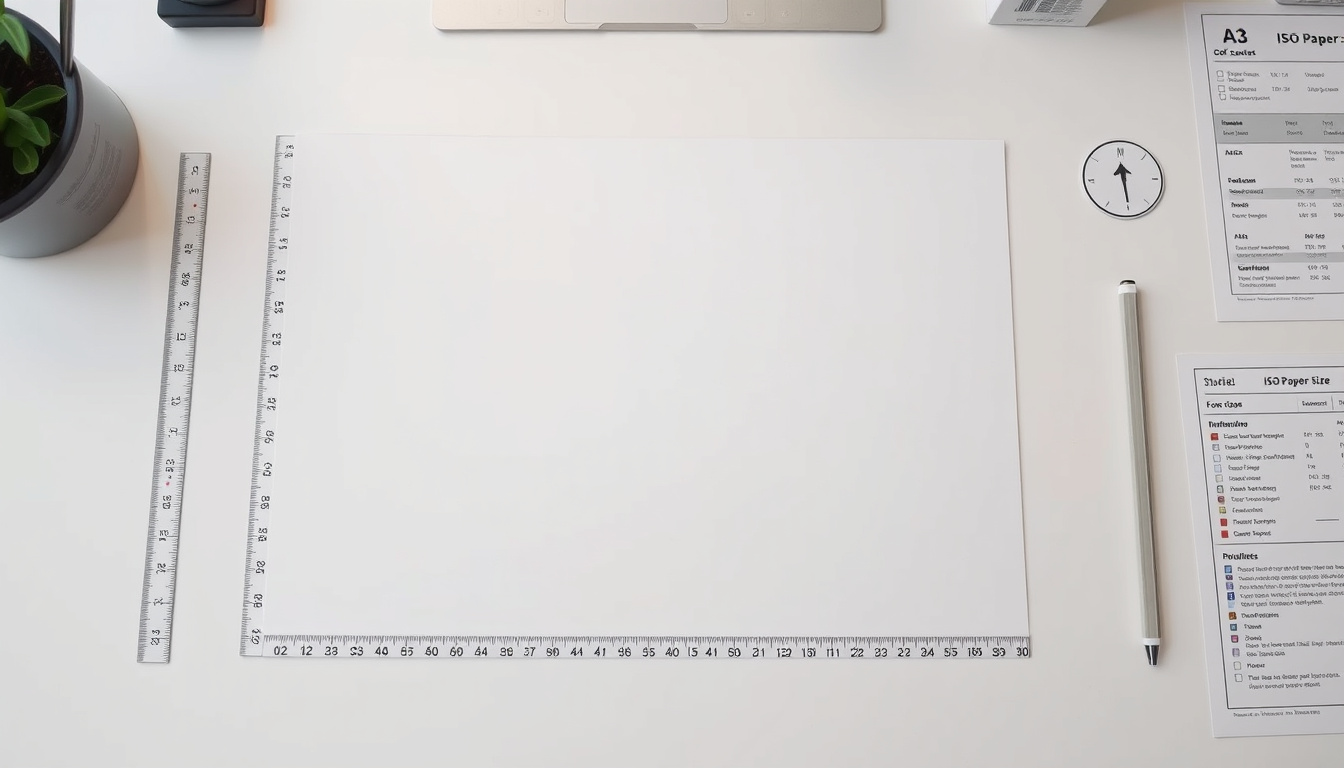
If you’ve ever ordered a poster or picked up a sketchpad, you’ve probably seen “A3” printed somewhere on the packaging. Most people assume A3 means 30 by 40 centimeters—and they’re close, but not quite right. The actual dimensions are 29.7 cm wide by 42.0 cm tall, as defined by the ISO 216 standard that governs paper sizes across most of the world. This guide walks through the exact measurements, how they compare to other common formats, and clears up the common 30×40 confusion.
A3 Dimensions (cm): 29.7 x 42 · A3 Dimensions (mm): 297 x 420 · A3 Dimensions (inches): 11.7 x 16.5 · A3 Area (m²): 0.125 · ISO Standard: ISO 216
Quick snapshot
- A3 equals 297 × 420 mm (29.7 × 42.0 cm) (Adobe)
- Whether to call A3 “medium” or “large” varies by region and industry
- A3 remains the go-to size for small posters, magazine spreads, and architectural drafts
- Each A-series step halves the area: A3 is one-eighth of A0 (Pixartprinting)
| Measurement | Value |
|---|---|
| Width (cm) | 29.7 |
| Height (cm) | 42.0 |
| Width (inches) | 11.7 |
| Height (inches) | 16.5 |
| Surface Area | 0.125 m² |
What is the A3 size in cm?
The A3 paper size in centimeters is exactly 29.7 cm wide by 42.0 cm tall (Virtuall Blog). This is not an approximation—it is the precise dimension defined by the ISO 216 international standard. Adobe, the design software company whose tools millions use daily, confirms the same measurements (29.7 cm × 42.0 cm) on their official format page (Adobe Creative Cloud).
Dimensions in mm and inches
Converting to millimeters, A3 measures 297 mm × 420 mm, which translates to approximately 11.7 inches × 16.5 inches (Papersizeswiki). The Dimensions.com engineering reference lists the area as 1.35 square feet (Dimensions.com).
Area and aspect ratio
A3 covers a surface area of 0.125 square meters (1250 cm²) (Adobe). The magic behind A-series proportions lies in the 1:√2 aspect ratio, approximately 1.414, which allows every size to be halved or doubled while preserving identical proportions (ColorCopiesUSA). This mathematical elegance means folding any A-series sheet exactly in half yields the next size down with no distortion or cropping.
The implication: this consistent ratio means you can scale any A3 artwork to A5 or shrink it to A4 without losing the relationship between elements—a feature designers and architects rely on daily.
Is 30x40cm A3?
No. The common approximation of 30×40 cm is close to A3 but not identical. True A3 is 29.7 × 42.0 cm (Papersizeswiki). The 30 × 40 cm figure rounds both dimensions and is not part of any ISO standard. ColorCopiesUSA notes that 30×40 cm approximates A3 but falls outside the official specification (ColorCopiesUSA).
Exact match verification
Checking the math: A3 width of 29.7 cm rounds to 30 cm (a 1% increase), while height of 42.0 cm stays essentially 42 cm. For casual purposes, 30×40 cm feels close enough—but for print production, design files, or framing, that small gap causes misaligned bleeds, ill-fitting frames, or cropped images.
Common approximations
Phomemo, a paper and printing knowledge resource, explicitly warns that 30×40 cm is often confused with A3 but the two are not interchangeable (Phomemo). The practical catch: if a frame or template lists 30×40 cm, it may not fit a true A3 document without slight overhang or trimming.
What this means: designers should always specify 29.7 × 42.0 cm when accuracy matters, while general consumers using 30×40 will likely get acceptable results for non-precision tasks.
What size is an A3 photo?
An A3 photo matches the paper dimensions: 29.7 × 42.0 cm (11.7 × 16.5 inches) (Papersizeswiki). At 300 DPI—the standard resolution for print—A3 corresponds to 1754 × 2480 pixels (Papersizeswiki).
Standard photo print sizes
A3 falls between the common photo print sizes of 8×10 inches and 11×14 inches. At roughly 11.7 × 16.5 inches, A3 is larger than most standard frames sold in general retail stores. It is often referred to as a “tabloid” equivalent in the United States, though tabloid actually measures 11 × 17 inches.
Framing considerations
ColorCopiesUSA notes that A3 serves common uses including magazines, reports, and small posters (ColorCopiesUSA). For photographers, A3 works well for gallery prints, portfolio pieces, and exhibition displays where the larger format showcases detail that A4 cannot.
The trade-off: A3 frames and mats are more expensive and harder to find than standard sizes, so photographers should budget accordingly and order custom framing or specialty suppliers.
Which is bigger, an A3 or an A4?
A3 is larger than A4. Specifically, A3 measures 29.7 × 42.0 cm while A4 measures 21.0 × 29.7 cm (Virtuall Blog). This means A3 has exactly twice the surface area of A4—a relationship that comes directly from the √2 scaling principle. Papersizes.org confirms that A4 is 210 mm × 297 mm, exactly half the area of A3 (Papersizes.org).
Side-by-side dimensions
- A3: 297 mm × 420 mm (29.7 cm × 42.0 cm)
- A4: 210 mm × 297 mm (21.0 cm × 29.7 cm)
The shorter side of A3 (29.7 cm) matches the longer side of A4, which makes physical comparison straightforward: picture two A4 sheets placed end to end along their long edges, and you have A3.
Use cases
A4 dominates everyday office printing, schoolwork, and document production worldwide. A3 steps up for larger documents: folded brochures, detailed spreadsheets, architectural drawings, and presentations that need visual breathing room. Wikipedia reports that A4 is the most common paper size globally, with A3 as the next step up for larger formats (Wikipedia).
The catch: not all office printers accept A3. Many home and small office devices max out at A4, so check your printer specifications before designing for A3 output.
What is A1, A2, A3, and A4?
The A-series forms a logical size ladder where each step halves the area of the previous size. The sequence starts with A0 at 1 square meter and descends through A1, A2, A3, and A4, among others (A2-size.com).
Full A-series chart
Here are the five most common A-series sizes and their centimeter dimensions:
| Size | Dimensions (cm) | Relation to A0 |
|---|---|---|
| A0 | 84.1 × 118.9 | Full size (1 m²) |
| A1 | 59.4 × 84.1 | Half of A0 |
| A2 | 42.0 × 59.4 | Quarter of A0 |
| A3 | 29.7 × 42.0 | One-eighth of A0 |
| A4 | 21.0 × 29.7 | One-sixteenth of A0 |
A2 measures 42.0 cm × 59.4 cm, meaning A3 is precisely half its area (ColorCopiesUSA). Papersize.co.uk (ISO table) confirms A2 dimensions as 420 mm × 594 mm under ISO 216 (Papersize.co.uk). A1 comes in at 59.4 cm × 84.1 cm.
Scaling rules
The ISO 216 standard originated from the German DIN 476 standard created in the 1920s before becoming an international norm in 1975 (A2-size.com). Wikipedia notes that ISO 216 enables distortion-free scaling across all sizes (Wikipedia). A2-size.com explains that the B-series shares the same 1:√2 ratio but with different areas for specialized envelopes and books (A2-size.com).
The elegance of the √2 ratio means that A-series paper scales perfectly at every step. Architects, engineers, and designers worldwide rely on this property to enlarge blueprints or reduce diagrams without recalculating proportions—a small mathematical fact with enormous practical payoff.
The official ISO 216 standard for an A3 sheet of paper is exactly 29.7 centimetres wide by 42.0 centimetres high.
— Virtuall Blog (Design Resource)
The ISO 216 standard uses the √2 (1.414) aspect ratio, which means when you fold any size in half, you get the next smaller size with identical proportions.
— ColorCopiesUSA (Printing Guide)
ISO 216 is an international standard for paper sizes, used around the world except in North America and parts of Latin America.
— Wikipedia (Encyclopedia)
A3 vs other formats
A comparison with common alternatives clarifies where A3 sits in the paper size landscape:
| Format | Dimensions (cm) | Area vs A3 | Notes |
|---|---|---|---|
| A2 | 42.0 × 59.4 | 2× larger | Double A3 area |
| A3 | 29.7 × 42.0 | Reference | ISO 216 standard |
| A4 | 21.0 × 29.7 | 2× smaller | Most common worldwide |
| US Letter | 21.59 × 27.94 | ~60% of A3 | ANSI standard, not ISO |
| 30 × 40 cm | 30.0 × 40.0 | ~103% of A3 | Non-standard approximation |
Wikipedia reports that North America uses ANSI sizes instead of ISO 216, preferring US Letter over A4 and tabloid over A3 (Papersizes.io). US Letter at 21.59 cm × 27.94 cm is noticeably smaller than A3 (Virtuall Blog). Papersizes.io tracks that A-series adoption grew globally through the late 20th century but never replaced North American formats (Papersizes.io).
For anyone working internationally, the key takeaway is straightforward: A-series dominates everywhere except the United States, Canada, and parts of Latin America. If your work crosses borders, A3 is your medium format—bigger than A4 but still compact enough for most office equipment.
History and global adoption
ISO 216 traces its roots to German DIN 476 in the 1920s, eventually becoming an international standard in 1975 (Wikipedia). The A-series gained traction across Europe beginning in the 19th century, expanding globally throughout the 20th century except in North America (Papersizes.io). Neenah Paper’s resource library confirms that ISO 216 defines A, B, and C series using the 1:√2 ratio for consistent proportions (Neenah Paper).
The ISO 216 standard unifies paper sizing across most of the world—meaning a designer in Berlin and a printer in Tokyo work from identical dimensions. Only North America, parts of Mexico, and a few other regions stick with incompatible ANSI standards, creating friction for cross-border document exchange.
The ISO 216 standard also includes supplementary standards ISO 217 and ISO 269, which cover related sizing systems like the raw paper formats and envelope sizes (Wikipedia). Wikipedia further notes that folding an A3 sheet in half produces two A4 sheets with identical proportions—a property that makes the A-series uniquely practical for binding and booklet production (Wikipedia).
Full A-series specifications
Seven sizes make up the complete A-series from A0 to A6, each halving the area of the previous size:
| Size | Centimeters | Millimeters | Inches | Area (m²) |
|---|---|---|---|---|
| A0 | 84.1 × 118.9 | 841 × 1189 | 33.1 × 46.8 | 1.000 |
| A1 | 59.4 × 84.1 | 594 × 841 | 23.4 × 33.1 | 0.500 |
| A2 | 42.0 × 59.4 | 420 × 594 | 16.5 × 23.4 | 0.250 |
| A3 | 29.7 × 42.0 | 297 × 420 | 11.7 × 16.5 | 0.125 |
| A4 | 21.0 × 29.7 | 210 × 297 | 8.27 × 11.69 | 0.0625 |
| A5 | 14.8 × 21.0 | 148 × 210 | 5.83 × 8.27 | 0.0313 |
| A6 | 10.5 × 14.8 | 105 × 148 | 4.13 × 5.83 | 0.0156 |
A3 is the fifth size in the series, representing one-sixteenth of the original A0’s area. This mathematical relationship gives the A-series its predictable scaling behavior.
Related reading: Countries in North America · North America explained
ISO 216 sets A3 at 29.7 x 42 cm, or precisely A3 size in inches at 11.69 x 16.54 for cross-unit comparisons.
Frequently asked questions
What is A2 size in cm?
A2 measures 42.0 cm × 59.4 cm, exactly double the area of A3 (Papersize.co.uk (ISO table)).
What is A4 size in cm?
A4 measures 21.0 cm × 29.7 cm, exactly half the area of A3 (ColorCopiesUSA).
What is A1 size in cm?
A1 measures 59.4 cm × 84.1 cm, four times the area of A3 (A2-size.com).
What is A5 size in cm?
A5 measures 14.8 cm × 21.0 cm, one-quarter the area of A4, or one-sixteenth of A3 (A2-size.com).
What is A3 size in inches?
A3 measures 11.7 inches × 16.5 inches, which is approximately 297 mm × 420 mm (Papersize.co.uk (ISO table)).
Is 30x40cm small?
Compared to everyday document sizes like A4, 30×40 cm (or true A3 at 29.7×42 cm) is relatively large—it is twice the area of standard letter or A4 paper. However, compared to true large-format prints like A2 or A1, it falls into the “medium” or “small poster” category.
Is A3 medium or large?
In most publishing and printing contexts, A3 sits between A4 (small/standard) and A2 (large). It is commonly described as “medium format” for posters or “large” for documents, but there is no universal industry label—usage varies by country and application.
For print buyers and designers outside North America, the choice between A3 and alternatives is clear: use A3 whenever your project requires international compatibility, and always verify your printer’s maximum sheet size before finalizing artwork dimensions.
Related stories





Samuel Hart is Devices & Reviews Editor at ScopePress.uk, covering smartphones, laptops, hardware and hands-on reviews.