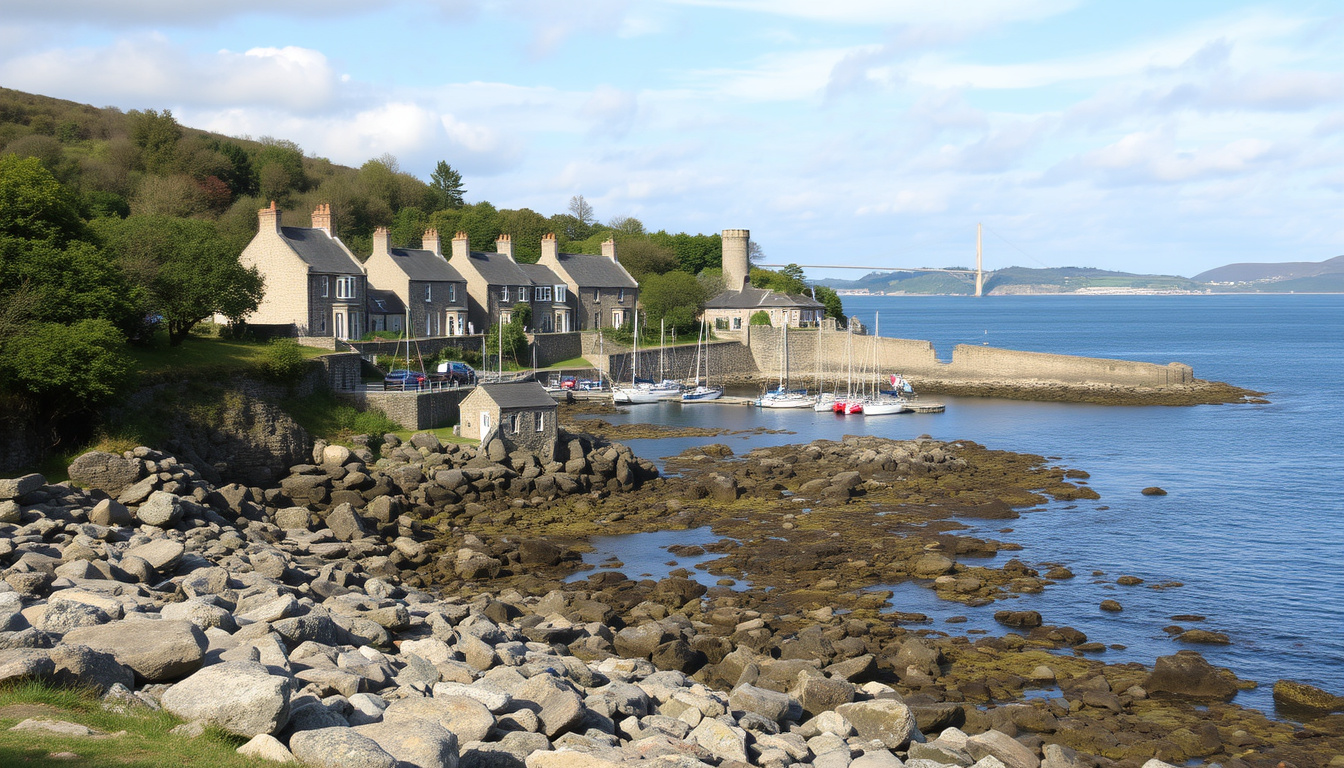
You might know Bo’ness as that town you pass on the train between Falkirk and Linlithgow, but there’s a surprising amount tucked into this humble Forth-side town. From Scotland’s oldest cinema to a steam railway that runs through 300-million-year-old fireclay mines, Bo’ness offers more than its modest postcode suggests.
Population: 14,490 (2011 census) ·
Distance from Edinburgh: 20 miles (32 km) ·
Distance from Glasgow: 30 miles (48 km) ·
Heritage Railway: Bo’ness and Kinneil Railway ·
Beach: Kinneil Beach (mudflat and sand)
Quick snapshot
- Bo’ness (short for Borrowstounness) lies on the south bank of the River Forth (Undiscovered Scotland travel guide)
- Population 14,490 (2011 census) (Undiscovered Scotland travel guide)
- The Bo’ness & Kinneil Railway operates steam trains over 3.5 miles (The Gazetteer for Scotland historical reference)
- Kinneil Beach is accessible for walking and birdwatching (Bo’net local tourism group)
- Exact current economic revitalization status — town centre footfall data not publicly available
- Current crime rates — no recent official figures published for the EH51 postcode area
- Recognised as a port in 1601 (The Gazetteer for Scotland historical reference)
- Decline after Forth and Clyde Canal opened in 1790 (The Gazetteer for Scotland historical reference)
- Heritage railway opened in the 1980s (VisitScotland national tourism board)
- Continued heritage tourism focus via the Bo’ness and Kinneil Railway
- Growing day-trip traffic from Edinburgh and Glasgow
| Attribute | Detail |
|---|---|
| Town name | Bo’ness (Borrowstounness) |
| Council area | Falkirk |
| Population | 14,490 (2011) |
| Postcode | EH51 |
| Famous for | Heritage railway, historic port |
| Distance from Edinburgh | 20 miles (32 km) |
| Distance from Glasgow | 30 miles (48 km) |
The pattern is clear: Bo’ness is a small town with a compact set of definable statistics, but its real character lies beyond the numbers.
Is Bo Ness worth visiting?
Bo’ness isn’t the kind of town that shouts about itself. It doesn’t have a castle on a hill or a Michelin-starred restaurant. What it does have is a genuine, unpolished character — plus a handful of genuinely good reasons to make the trip from Edinburgh or Glasgow.
What makes Bo’ness a unique destination?
The town’s main draw is its heritage railway, the Bo’ness and Kinneil Railway, which runs 3.5 miles (5.5 km) from the town centre to Birkhill Fireclay Mine (The Gazetteer for Scotland historical reference). The journey is part train ride, part geology lesson — the mine contains exposed fossil beds that are 300 million years old. The railway is operated by the Scottish Railway Preservation Society, a national heritage body and offers themed days such as Thomas the Tank Engine events that draw families from across central Scotland.
Beyond the rails, the Hippodrome cinema — Scotland’s oldest surviving purpose-built cinema, built in 1912 (Adventures Around Scotland travel blog) — still screens films and hosts live events. It’s a rare survival in an era of multiplexes, and part of what gives the town centre its vintage feel.
How does Bo’ness compare to other Scottish towns?
Comparisons with places like South Queensferry or North Berwick are inevitable, but Bo’ness trades polish for authenticity. It doesn’t have a high street full of artisan cafes, but it does have:
- A working heritage railway with steam and diesel locomotives
- A beach (Kinneil Beach) that’s more wild than curated
- Views of the Forth Bridges from the foreshore (Bo’net local tourism group)
- Blackness Castle, a major historic site, just a 3-mile walk west along the coast
The implication: Bo’ness succeeds precisely because it doesn’t try to be something it’s not. It’s an honest town with honest attractions — and that’s rarer than it sounds.
What is Bo Ness famous for?
Bo’ness has two distinct identities: its industrial past as a major port, and its present as a heritage destination built on that history.
The Bo’ness and Kinneil Railway
This is the town’s headline attraction. The railway operates regular steam and diesel services from its station at the foot of the town centre to Birkhill Fireclay Mine, where guided tours take visitors into underground tunnels containing fossilised plant remains from the Carboniferous period (The Gazetteer for Scotland historical reference). The railway also hosts a museum — the Museum of Scottish Railways — on site, with rolling stock and artefacts covering the country’s railway history (VisitScotland national tourism board).
History as a major port
Bo’ness was recognised as a port in 1601 and became one of Scotland’s leading ports after the customs house moved from Blackness in the early 18th century (The Gazetteer for Scotland historical reference). The tobacco trade drove much of its early wealth. That prosperity collapsed when the Forth and Clyde Canal opened in 1790, shifting maritime trade to Grangemouth. The town never fully recovered its commercial standing, but the port heritage is still visible in the old harbour area and in the architecture along the seafront.
Kinneil House and Estate
Kinneil House, run by Historic Environment Scotland, is a 16th-century mansion with tours available from April to September (Scots2Travel travel information site). The house sits within Kinneil Estate, a large public park that includes the remains of a Roman fort and the Kinneil Museum, which is free to visit and covers local history including the Bo’ness Children’s Fair, mining, and porcelain production (Scots2Travel travel information site).
Bo’ness’s fame rests on a narrow but real foundation. A visitor who doesn’t care about railways or 18th-century port history will find the town thin. But for those who do, Bo’ness offers what Edinburgh and Glasgow cannot: direct, tactile access to Scotland’s industrial past — with actual steam trains and fossil beds to prove it.
Is Bo Ness a nice place to live?
This is the question that gets asked most on Reddit forums and local Facebook groups. The answer, depending on who you ask, ranges from “it’s fine” to “it needs investment.”
Community and amenities
Bo’ness has a population of roughly 14,490, with a mix of older housing stock near the town centre and newer developments on the outskirts. The town has two primary schools — Bo’ness Public and Kinneil — plus Bo’ness Academy for secondary education. Shops along the high street cover everyday needs, but the town centre has seen the same pressures as many Scottish market towns: empty units and a shift toward retail parks on the edge of town.
Transport links
The town sits roughly midway between Edinburgh (20 miles east) and Glasgow (30 miles west), connected by the M9 motorway and A8 corridor. Regular buses run to Falkirk (where the nearest train station is — Falkirk High or Falkirk Grahamston), Edinburgh, and Stirling. There is no direct train station in Bo’ness itself, a fact that surprises many first-time visitors. The nearest rail connection is via Falkirk, with trains to Edinburgh taking roughly 20 minutes and to Glasgow about 30 minutes.
Cost of living
Housing in Bo’ness is generally cheaper than in Edinburgh and the Lothians. Median house prices in the EH51 postcode area sit well below the Scottish national average for urban areas, according to Undiscovered Scotland travel guide. That said, some areas — particularly near the old harbour — can feel isolated from amenities, and local regeneration efforts have been inconsistent.
Bo’ness offers affordable housing and good road links to two major cities. The trade-off is a town centre that hasn’t yet completed its post-industrial reinvention. For remote workers or retirees who value coastal views and space over nightlife, the equation leans positive. For families who want schools and amenities within walking distance, the calculus is more nuanced.
Does Bo Ness have a beach?
Yes — but it’s not a sandy beach in the traditional sense. Kinneil Beach is a mix of mudflats and sand, more suited to dog walkers and birdwatchers than sunbathers.
Kinneil Beach
The foreshore runs from the town centre east toward Kinneil Estate, where the beach area opens up. At low tide, mudflats extend a long way out into the Firth of Forth, and the water recedes far enough that swimming isn’t really practical. But the views across the Forth toward the Kingdom of Fife — and, on a clear day, the Forth Bridges — are excellent (Bo’net local tourism group).
Activities and wildlife
The foreshore walk is part of the John Muir Way, a long-distance walking route that stretches across central Scotland (Bo’net local tourism group). Birdwatching is the primary activity here — waders, ducks, and occasionally seals can be spotted. The walk from Bo’ness to Blackness Castle is roughly 3 miles (5 km) along the coast and is one of the area’s most popular routes.
Safety and access
The beach is accessible via a path from the town centre and from Kinneil Estate. There are no lifeguards, and the mudflats can be dangerous if you stray from the designated paths. Signs advise against swimming due to tidal currents and the soft mud.
Kinneil Beach is not a beach holiday destination. It’s a wild, scenic stretch of coast perfect for walking, photography, and escaping the city for an afternoon. If you’re looking for golden sand and calm water, head to East Lothian. If you want a genuinely quiet coastal walk with industrial heritage as a backdrop, this beach delivers.
What is there to do in Bo Ness?
For a town of 14,000 people, the number of structured things to do is surprisingly high — provided you lean into the heritage theme.
Ride the heritage railway
A round trip on the Bo’ness and Kinneil Railway takes roughly 40 minutes, plus time to tour Birkhill Fireclay Mine. The railway operates on weekends and select weekdays from spring through autumn, with extra services during school holidays (VisitScotland national tourism board). Adult ticket prices are around £12–£16 return, with family deals available.
Visit the Museum of Scottish Railways
Located at the same site as the railway, the museum houses a collection of locomotives, carriages, and railway memorabilia from across Scotland’s railway history. It’s included in the railway ticket or can be visited separately.
Walk the Bo’ness & Blackness Heritage Trail
This coastal walk runs along the John Muir Way from Bo’ness town centre to Blackness Castle, a 15th-century fortress that featured in the film The 39 Steps. The walk takes around 1.5 hours each way and passes Kinneil Estate, the foreshore, and several historic viewpoints (Bo’net local tourism group).
Explore Kinneil Estate
The estate includes Kinneil House, the Kinneil Museum, and extensive parkland with Roman remains and woodland walks. The museum is free and open year-round, though the house tours are seasonal (April–September) (Scots2Travel travel information site).
Most of Bo’ness’s attractions are seasonal. The railway and house tours operate on reduced hours in winter, and the foreshore walk can be windswept even in summer. Plan your trip between April and September for the widest range of open attractions — and bring a jacket regardless.
Pros and Cons of Visiting or Living in Bo’ness
Upsides
- Genuine heritage attractions with working steam trains
- Affordable housing compared to Edinburgh and Glasgow
- Scenic coastal walks with views of the Forth Bridges
- Good road links to central Scotland’s cities
- Quiet, uncrowded atmosphere — even in peak season
Downsides
- No direct train station — bus or car required
- Town centre shows signs of economic strain
- Beach is mudflat-based, not suitable for swimming
- Limited evening entertainment and restaurant options
- Most attractions are seasonal
The pattern: Bo’ness’s strengths and weaknesses are two sides of the same coin. Its quiet, unpolished character is either its charm or its drawback — there is no middle ground.
Quotes and Perspectives
“Bo’ness is one of those towns that had a past. My grandfather worked the docks. Now the railway brings the visitors, but the heart of the town is still the old harbour.”
Reddit user, descendant of a mining family (community discussion)
“The Bo’ness foreshore is one of the best spots in the Forth Valley to watch the sunrise over the Forth Bridges. It’s a walk that’s been used for centuries, and it’s still the best way to see the town.”
Visit Falkirk official (promotional description of heritage trail)
tripadvisor.com, en.wikipedia.org, expedia.co.uk, corvis.kitchen, falkirklocalhistory.club, wanderlog.com, trendmag.nl
For a deeper dive into the town’s history and highlights, readers may also consult this detailed Bo Ness guide from another local resource.
Frequently asked questions
Is Bo’ness safe for tourists?
Yes — Bo’ness is generally considered a safe town. Like any small town, exercise normal caution at night, but it is a low-crime area by Scottish standards.
What are the best restaurants in Bo’ness?
Options include the Bo’ness Reef (fish and chips), The Royal Bank (pub food), and Synergy (Indian cuisine). Most restaurants are casual and family-oriented.
How long does the Bo’ness and Kinneil Railway ride take?
The round trip from Bo’ness to Birkhill Fireclay Mine and back takes approximately 40 minutes. Adding the mine tour extends the experience to about 1.5–2 hours total.
Can you walk from Bo’ness to Blackness Castle?
Yes — the Bo’ness & Blackness Heritage Trail follows the John Muir Way along the coast, taking around 1.5 hours each way (3 miles / 5 km). It’s a flat, well-maintained path.
Is there parking in Bo’ness?
Yes — there are several free car parks in the town centre, including at the railway station, and along the foreshore. On-street parking is also available in most residential areas.
What is the nearest train station to Bo’ness?
There is no train station in Bo’ness itself. Falkirk High station (for Edinburgh–Glasgow services) is roughly 5 miles (8 km) away, and Linlithgow station is about 4 miles (6 km) east.
Are there any hotels in Bo’ness?
There are limited hotel options in Bo’ness itself. For a wider selection, nearby Falkirk and Linlithgow offer more accommodation choices. Day-trip visitors from Edinburgh often return to the city.
Editor’s note: This guide is based on publicly available information from tourism boards, historical records, and local sources. Factual details were verified as of the time of publication.
Related reading: Mount Olympus guide · Rain jacket guide for Ireland
Related stories





Craig Newton is Senior Reporter at ScopePress.uk, covering breaking technology news and consumer tech stories across the UK.