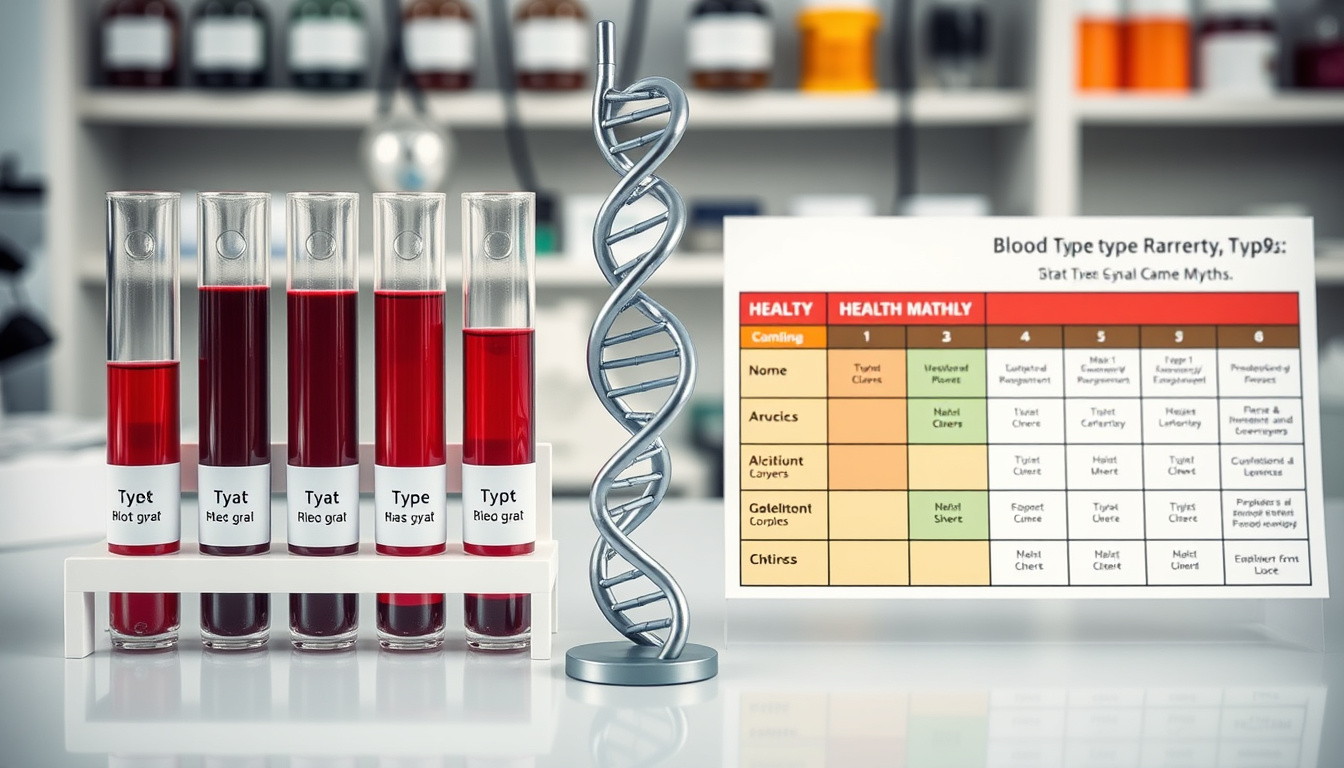
Few things connect us quite as literally as the blood in our veins — yet most of us don’t know our own blood type. Understanding whether you are A, B, AB, or O, and whether your Rh factor is positive or negative, can be surprisingly useful when it comes to medical emergencies or pregnancy planning. This guide separates well-grounded facts from popular myths about blood type, covering rarity rankings, health claims, and how you inherit it from your parents.
Most common blood type: O+ (approximately 35% of population) · Rarest blood type: AB- (less than 1%) · Universal donor: O- · Universal recipient: AB+ · Number of main blood types: 8 (A+, A-, B+, B-, AB+, AB-, O+, O-)
Quick snapshot
- Blood type inheritance follows Mendelian genetics — each parent contributes one allele (American Red Cross)
- O- is the universal red blood cell donor (American Red Cross)
- AB- is the rarest blood type overall (American Red Cross)
- Rh incompatibility can cause hemolytic disease in newborns (Mayo Clinic)
- Whether any blood type is definitively ‘healthiest’ (no consensus)
- Link between blood type and longevity or aging remains weak
- Causal relationship between blood type and dementia risk is uncertain
- Blood type is determined at birth from genetic inheritance and remains stable throughout life (American Red Cross)
- While blood type cannot change, advanced typing can reveal rare subtypes that may affect transfusion safety
These core statistics paint a clear picture of blood type distribution and its practical implications for donation and transfusion.
| Attribute | Value |
|---|---|
| Total blood types | 8 (A+, A-, B+, B-, AB+, AB-, O+, O-) |
| Most common | O+ (approx. 35% worldwide) |
| Rarest | AB- (<1%) |
| Universal donor | O- |
| Universal recipient | AB+ |
What blood type is rarest?
What are the 3 rarest blood types?
- AB-negative (AB-) is the rarest blood type overall, found in <1% of the global population. According to the American Red Cross, rarity is defined by lacking antigens that 99% of people carry.
- B-negative (B-) is the second rarest, with approximately 1.5% of the U.S. population, per World Population Review.
- AB-positive (AB+) is also rare at about 3.4% in the U.S., but it’s the universal recipient for blood transfusions (American Red Cross).
Which blood type is the most common?
- O-positive (O+) is the most common blood type worldwide, making up about 35–37% of the population in many countries. Data from World Population Review shows O+ at 37.4% in the U.S. and 32.5% in India.
- Distribution varies: in some East Asian countries, type B is more prevalent; for instance, China has B+ at 28.9% and O+ at 34% (Healthline).
Rarity is not a binary — it depends on geography and ethnicity. A blood type that’s common in one region can be rare in another.
The pattern: blood type rarity is location-dependent, making global rankings less useful for local decisions.
What is the healthiest blood type?
What blood type rarely gets sick?
No blood type has been proven to be universally healthier. Some observational studies suggest that people with type O may have a lower risk of developing blood clots, but the evidence is not strong enough to make health recommendations. The Mayo Clinic notes that blood type alone should not guide lifestyle decisions.
What blood type ages slower?
Claims linking blood type to aging speed are largely speculative. A 2020 review in Evidence-Based Practice found no consistent association between ABO type and longevity. The pattern is weak and confounded by socioeconomic factors.
What blood type has the most dementia?
Research from Harvard Health suggests that type AB may carry a slightly higher risk of cognitive decline compared to type O. However, the effect size is small, and causal mechanisms remain unclear.
Which blood type has the strongest immune system?
There is no scientific consensus. While type O may have some protective effects against certain infections (e.g., severe malaria), the immune system is influenced by many more factors than blood type alone. The NHS Blood and Transplant states that “your blood group does not determine your overall health.”
The same blood type that might offer a small advantage in one disease can be a risk factor in another. O type, for instance, appears protective against blood clots but may increase susceptibility to peptic ulcers (NIH).
The implication: blood type health claims remain associative, not causal — no type is a reliable predictor of overall wellness.
Which is better, O+ or AB+?
Blood type compatibility for donation
The table below highlights how O+ and AB+ differ in their roles within the blood supply system.
| Feature | O+ | AB+ |
|---|---|---|
| Frequency (U.S.) | 37.4% (World Population Review) | 3.4% |
| Can donate to | A+, B+, AB+, O+ (all Rh-positive types) | AB+ only (universal recipient for Rh+ plasma) |
| Can receive from | O+, O- (and Rh-negative with caution) | All Rh-positive types (A+, B+, AB+, O+) – truly universal recipient for Rh+ |
Universal donor and recipient roles
- O-negative is the universal red cell donor, acceptable for any patient in emergency (American Red Cross).
- AB-positive is the universal recipient for red cells from Rh-positive donors, but AB+ individuals can safely receive only AB+ plasma.
The catch: O+ donors save more lives directly, while AB+ recipients have more transfusion options in non-emergency settings.
Can a child have a different blood type than both parents?
How blood type is inherited
Blood type is determined by two sets of genes: the ABO system and the Rh factor. Each parent contributes one allele for ABO. The American Red Cross explains that if both parents have, say, A and O alleles, their child could end up with O (from two O alleles) — a blood type that neither parent expresses if they are both type A. This is perfectly normal.
What is inherited from father only?
The Rh factor is determined by a dominant allele (Rh-positive) and a recessive one (Rh-negative). If the father is Rh-positive and the mother Rh-negative, the child can be Rh-positive (inherited from the father). The Tech Interactive notes that Rh-negative is recessive, so it typically only appears when inherited from both parents.
What two blood types can’t have a baby?
No blood type combination makes pregnancy impossible. The phrase “can’t have a baby” refers to Rh incompatibility, which occurs when an Rh-negative mother carries an Rh-positive child. The Mayo Clinic states that this incompatibility can lead to hemolytic disease of the newborn if untreated, but it does not prevent conception.
Rh compatibility matters during pregnancy, not before. All couples can conceive regardless of blood types, but Rh-negative mothers should receive RhoGAM to protect subsequent pregnancies.
What this means: the idea of blood type “matching” for conception is a myth — pregnancy is always possible, but Rh monitoring is essential.
Do you get blood type from mom or dad?
Do you inherit blood type from both parents?
- Yes — one ABO allele from each parent. The BYU 3D-RST genetics module illustrates that if you inherit an A from one parent and an O from the other, you are type A (A is dominant over O).
Can blood type skip generations?
No, blood types do not skip generations. They follow standard Mendelian inheritance: a recessive allele (O) can be “silently” carried by people with A or B types, then reappear when two carriers have a child. The Harvard/Mass Eye and Ear explains that O is recessive, so two parents who are both type A (AO) can produce a type O child. That is not skipping — that’s simple recessive inheritance.
Confirmed facts
- Blood type inheritance follows Mendelian genetics
- O- is the universal red blood cell donor
- AB- is the rarest blood type
- Rh incompatibility can cause hemolytic disease in newborns
What’s unclear
- Whether any blood type is definitively ‘healthiest’
- Link between blood type and longevity or aging
- Causal relationship between blood type and dementia risk
The pattern: confirmed facts are grounded in genetics and transfusion medicine, while the unclear items involve weak epidemiological associations.
“Blood type is determined by the presence or absence of specific antigens on the surface of red blood cells. These antigens are inherited from your parents.”
— American Red Cross (blood donation authority)
“Knowing your blood group is important if you need a blood transfusion, but your blood group does not determine your overall health.”
“Rh factor is inherited and can cause complications during pregnancy if the mother is Rh-negative and the baby is Rh-positive.”
— Mayo Clinic (clinical health and research organisation)
The science of blood type is straightforward at the genetic level but quickly clouds when health claims are added. For anyone in Ireland — where O+ is the most common type at around 35% — the most practical takeaway is to know your own type and register as a donor if possible. For expectant parents, understanding Rh compatibility matters more than chasing dietary fads. The choice is clear: trust the genetics, verify the health myths, and donate if you can.
bloodtypechart.com, thetech.org, int.livhospital.com, bloodtypechart.com, rhesusnegative.net, blood-analysis.com
Frequently asked questions
Can blood type change over time?
In ordinary circumstances, blood type is fixed for life. Rare exceptions include bone marrow transplant or certain cancers that can alter antigen expression (American Society of Hematology).
What does Rh factor mean?
Rh factor is a protein inherited on red blood cells. If you have it, you are Rh-positive; if not, you are Rh-negative. It’s most relevant in pregnancy and transfusion (Mayo Clinic).
Is there a blood type diet that works?
No robust scientific evidence supports the blood type diet. A 2013 review in the European Journal of Clinical Nutrition found that any benefits observed were due to the diet’s general healthful directives, not blood type.
How is blood type determined?
Through a simple blood test that mixes your blood with antibodies against A, B, and Rh antigens. The pattern of agglutination reveals your type (American Red Cross).
Why is O negative blood so critical for transfusions?
O-negative red cells lack all major antigens, making them safe for any patient in emergencies when time doesn’t allow for matching. It’s the universal donor (American Red Cross).
What are the 3 rarest blood types?
AB- (rarest), B-, and AB+ are the top three rarest in most populations (World Population Review).
Do children always have the same blood type as a parent?
No. A child can have a different type than either parent due to recessive O alleles. For example, two type A parents (both AO) can have an O child (Harvard/Mass Eye and Ear).

Craig Newton is Senior Reporter at ScopePress.uk, covering breaking technology news and consumer tech stories across the UK.