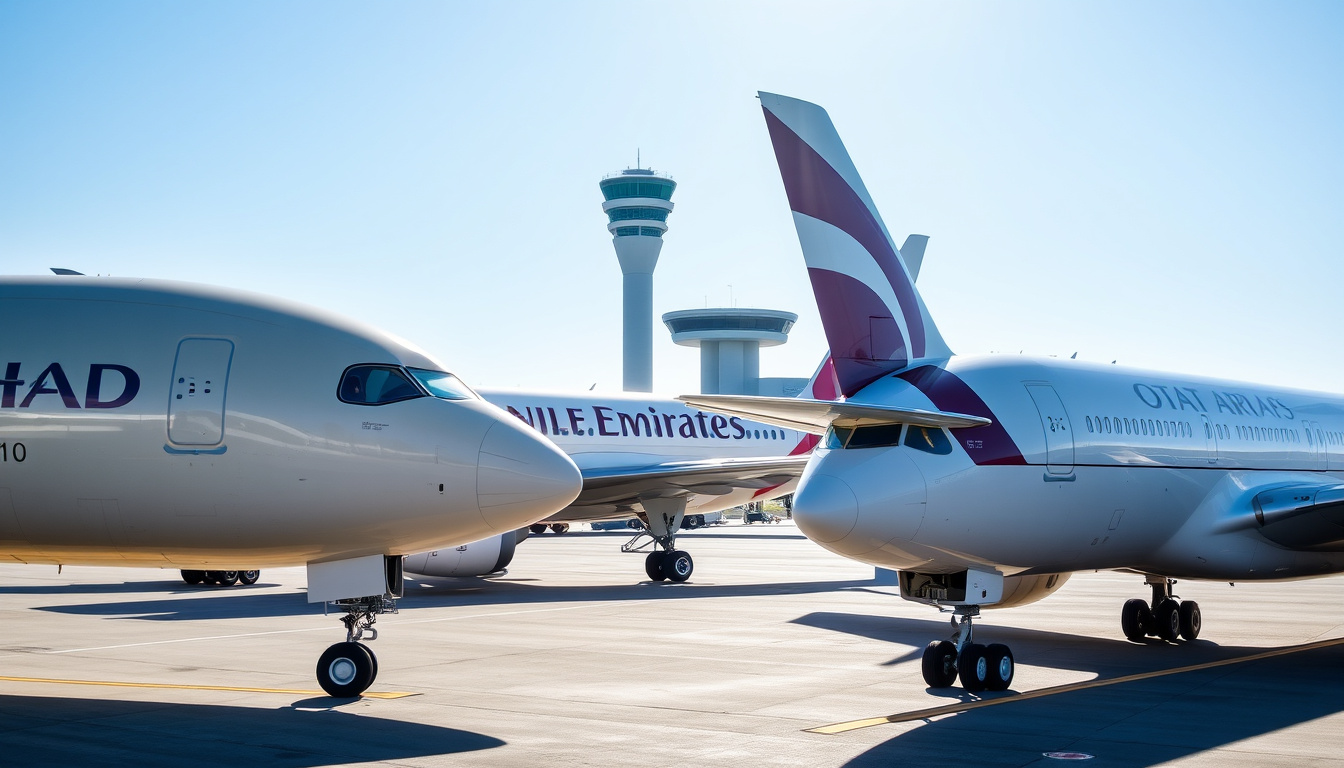
Choosing between Etihad, Emirates, and Qatar Airways often comes down to more than just who offers the best business class seat. This comparison breaks down their 2025 strategies, fleet plans, and operational strengths to help you decide which Gulf carrier fits your next trip.
Key Facts at a Glance
- Operating fleet stood at 111 aircraft as of July 2025, per Etihad’s July 2025 traffic report
- Expected 20 additional aircraft deliveries per year in 2025 and 2026, per Etihad’s fleet announcement
- 32 new Airbus aircraft on order, arriving from 2027, per Etihad’s November 2025 order update
- Recorded AED 26 billion (US $6.98 billion) revenue in 2025, per Etihad’s 2025 financial results
- Published US $698 million operating profit, per the same report
- Etihad grew to 81 passenger destinations year over year by July 2025, per its July 2025 traffic report
- Emirates and Qatar Airways maintain larger global route maps
- Access to lounges and priority services a key differentiator
- Emirates invests heavily in onboard product upgrades, including a retrofit program covering 111 aircraft, per Emirates’ media centre
What Makes Etihad Different from Emirates and Qatar Airways?
Etihad’s strategy rests on a distinct foundation: its Abu Dhabi home base. Unlike Emirates, which has turned Dubai into a global aviation artery, or Qatar Airways, which leverages Doha’s central position, Etihad has focused on being the “national carrier of the UAE” alongside Emirates, but with a more selective growth path. Its fleet modernization plan — adding 32 Airbus widebody aircraft from 2027 — signals a deliberate investment in efficiency and passenger comfort rather than sheer expansion for its own sake.
The airline’s 2025 financial results underline its improved operational reliability. With revenue climbing to AED 26 billion (US $6.98 billion) and an operating profit of US $698 million, Etihad reported its strongest performance ever in 2025 — a sharp turnaround from the pandemic-era losses recorded by most international carriers. This profitability, coupled with a July 2025 fleet of 111 aircraft, positions Etihad as a more disciplined player compared to its Gulf rivals.
Where Emirates often wins on cabin glitz and Qatar Airways on frequent-flyer perks, Etihad’s edge is increasingly about guest experience consistency. Its customer experience differentiators — lounge access, priority services, and seat comfort — have become a measurable part of its brand identity. The airline’s July 2025 traffic statistics showed growth to 81 passenger destinations year over year, a clear indicator that its Abu Dhabi hub strategy is paying off.
Etihad vs Emirates vs Qatar Airways: The Operational Comparison
The three airlines differ sharply in scale and strategy, as the table below shows.
| Attribute | Etihad Airways | Emirates | Qatar Airways |
|---|---|---|---|
| Owner | Etihad Aviation Group (state-owned, UAE) | Emirates Group (state-owned, Dubai) | Qatar Airways Group (state-owned, Qatar) |
| Hub | Zayed International Airport, Abu Dhabi | Dubai International Airport (DXB) | Hamad International Airport, Doha |
| Destinations | 81 passenger destinations (July 2025) | Over 130 destinations globally | Over 160 destinations globally |
| Fleet size | 111 aircraft (July 2025), 32 Airbus on order | ~250 aircraft, including Airbus A380 and Boeing 777 | ~200 aircraft, including Airbus A350 and Boeing 777X on order |
| On-time performance | Focus on reliability; July 2025 traffic stats show growth | Strong global hub operations in Dubai | Known for punctuality out of Doha |
The implication: Emirates wins on raw network size, Qatar Airways on product innovation, but Etihad is quietly closing the gap with a more modern, reliable fleet.
Emirates remains the largest of the three, with Dubai’s airport serving as a massive transfer point between Europe, Asia, and Africa. Its persistent investment in cabin upgrades — particularly the retrofit program across its Boeing 777 and Airbus A380 fleets — shows a commitment to maintaining a premium feel, but this scale can bring operational complexity. Qatar Airways, meanwhile, has leaned into its award-winning Qsuite and the convenience of Hamad International, often rated among the world’s best airports, to attract high-yield passengers.
Etihad’s July 2025 traffic report highlighted both its passenger growth and operational stability. The airline reported its fleet stood at 111 aircraft as of mid-2025, with plans to add 20 more aircraft annually through 2026. This expansion isn’t just about numbers — it includes a significant Airbus order placed in November 2025 covering A350-1000s, A350F freighters, and A330-900s, with deliveries beginning in 2027. For passengers, this means newer cabins with better fuel efficiency and potentially more lie-flat seats in business class.
The upshot
Emirates wins on raw network size, Qatar Airways on product innovation, but Etihad is quietly closing the gap with a more modern, reliable fleet. Its 2025 financials and aircraft orders suggest Abu Dhabi is no longer the third wheel in Gulf aviation.
Guest Experience Differences: More Than Just a Seat
When it comes to the cabin, the three airlines take distinct approaches. Emirates invested heavily in its premium economy product, rolling it out across its A380 fleet to capture travelers who want more than economy but don’t need business class. Its retrofit program is designed to standardize the experience across the fleet, but passengers may notice differences depending on the aircraft they’re flying. Qatar Airways, meanwhile, markets its Qsuite as a “business class first,” offering sliding doors and privacy that set an industry benchmark.
Etihad’s answer has been a focus on breadth rather than just a single flagship seat. The airline’s guest experience differentiators — lounge access, priority services, and premium check-in — are frequently cited as key strengths. Its July 2025 traffic statistics showed not only fleet growth to 111 aircraft but also an increased number of destinations, now at 81 passenger cities. That operational expansion is matched by an emphasis on service consistency, which for many flyers translates to fewer surprises at the airport and onboard.
For travelers connecting through the Gulf, the hub experience is part of the product. Abu Dhabi’s Zayed International Airport is newer and less congested than Dubai’s DXB, which can mean faster connections. Emirates and Qatar Airways have invested heavily in their hub lounges and airport facilities, but Etihad’s hub is an understated advantage for time-conscious passengers. Access to lounges and priority services is a recurring theme in customer feedback, making it a genuine differentiator rather than a marketing bullet point.
The trade-off
Choose Emirates for mega-hub connectivity, Qatar Airways for a Qsuite experience, and Etihad for a more relaxed, modern hub with increasing route options and strong financial backing.
Fleet Expansion and Reliability — What Passengers Should Know
Etihad’s fleet strategy has shifted from its earlier years of rapid, sometimes chaotic growth to a more measured plan. The airline’s November 2025 announcement of 32 new Airbus aircraft — A350-1000s, A350F freighters, and A330-900s — arriving from 2027, comes hand-in-hand with expectations of 20 additional aircraft per year through 2025 and 2026. This isn’t just about replacing old jets; it’s a bet on long-haul efficiency. The A350-1000 is particularly well-suited for ultra-long flights with lower fuel burn, which should keep fares competitive on routes to Australia, North America, and beyond.
Emirates, by contrast, remains committed to the Airbus A380, the biggest passenger jet in the world, as a statement of its premium brand. Its retrofit program is one of the largest in aviation history, updating everything from seat cushions to inflight entertainment screens. Qatar Airways’ fleet is younger on average, with a mix of A350s, Boeing 777s, and 787s, and it has placed substantial orders for the Boeing 777X, though deliveries have faced delays. For travelers sensitive to aircraft age and reliability, a newer fleet often correlates with fewer cancellations and better inflight comfort.
Etihad’s July 2025 traffic statistics explicitly show that its operating fleet stood at 111 aircraft, a number that has grown steadily. The airline’s published data on its July 2025 traffic statistics also noted an increase in passenger numbers and load factors, indicating that its reliability gains are translating into business performance. When an airline adds both capacity and destinations while maintaining punctuality, it often signals strong operational health — something Etihad documented in its record 2025 financial results.
What to watch
Etihad’s next few years will be defined by its Airbus deliveries starting in 2027. If the airline sticks to its growth plan, it will likely add more nonstop routes and improve its competitive edge on fuel costs, which could reshape pricing across Gulf carriers.
Cost, Value, and Loyalty Perks: A Quick Reality Check
While premium cabins dominate the headlines, most passengers fly in economy or premium economy. Here, the differences between the three airlines narrow, but they don’t disappear. Etihad’s financial efficiency, reflected in its 2025 operating profit, allows it to invest in service without being forced into drastic cost-cutting that affects the passenger experience. Emirates’ brand strength often lets it command slightly higher fares on some routes, while Qatar Airways frequently engages in competitive pricing to fill its growing capacity.
Respective loyalty programs — Etihad Guest, Skywards, and Privilege Club — each offer elite tiers with benefits like lounge access and priority boarding. Etihad has simplified its program recently, moving toward revenue-based earning, which rewards higher-spending flyers. Emirates Skywards is one of the most generous for families and co-branded credit card holders, while Qatar Airways’ Privilege Club partners with Qatar Airways’ oneworld alliance, offering miles that can be redeemed across a broader network of partner airlines. For frequent flyers, the choice often comes down to which alliance they already use: Etihad is not aligned with a global alliance but has partnerships with many carriers, including American Airlines, Emirates itself, and Air Serbia.
The catch
Loyalty programs are sticky, but they’re only worth it if you fly the airline’s actual routes. Etihad’s growing network to 81 destinations means more opportunities to earn and burn miles, even if its alliance coverage isn’t as broad as Qatar Airways’ oneworld membership.
Reliability and Operational Transparency
On-time performance and flight cancellation rates are among the most searched topics for any airline. While specific monthly statistics are published by each carrier, a general pattern emerges: Gulf carriers maintain high standards because their hubs depend on smooth connections. The Etihad Airways growth narrative, backed by its record aircraft deliveries and 32 new Airbus aircraft arriving from 2027, points to an airline that is investing to avoid the scheduling headaches that have plagued other carriers post-pandemic. Its July 2025 report showed robust traffic growth, which often correlates with fewer irregular operations when combined with fleet planning.
Qatar Airways’ approach to reliability is notable for its use of Hamad International as a fortress hub, where transfer times are designed to be short. Emirates’ sheer volume at DXB means occasional congestion, but the airline’s premium infrastructure helps manage peak times. Etihad, with relatively smaller operations, can offer a more personalized airport experience — a point echoed in its focus on lounge and priority services as a core part of the brand.
For passengers, the practical takeaway is twofold: first, check the specific aircraft for your route; second, look at the airline’s recent punctuality data. Etihad’s financial results and fleet expansion, detailed in its official fleet announcement, suggest it’s on a stable operational footing. This matters because a financially strong airline is more likely to maintain spare aircraft, which translates to fewer cancellations.
Why this matters
Airlines that invest in fleet renewal and report record profits are better positioned to handle disruptions. Etihad’s 2025 performance — including a US $698 million operating profit — provides a financial cushion that keeps operations running smoothly, even during peak travel seasons.
Which country owns Etihad Airways?
Etihad’s parent company and government ownership
Etihad Airways is owned by the government of Abu Dhabi, part of the United Arab Emirates. It operates as a state-owned enterprise under the Etihad Aviation Group.
Where is Etihad’s headquarters located?
Its head office is in Khalifa City, Abu Dhabi. Etihad is one of two flag carriers of the UAE, the other being Emirates.
Is Etihad a good airline to fly?
Customer ratings and Skytrax reviews
Etihad holds a 4-star Skytrax rating as of 2025. Passenger reviews often highlight seat comfort and inflight entertainment. Cabin crew service is generally praised, but consistency can vary.
Key strengths and weaknesses of Etihad Airways
Strengths include a modern fleet and strong financial stability. Weaknesses relative to rivals include a smaller route network and fewer alliance partners.
Is Etihad as good as Emirates?
Etihad vs Emirates: fleet and destinations
Both are UAE flag carriers but based in different emirates. Emirates has a larger fleet and more destinations. Etihad focuses on premium service with features like the Residence, available on select aircraft.
Service comparison in Economy, Business, and First Class
Emirates generally offers a more consistent premium product across its fleet, while Etihad’s service quality varies more by aircraft type. In economy, both offer complimentary meals and beverages.
Which is better, Emirates or Qatar or Etihad?
Route networks and hub advantages
Qatar Airways is a 5-star Skytrax airline; Etihad and Emirates hold 4-star ratings. Emirates operates the largest Airbus A380 fleet globally. Qatar’s hub, Hamad International, has been named the world’s best airport multiple times.
Cabin comfort and inflight experience
Qatar Airways’ Qsuite sets the benchmark for business class privacy. Emirates offers an onboard lounge on A380s. Etihad’s business class is competitive but generally trails in hard product innovation.
Frequent flyer programs compared
Emirates Skywards is generous for families; Qatar Airways Privilege Club benefits from oneworld membership; Etihad Guest is simpler but effective on its own routes.
What’s included in the Etihad economy?
Free drinks and complimentary meals
Etihad Economy includes complimentary meals and beverages, excluding premium alcoholic drinks.
Baggage allowance for Economy passengers
Checked baggage allowance is typically 23 kg on international routes.
Seat pitch and width measurements
Economy seat pitch ranges from 30 to 32 inches depending on aircraft type.
Is business class on Etihad worth it?
Etihad Business Class: seat and service features
Etihad Business features a 1-2-1 configuration on many aircraft. Complimentary chauffeur service is included on certain routes.
Pricing vs competitor business products
Etihad Business is often priced competitively against Emirates and Qatar Airways. Reviews generally rate it highly, with some noting inconsistency.
Access to lounges and priority services
Business class passengers get access to Etihad’s lounges in Abu Dhabi, plus priority check-in and boarding.
etihad.com, etihad.com, gulfnews.com, etihad.com, etihad.com, reuters.com, thepeninsulaqatar.com, aerotime.aero
Frequently Asked Questions
Which airline has more direct flights to Asia and Australia?
Emirates generally offers more frequencies to Asian and Australian cities due to its larger fleet and historical network strength. Qatar Airways is also aggressive with routes via Doha. Etihad is expanding, adding 81 passenger destinations by July 2025, with new nonstop options increasingly common on Australian routes like Abu Dhabi–Melbourne.
Is Etihad the same as Emirates?
No. Etihad is a separate airline based in Abu Dhabi, while Emirates is based in Dubai. Both are UAE flag carriers, but they operate independently, have different fleets, loyalty programs, and route networks. They even cooperate on some routes through a codeshare agreement.
How do the business class seats compare?
Qatar Airways’ Qsuite is often rated highest for privacy with its sliding doors. Emirates offers a highly regarded business class with a lie-flat seat and an onboard lounge on A380s. Etihad’s business class is competitive, and its new A350 deliveries may introduce improved seats, but it generally trails Emirates and Qatar in hard product innovation.
Which airline is best for family travel?
Emirates is popular with families due to its extensive children’s services, seat selection options, and family-friendly entertainment. Etihad also offers good family amenities, and its newer, quieter aircraft can be a plus. Qatar Airways’ Qsuites aren’t ideal for sharing, but their economy product is rated well.
Does Etihad have a premium economy?
Etihad introduced premium economy on select routes; check its website for current deployment. It’s not as widely rolled out as Emirates’ premium economy on A380s, but it’s available on some newer aircraft and key long-haul routes.
What is the main advantage of flying from Abu Dhabi?
Abu Dhabi’s Zayed International Airport is newer and less crowded than Dubai’s DXB, which can mean shorter check-in and security queues. It also offers quick connections, and Etihad has invested in its lounges and priority services, making it a smoother start to a journey for many passengers.
Are these airlines all safe?
Yes, all three hold the highest safety ratings from international regulators, including IATA’s Operational Safety Audit (IOSA). Etihad’s July 2025 traffic report and financial stability indicate robust operational management.
Final Takeaway: Which Airline Suits You?
Deciding between Etihad, Emirates, and Qatar Airways shouldn’t revolve around loyalty points alone. The real question is what you value: Emirates offers the largest network and a premium product, Qatar Airways delivers the most innovative seats in the sky, and Etihad provides a growing, reliable alternative with a less congested hub. Key considerations for 2025 include fleet age, on-time performance, and specific route availability. As Etihad integrates its 32 new Airbus jets from 2027, its competitive positioning will only strengthen.
For travelers, the practical advice is to search for your specific route, compare aircraft types, and read recent punctuality data. If you’re traveling solo and crave privacy, Qatar Airways is a safe bet. If you need maximum connection options and don’t mind a busier airport, Emirates is a proven choice. But if you prioritize ease, modern efficiency, and a growing route map from Abu Dhabi, Etihad might be the underdog that surprises you with its consistency and improving service.
Related stories





Craig Newton is Senior Reporter at ScopePress.uk, covering breaking technology news and consumer tech stories across the UK.