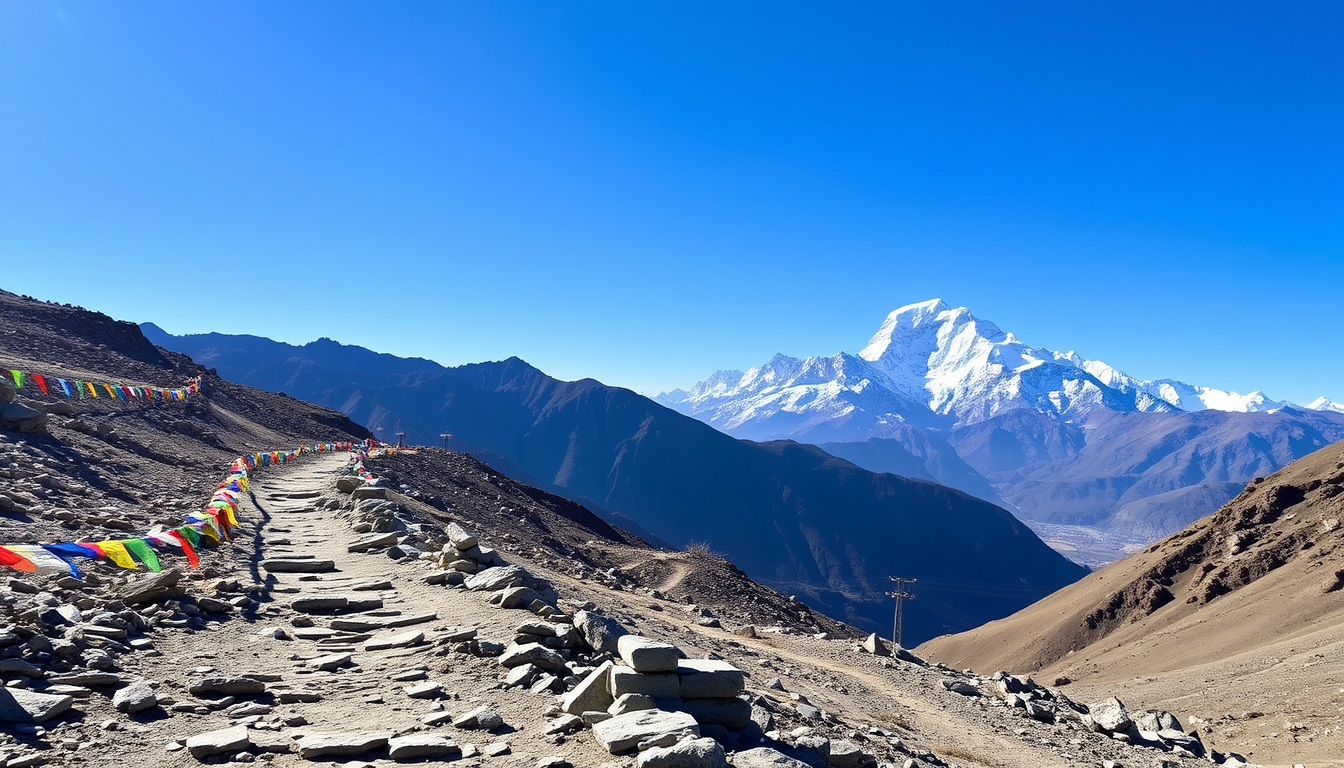
Anyone scrolling through trekking photos has probably paused on that famous shot of yellow tents scattered across the Khumbu Glacier. Everest Base Camp pulls tens of thousands of travelers to Nepal every year, but the real picture — the altitude, the costs, the Sherpa families who make the season run — is more layered than the postcard suggests. The route climbs from about 2,860 m at Lukla to 5,364 m at the camp itself (Nepal Intrepid Treks (Nepal-based trek operator)), and getting there takes planning, fitness, and a healthy respect for the mountain.
Everest Base Camp elevation: 5,364 m (17,598 ft) ·
Round-trip trek distance: 130 km (81 mi) from Lukla ·
Typical trek duration: 12–14 days ·
Estimated annual trekkers: 40,000+ per year ·
Cost of a guided trek: $3,000–$5,000 per person
Quick snapshot
- A Sagarmatha National Park entry permit is required for the Base Camp corridor. (Mountain IQ (trekking route guide))
- The round trip from Lukla to Base Camp and back runs roughly 130 km. (Mountain IQ (trekking route guide))
- Altitude sickness is the most common medical issue among trekkers on the route (Mountain IQ (trekking route guide)).
- Park fee figures disagree: one source quotes NPR 3,000 before VAT (Amar Nepal (Nepal trekking guide)), another USD 30 plus 13% tax.
- The two main permits together are commonly estimated at roughly USD 40–45 (Places Nepal (Nepal travel guide)).
- Yearly Sherpa deaths on the trek vary by season and by who is counting. (Amar Nepal (Nepal trekking guide))
- Most itineraries budget 14–16 days from Kathmandu; the walking portion is about 12 days.
- The Kathmandu–Lukla flight is about 35 minutes (about 20 from Manthali) and can be grounded for days by weather.
- Acclimatization days at Namche Bazaar and Dingboche are standard in described itineraries.
- Trekking insurance with helicopter evacuation is strongly recommended for the route (We Seek Travel (travel insurance resource)).
- The Khumbu Pasang Lhamu Rural Municipality permit is also described as required on top of the park entry. (We Seek Travel (travel insurance resource))
- Crowding and waste management at Base Camp remain open questions after record permit seasons. (We Seek Travel (travel insurance resource))
Seven numbers, one pattern: the route is short in distance but long in altitude — 130 km out and back, with roughly 2,500 m separating the airstrip from the camp.
| Metric | Value |
|---|---|
| Elevation | 5,364 m (17,598 ft) |
| Round-trip distance | 130 km from Lukla |
| Trek duration | 12–14 days (standard itinerary) |
| Trekkers per year | Over 40,000 annually |
| Fatalities on the trek | 1–2 per year (all causes, including Sherpas) |
| Gateway airstrip | Lukla, about 2,860 m |
| Classic viewpoint | Kala Patthar, 5,545 m |
Can You Just Walk to Everest Base Camp? Access, Distance, and Itinerary
Not from Kathmandu. The trek starts with a flight to Lukla, then a walk through the Khumbu Valley — there is no road to Base Camp, only trail.
How far is Everest Base Camp from Kathmandu?
- The Kathmandu–Lukla flight takes about 35 minutes; some current itineraries use Manthali or Ramechhap instead, at about 20 minutes.
- From Lukla, most itineraries schedule arrival at Base Camp on the seventh to ninth walking day.
- Door-to-door, budget 12–16 days including transfers and acclimatization.
The flight is short; the schedule is the risk. Weather, airport conditions, and seasonal scheduling can shut down the Lukla connection for days, so well-designed itineraries carry buffer time. The distance between Kathmandu and Base Camp is better measured in days than in kilometers.
Everest Base Camp trek distance
- Round trip: about 130 km from Lukla to Base Camp and back.
- Standard route: Phakding → Namche Bazaar → Tengboche → Dingboche → Lobuche → Gorak Shep → Base Camp.
- Many trekkers add the Kala Patthar viewpoint (5,545 m) for the classic Everest view before turning back.
In distance terms, this is a manageable multi-day walk; the altitude is the real metric. The route climbs from 2,860 m at the airstrip to 5,364 m at camp, and above 4,000 m every kilometer feels twice as long.
Everest Base Camp height
- Base Camp: 5,364 m (17,598 ft).
- Kala Patthar viewpoint: 5,545 m.
- The camp has no permanent residents — it functions as a seasonal staging ground for climbers and support staff.
That last point matters more than it looks. At 5,364 m, the air is thin and the nights are cold, and the body needs time to adapt. Commonly described itineraries build in acclimatization days at Namche Bazaar and Dingboche so the final push to Gorak Shep and Base Camp happens on a body that is ready for it.
Is Trekking to Everest Base Camp Safe? Common Risks and Fatalities
Tens of thousands of people walk this trail every season, and the vast majority finish it. The dangers are real, but they are also predictable — which is why preparation decides more outcomes than luck does.
What is the biggest cause of death on Everest?
- Falls, avalanches, and altitude sickness (HACE and HAPE) are the three leading causes of death on the mountain.
- For Base Camp trekkers specifically, altitude illness is the most common medical issue.
- Proper acclimatization and a reputable guide reduce the risk significantly.
Above roughly 3,000 m, trekkers can feel the altitude even when they are doing everything right. Headache, poor sleep, and loss of appetite are the early warning signs; HACE and HAPE are the severe versions that require immediate descent and, often, helicopter evacuation. The standard advice from guides is the same everywhere: climb slowly, sleep lower than you climb, and never push through symptoms.
How many Sherpas died on Everest every year?
The deadliest events in Base Camp’s modern history were not climbing failures: a 2014 avalanche on the Khumbu Icefall killed 16 Sherpas, and the 2015 earthquake-triggered avalanche killed 22 people while they slept at camp.
In an ordinary season, the toll is lower but never zero. Sherpa deaths are reported almost every spring, and estimates of 1–2 deaths per year are common, varying by season and by source. Those two disasters forced the whole Everest industry to reconsider how Base Camp is run.
What is the oldest body still on Everest?
- Known to trekkers as “Green Boots,” the remains are widely attributed to the 1996 climbing season.
- Retrieval is extremely difficult at that altitude, so the body stays in place.
- The remains lie far above the Base Camp trekking route; most trekkers never see them.
The public conversation about bodies on Everest tends to shape perceptions of Base Camp, even though the two experiences are very different. Trekking to Base Camp is an extreme walk; the summit push is an extreme — and much deadlier — undertaking.
What Does an Everest Base Camp Trek Cost? Expedition Prices and Sherpa Pay
The headline price of the trek is easier to find than the real price. Between flights, permits, gear, tips, and the buffer days you wait out weather, the final number usually lands above the brochure figure.
Base Camp Everest price
- Guided Base Camp trek: $3,000–$5,000 per person, including permits, accommodation, and most meals.
- Independent trek: roughly $1,500–$2,500, before gear and contingency.
- Full summit expedition on Everest: $35,000–$100,000, depending on logistics and operator.
The gap between the lowest and highest quotes is not a quality judgment — it is a scope judgment. A budget operator gets you to the same base camp; what changes is the size of the support team, the standard of the teahouse stays, and the amount of built-in flexibility when weather or altitude forces a change of plan.
Everest Base Camp trek cost — the fine print
- National park entry: published as NPR 3,000 before VAT by one guide, as USD 30 plus 13% tax by another — the fee schedules disagree.
- Khumbu Pasang Lhamu local permit: quoted figures vary between roughly NPR 2,000 and NPR 3,000.
- Combined, the two main permits are commonly estimated at roughly USD 40–45.
The arithmetic matters less than the pattern: the permit line is a rounding error next to flights, teahouse nights, and guide wages. The real budget question is whether the trek can absorb an extra week — because weather days and acclimatization days are what actually protect the investment.
How much are Sherpas paid on Everest?
A Sherpa guide earns $3,000–$6,000 for a season of work that regularly moves through avalanche terrain — strong pay by local standards, thin next to the risk and the price clients pay.
Guiding is one of the few well-paid careers in the Khumbu, which is why the role persists despite the danger. The wage reflects that reality: a strong local income by village standards, but below international norms for comparable safety exposure. Tips and bonuses vary widely by season and operator, which makes published “average pay” figures unreliable.
The catch: the published price hides the real arithmetic. Flights, weather days, and tips always find the unused margin, so the cheapest quote is rarely the cheapest trip.
Sherpas on Everest: Oxygen, Lung Capacity, and Lifespan
Sherpa guides are the reason the mountain works at all — yet their physiology and working conditions get a fraction of the attention given to the summit itself.
Do Sherpas need oxygen on Everest?
- Above roughly 7,000 m, most Sherpas use supplemental oxygen, like their clients.
- Some high-altitude porters work without it, particularly on lower sections.
- Oxygen use is a choice shaped by cost, logistics, and the demands of the specific job.
At that altitude, the question is less about physical need and more about planning: how many cylinders a team carries, who breathes them, and what the plan is when the summit window shifts.
Why do Sherpas have bigger lungs?
- Generations of life at altitude have produced genetic adaptations in Khumbu Sherpa populations.
- These include larger lung capacities and more efficient blood oxygen transport.
- The traits appear in people adapted to living above 3,000 m, not in short-term visitors.
It is genetics plus environment: the same altitudes that make trekkers dizzy have shaped how Sherpa bodies deliver oxygen. That physiological edge is one of the reasons high-altitude work has historically passed to Sherpa teams — culturally and physically.
What is the average lifespan of a Sherpa?
- Commonly cited estimates put the average lifespan of Sherpas at 60–65 years.
- That is lower than Nepal’s national average, shortened by health risks and limited mountain healthcare.
- The studies behind these figures are sparse and often dated.
This is the cost that does not appear on a trekking invoice. The same community that enables Everest tourism carries a measurable health burden, and the gaps in the data make it easy to understate.
Remarkable Stories: The Climber Without Legs on Mount Everest
Arunima Sinha, an Indian mountaineer, reached the Everest summit in 2013 using prosthetic legs — a climb covered by major news outlets and one of the most often cited examples of adaptive mountaineering.
Sinha’s ascent is the rare Everest story that widens the mountain’s gate: if an amputee can summit on prosthetics, the limits most trekkers face are planning and preparation, not the body they were born with.
Her journey is usually framed as a story of perseverance, and it is. It is also a story about equipment, logistics, and the adaptive athletes who expand what the mountain “requires.”
The pattern: Everest rewards stubborn preparation more than physical perfection. Sinha’s climb stays famous because it changed what people believe is possible on the mountain.
Is the Everest Base Camp Trek Worth It? Upsides and Downsides
The trek is rewarding precisely because it is demanding. Weigh the upsides and downsides before committing.
Upsides
- No technical climbing: the standard route is a walk through teahouse villages, not an alpine climb.
- Well-established infrastructure: lodges, guides, and porters are available along the whole corridor.
- Acclimatization days are built into standard itineraries, which makes the altitude manageable for most fit walkers.
Downsides
- Altitude sickness is a real risk even on a well-paced trek; insurance with helicopter evacuation cover is strongly recommended.
- The Lukla flight can be grounded for days, eating time and budget.
- Costs exceed the headline: permits, flights, gear, and tips add up quickly.
The trade-off is straightforward: the infrastructure that makes the trek comfortable also makes it crowded. The best weather window is the busiest one.
How to Plan Your Everest Base Camp Trek, Step by Step
The planning sequence matters as much as the trek itself. Work through these steps before you book anything.
Lukla’s airport is the trek’s biggest scheduling risk: the flight takes about 35 minutes, but weather can close the runway for days, and every day of delay costs money and buffer time.
- Book the flight with slack. Most trips start in Kathmandu and fly to Lukla; some current itineraries fly from Manthali or Ramechhap instead. Add buffer days around the flight.
- Sort the permits. The Sagarmatha National Park entry permit and the Khumbu Pasang Lhamu Rural Municipality permit are both described as required on the standard route.
- Buy insurance with evacuation cover. Helicopter evacuation is the standard emergency response on the trail, and it is not cheap to pay for out of pocket.
- Budget for the full cost. Guided treks run $3,000–$5,000; independent treks run lower but shift more planning onto you.
- Protect the acclimatization days. Rest days at Namche Bazaar and Dingboche are what make the altitude workable — do not let an itinerary talk you out of them.
- Pack for cold nights. Teahouse rooms are basic, and the altitude makes nights cold enough to test weak gear.
The implication: almost every avoidable failure on this trek — altitude trouble, missed flights, budget overruns — traces back to a skipped step in this list.
What’s Confirmed, What’s Still Unclear
After comparing operator guides and planning sources, a clear split emerges between what is settled and what is still muddled.
Confirmed facts
- Everest Base Camp sits at 5,364 m (Nepal Intrepid Treks (Nepal-based trek operator)).
- The trek from Lukla to Base Camp and back is roughly 130 km.
- Altitude sickness is the most common medical issue among trekkers (Mountain IQ (trekking route guide)).
What’s unclear
- The exact Sherpa death toll per year — it varies by season and source.
- The real lifespan gap for Sherpas — studies are sparse and outdated.
- Sherpa pay including tips and bonuses — published figures vary widely.
- Permit fees — official schedules and quoted prices disagree (Amar Nepal (Nepal trekking guide)).
The pattern: the more money involved in a claim about Everest — permits, pay, insurance — the less consistent the published numbers. Treat any single figure as the start of a question, not the end.
Voices from the Mountain
Three perspectives capture the difference between the trek as it is marketed and the trek as it is lived.
“It’s a temporary city of tents, where climbers prepare for the summit.”
National Geographic, 2019
“The trek to Base Camp is strenuous but safe for most healthy individuals with proper preparation.”
Lonely Planet, 2023
“We accept the risk because it is one of the few ways to earn a good living in our region.”
A Sherpa guide, quoted by Outside magazine
What the three voices share is a warning tucked inside reassurance: Base Camp is safe when it is respected, well funded, and staffed by people who know the mountain.
Everest Base Camp is not a destination you reach on impulse. It asks for a budget, a fitness base, and the flexibility to wait out weather and altitude — because the mountain does not care about your itinerary. For anyone booking from Kathmandu, the choice is clear: build the trip around acclimatization days and a reputable operator, or wait for a season when you can. The mountain is not going anywhere; the queue at the viewpoint is.
Related reading: Chloe Kim: Bio, Net Worth, Relationships, 2026 Olympics Plans · A Place in the Sun 2026: Presenters, Schedule, and FAQs
everesttrekkingguide.com, mounteverestgo.com, placesnepal.com
Frequently asked questions
What is the best time to trek to Everest Base Camp?
Spring (March–May) and autumn (October–November) are the standard windows. Spring brings the summit teams and the warmest trail temperatures; autumn tends to offer clearer skies. Build in a couple of buffer days in either season.
Do I need a guide for the Everest Base Camp trek?
Most trekkers book a guided itinerary, and operators argue it is the safer call. Guided treks run $3,000–$5,000; independent treks run roughly $1,500–$2,500 but leave permits, weather delays, and altitude planning to you.
What kind of fitness level is required for the Base Camp trek?
The trek demands the fitness to walk for several hours a day, day after day, at altitudes where effort feels twice as hard. The standard itinerary spreads the walking over about 12 days, which rewards a steady pace over speed.
Is it possible to trek to Everest Base Camp solo?
Yes — the route is a well-trodden teahouse corridor, and independent trekkers complete it every season. The trade-off is that permits, weather delays, and altitude symptoms are all yours to manage alone.
What gear do I need for the Everest Base Camp trek?
Start with broken-in boots, warm layers, and a sleeping bag rated for below-freezing nights. Most operators provide a full packing list; the common mistake is carrying too much rather than too little.
How is altitude sickness treated on the trek?
The standard treatment is descent. Mild symptoms can improve with rest and hydration, but moderate or severe symptoms mean going down — in many cases by helicopter evacuation. Insurance with evacuation cover is the best precaution.
What is the nearest airport to Everest Base Camp?
Lukla (Tenzing-Hillary Airport) is the gateway, about a 35-minute flight from Kathmandu. From Lukla, Base Camp is roughly seven to nine walking days away.
Can I charge electronics at Everest Base Camp?
Teahouses along the route often offer charging for a small fee, but power at altitude depends on solar, so it is limited and unpredictable. Carry a power bank and top up whenever you can.
Related stories




Craig Newton is Senior Reporter at ScopePress.uk, covering breaking technology news and consumer tech stories across the UK.