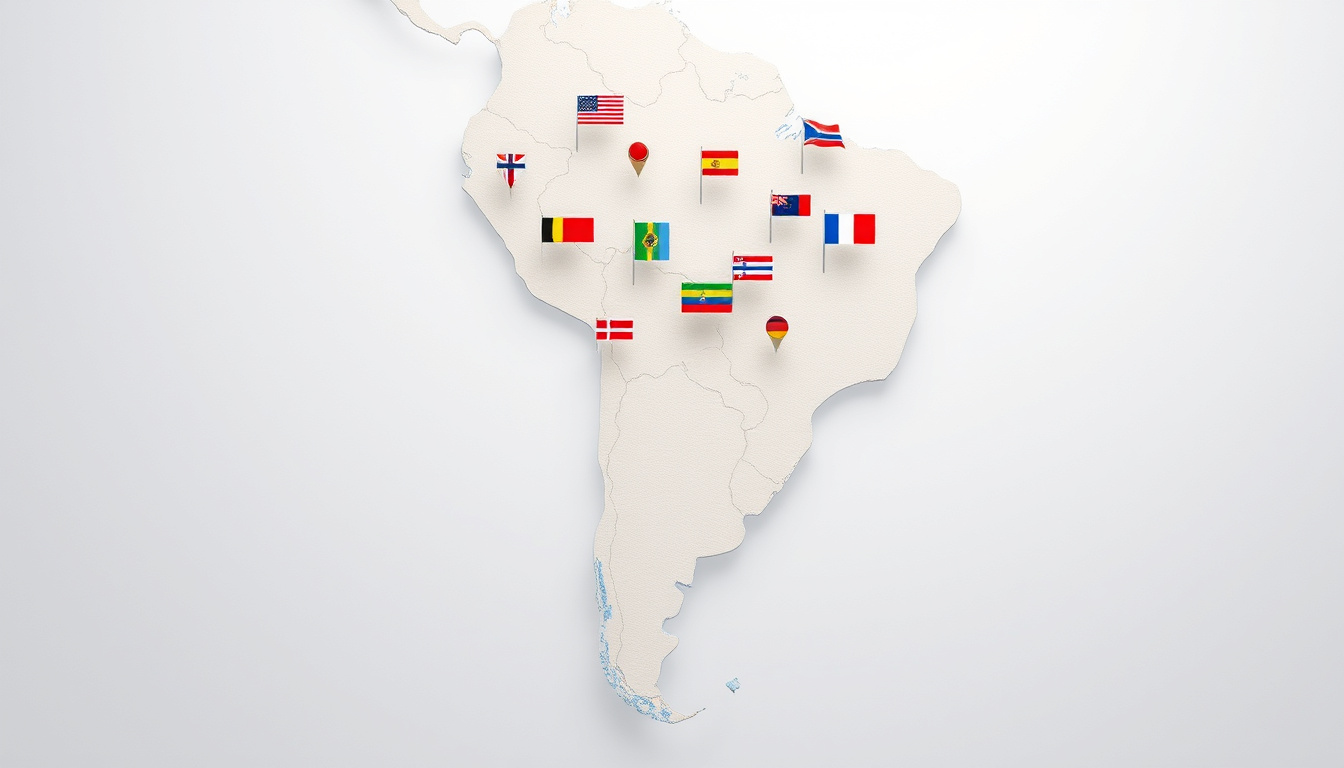
If you’ve ever traced your finger across a map of South America and wondered exactly how many countries fit into that sprawling continent, you’re not alone. The answer is 12 sovereign nations, each with its own capital, language, and character.
Sovereign countries: 12 · Dependent territories: 3 · Largest country (area): Brazil · Smallest country (area): Suriname · Most spoken language: Spanish · Total population (approx.): 442 million
Quick snapshot
- Argentina, Bolivia, Brazil, Chile, Colombia, Ecuador, Guyana, Paraguay, Peru, Suriname, Uruguay, Venezuela (FAO UN food and agriculture agency)
- French Guiana (France), Falkland Islands (UK), South Georgia and the South Sandwich Islands (UK) (Britannica reference publisher)
- Spanish (9 countries), Portuguese (Brazil), English (Guyana, Falklands), Dutch (Suriname) (Britannica reference publisher)
- Uruguay, Chile, Argentina, Paraguay, Ecuador (World Population Review demographic database)
Four key metrics give a quick read on the region’s shape:
| Metric | Value |
|---|---|
| Total sovereign countries | 12 (FAO UN food and agriculture agency) |
| Total dependent territories | 3 (Britannica reference publisher) |
| Total population (approx.) | 442 million (Britannica reference publisher) |
| Most common language | Spanish (Britannica reference publisher) |
How many countries are in South America?
Official count of sovereign nations
- South America has 12 sovereign countries: Argentina, Bolivia, Brazil, Chile, Colombia, Ecuador, Guyana, Paraguay, Peru, Suriname, Uruguay, and Venezuela. This count is used by the FAO UN food and agriculture agency and is the standard geographic definition.
Dependent territories and their status
- Three additional territories are not sovereign: French Guiana (an overseas département of France, as noted by Britannica reference publisher), the Falkland Islands (a British Overseas Territory), and South Georgia and the South Sandwich Islands (also British). World Atlas geography reference separates these from the sovereign-country count.
Difference between country and territory
- A sovereign country has full independence and UN recognition. Territories are administered by another state. FAO UN food and agriculture agency counts only the 12 sovereign states for its regional overviews.
The 12-country count is the most widely accepted baseline, but travelers and researchers should also know the three territories to avoid confusion on maps and political references.
The implication: separating sovereign states from dependent territories clarifies which entities have full international standing and which are administrative extensions of other nations.
What are the capitals of all South American countries?
List of countries and their capitals
| Country | Capital |
|---|---|
| Argentina | Buenos Aires (Britannica reference publisher) |
| Bolivia | Sucre (constitutional), La Paz (administrative) (Britannica reference publisher) |
| Brazil | Brasília (Britannica reference publisher) |
| Chile | Santiago (Britannica reference publisher) |
| Colombia | Bogotá (Britannica reference publisher) |
| Ecuador | Quito (Britannica reference publisher) |
| Guyana | Georgetown (Britannica reference publisher) |
| Paraguay | Asunción (Britannica reference publisher) |
| Peru | Lima (Britannica reference publisher) |
| Suriname | Paramaribo (Britannica reference publisher) |
| Uruguay | Montevideo (Britannica reference publisher) |
| Venezuela | Caracas (Britannica reference publisher) |
Capitals of dependent territories
- French Guiana: Cayenne (capital of the overseas département). Falkland Islands: Stanley. These are administrative seats rather than national capitals, as defined by World Atlas geography reference.
Knowing the difference between constitutional and administrative capitals—like Bolivia’s two—prevents confusion when looking up government offices or travel itineraries.
What this means: the dual-capital arrangement in Bolivia is rare globally, and travelers should verify which city houses the specific government function they need.
What is the safest country in South America?
Safety rankings based on Global Peace Index
- The 2023 Global Peace Index, compiled by the Vision of Humanity peace research institute, ranks Uruguay 1st in South America for peacefulness.
- Chile and Argentina follow closely, while countries like Venezuela and Colombia rank lower due to conflict and crime.
Uruguay as the safest
- World Population Review demographic database places Uruguay at the top of its safest countries in South America list, citing low homicide rates and political stability.
Comparison with other South American countries
- The pattern is clear: Uruguay, Chile, and Argentina form the safest cluster, while Guyana, Suriname, and Paraguay sit mid-range. The least safe countries are Venezuela, Colombia, and Brazil. The Global Peace Index peace research institute provides the comparative data.
Which language is most widely spoken in South America?
Spanish dominance
- Spanish is the official language in 9 of the 12 sovereign countries: Argentina, Bolivia, Chile, Colombia, Ecuador, Paraguay, Peru, Uruguay, and Venezuela, according to Britannica reference publisher.
Portuguese in Brazil
- Brazil’s sole official language is Portuguese, as documented by Britannica reference publisher. With over 215 million speakers, Portuguese is the second-most spoken language on the continent.
Indigenous languages and Quechua
- Bolivia, Peru, and Paraguay recognize indigenous languages at the national level. Bolivia’s constitution recognizes Spanish plus Quechua, Aymara, and over 30 other indigenous languages (Britannica reference publisher). Paraguay is officially bilingual in Spanish and Guaraní (Britannica reference publisher).
English in Guyana and Falkland Islands
- Guyana’s official language is English, reflecting its British colonial history (Britannica reference publisher). The Falkland Islands also use English.
Spanish speakers can travel across 75% of South America without language barriers. Portuguese speakers have Brazil, the continent’s largest economy, but lose fluency elsewhere. Indigenous languages remain vital locally but are rarely used in tourism.
The pattern: Spanish dominates the continent, but the linguistic map fractures along colonial lines, with Brazil’s Portuguese creating the largest single-language bloc.
What are 5 facts about South America?
Geographic extremes
- South America spans 12 sovereign countries and a population of about 442 million (Britannica reference publisher). Its highest point is Aconcagua in Argentina at 6,961 meters, and it contains the world’s highest waterfall, Angel Falls in Venezuela.
Biodiversity and the Amazon
- Brazil contains the largest portion of the Amazon rainforest (Britannica reference publisher), which houses about 10% of the world’s known species.
Amazon River
- The Amazon River is the world’s largest by discharge volume, flowing through Peru, Colombia, and Brazil.
Andes mountain range
- The Andes is the longest continental mountain range, running over 7,000 km along the western edge of the continent, through seven countries.
Cultural diversity
- South America’s linguistic map includes Spanish, Portuguese, English, Dutch, French, Quechua, Aymara, and Guaraní. This diversity reflects colonial histories and indigenous resilience, as documented by Britannica reference publisher.
Clarity check
Confirmed facts
- 12 sovereign countries defined by UN standards (FAO UN food and agriculture agency)
- Capitals as listed by Britannica reference publisher
- Uruguay ranked safest in South America by the 2023 Global Peace Index (Vision of Humanity peace research institute)
- Spanish and Portuguese are dominant languages (Britannica reference publisher)
What’s unclear
- Exact number of territories varies by definition (some exclude South Georgia).
- Safety rankings shift yearly; the 2023 GPI is the latest but not definitive.
Expert perspectives
“South America is home to 12 sovereign countries and three dependent territories, a breakdown widely used by international organizations.”
“Uruguay leads South America in peacefulness, ranking 1st in the region according to the 2023 Global Peace Index.”
— Global Peace Index 2023 peace research institute
For travelers eyeing South America, the takeaway is clear: the continent offers 12 distinct nations, each with its own capital, language, and safety profile. Understanding these differences is the foundation for planning a trip, a business move, or even a cultural study. For anyone mapping out their next move, the choice between Uruguay’s tranquility and Brazil’s vibrancy demands a deliberate trade-off.
For a more detailed breakdown of each nation’s capital and key facts, refer to this detailed list of South American countries.
Frequently asked questions
How many countries are there in South America exactly?
There are 12 sovereign countries: Argentina, Bolivia, Brazil, Chile, Colombia, Ecuador, Guyana, Paraguay, Peru, Suriname, Uruguay, and Venezuela (FAO UN food and agriculture agency).
What are the flags of South American countries?
Each country has a distinct flag. Most feature horizontal or vertical stripes, with common colors like red, yellow, and blue. The flags of Brazil (green and yellow), Argentina (blue and white), and Chile (red, white, blue) are widely recognized.
Which is the largest country in South America?
Brazil is the largest by both area (8,515,767 km²) and population (over 215 million) (Britannica reference publisher).
What is the currency used in most South American countries?
No single currency dominates. Brazil uses the real, Argentina the peso, Chile the peso, Colombia the peso, Peru the sol, and Uruguay the peso. Several countries use the US dollar unofficially, and Ecuador and El Salvador (though not in South America) use it officially.
Are there any landlocked countries in South America?
Yes, two: Bolivia and Paraguay. They have no coastline and depend on rivers and ports in neighboring countries for maritime trade.
What time zones are used in South America?
The continent spans five time zones from UTC-2 to UTC-5. Brazil alone uses four zones. Most countries observe no daylight saving time, but a few have seasonal adjustments.
Is French Guiana considered a country?
No. French Guiana is an overseas département of France, part of the European Union, and not a sovereign country (Britannica reference publisher).
What is the smallest country in South America by population?
Suriname is the smallest sovereign country by population, with about 632,000 people. French Guiana has fewer inhabitants (around 300,000) but is a territory, not a sovereign state.

George Pemberton is Consumer & Gaming Correspondent at ScopePress.uk, covering gaming, smart home and connectivity.