Most people never give a light switch a second thought. In Ireland, though, choosing, wiring, or replacing one involves specific types, wiring steps, and costs — all shaped by the National Rules for Electrical Installations (I.S. 10101:2020).
Standard voltage for light switches in Ireland: 230V AC ·
Typical lifespan of a mechanical light switch: 15-20 years ·
Average cost for a basic single light switch in Ireland: €5 – €20 ·
Commonest type of light switch in homes: Single-pole toggle switch
Quick snapshot
- Wikipedia defines a light switch as a device to control electric lights and outlets (Wikipedia (general reference)).
- Standard voltage in Irish homes is 230V AC (NSAI Standards Store (Irish standards body)).
- Common types are single-pole, three-way, four-way, and dimmer (deepreport.uk (home improvement guide)).
- Electricians charge between €70 and €130 for a like-for-like switch replacement (Northvoice.net (Irish electrical cost guide)).
- Whether an older home has a neutral wire in the switch box without visual inspection.
- Precise regulatory notification requirements for a DIY switch swap (varies by local authority interpretation).
- 2023: ETCI published updated National Rules for Electrical Installations (NRAI 2023) (Engineers Ireland (professional engineering body)).
- Check for neutral wire presence before installing smart switches or dimmers in older Irish homes.
- Expect growing adoption of smart lighting controls as I.S. 10101 compliance becomes standard in new builds.
Eight key specifications for Irish lighting circuits, one pattern: compliance with I.S. 10101 is non-negotiable for safety and certification.
| Specification | Value |
|---|---|
| Standard Voltage | 230V AC (single-phase) in Ireland |
| Most Common Switch Type | Single-pole toggle |
| Average DIY Replacement Time | 15–30 minutes |
| Electrician’s Average Charge (switch replacement) | €70–€130 |
| Wiring Colour (Live) | Brown (Ireland/EU standard) |
| RCD Protection for Lighting Circuits | Not exceeding 30 mA (Hager Ireland Regs Hub (electrical equipment manufacturer)) |
| Protective Earth at Switch Positions | Required (I.S. 357.5) (Safe Electric (Irish electrical safety regulator)) |
| Typical Cable Size for Lighting | 1.5 mm² copper, 6A overcurrent device |
Irish homeowners upgrading to dimmers or smart switches often discover their switch box lacks a neutral wire — a hidden cost that can turn a €20 swap into a €200 electrician call. Always check before buying.
What is a lighting switch?
How a light switch controls a circuit
- A light switch is an electromechanical device that opens or closes an electrical circuit to control a lamp or other load.
- In Ireland, standard switches are designed for 230V AC single-phase home circuits.
- When the switch is off, the circuit is open — no current flows. When on, it closes the circuit and power reaches the light.
Difference between a switch and a socket outlet
- A switch controls a permanently connected load (light, fan); a socket outlet provides a point to plug in portable devices.
- Sockets in Ireland are typically on a ring or radial circuit; switches are on dedicated lighting circuits with smaller cable (1.5 mm²) and lower overcurrent protection (6A).
Bottom line: For an Irish homeowner, a light switch is simply a gate for electricity, but the circuit behind it is governed by I.S. 10101 — every component from cable size to earth connection carries compliance weight.
Many Irish homes built before 2000 may not have a neutral wire at the switch position. This is perfectly legal for basic switches, but it blocks the installation of most smart switches and many dimmers.
The implication: a basic switch swap can be straightforward, but any upgrade that needs a neutral turns the job from cosmetic to electrical.
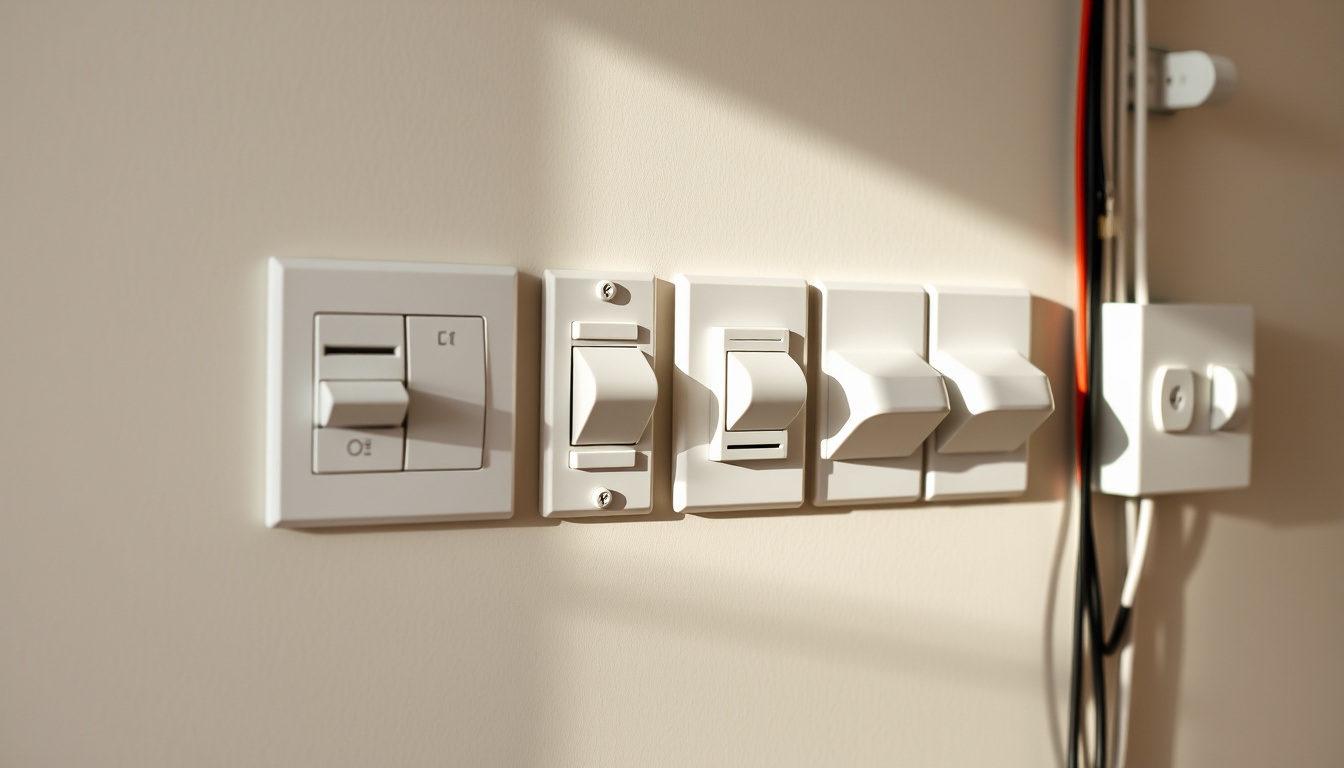
What are the 4 types of lighting switches?
Single-pole switch
- Controls a light from one location.
- Most common type in Irish homes — simple, reliable, and cheap to replace.
- Uses COM and L1 terminals in wiring.
Three-way switch
- Allows control from two separate locations (e.g., top and bottom of stairs).
- Also called two-way switching in Ireland; uses COM, L1 and L2 terminals (BritainDaily.uk (home improvement blog)).
Four-way switch
- Used in combination with two three-way switches to control a load from three or more points.
- Common in long hallways or large rooms with multiple entry points.
- Sometimes called an intermediate switch in Ireland.
Dimmer switch
- Varies light output by controlling voltage or current waveform.
- Requires a compatible bulb (LED, halogen, etc.) and neutral wire in many cases.
- Popular in living rooms and dining areas for adjustable ambiance.
Bottom line: For most Irish rooms, a single-pole switch is the default; choose three-way for stairs and hallways, dimmers for atmosphere, and four-way only for long corridors where multiple control points are essential.
Metal switch plates require an earth connection. Never fit a metal plate without verifying the earth terminal is connected – failure can create a live surface.
The pattern: the more control points a layout needs, the more terminals and planning the switch requires — which is why the single-pole remains the default.
What is the most common light switch?
Single-pole toggle switch prevalence
The single-pole toggle switch is the most common switch in Irish homes. It controls a light from one location, uses just COM and L1 terminals, and is the cheapest option to replace.
Why this type is the default choice for new builds
New domestic lighting circuits are designed around 230V AC single-phase supplies, and the single-pole switch fits that layout with no extra switching complexity. Builders fit it by default, with two-way switching added only where a second control point is needed.
The implication: if you are replacing a standard wall plate, the single-pole toggle is the low-risk baseline; any other type is a deliberate upgrade rather than a default.
How to wire a light switch in Ireland?
Identifying the live (brown), neutral (blue), and earth (green/yellow) wires in Irish wiring
- Live wire (brown) carries the current from the consumer unit to the switch.
- Neutral wire (blue) is not normally switched, but a neutral is required in the switch box for most smart switches and many dimmers.
- Earth wire (green/yellow) must be terminated at every switch position, even in plastic boxes.
- If a blue conductor is reused as a switched live, it must be sleeved or marked brown.
Step-by-step wiring for a single-pole switch
- Isolate the circuit at the consumer unit – switch off the relevant MCB and verify with a voltage tester.
- Remove the existing switch plate and check which wires are present.
- Connect the live feed (brown) to the COM terminal of the new switch.
- Connect the switched live (black or brown sleeved) to the L1 terminal.
- Connect the earth wire to the earth terminal (if metal plate) or terminate in a connector inside a plastic box.
- Screw the plate on, restore power, and test the switch.
Safety precautions before working on any circuit
- Always isolate the circuit at the consumer unit before touching any wiring.
- Use a voltage tester to confirm the circuit is dead before starting.
- In Ireland, only qualified electricians registered with Safe Electric should perform new wiring or alterations that affect the fixed installation.
- If you are unsure about any step, call a registered electrician.
Bottom line: Like-for-like replacement of a single-pole switch is a safe DIY job for a competent homeowner if the circuit is isolated and wires are clearly identified. Anything involving new cable runs, dimmers, or smart switches requires a registered professional.
DIYing a switch swap saves €40–€80 in labour, but a mistake – like leaving a live connection – can cost much more in fire or shock risk. Irish regulations (I.S. 10101) are designed to protect you; follow them.
What this means: the money saved by DIY is real, but the registration and certification trail is what protects a home sale or insurance claim after the switch is fitted.
Can I replace my light switch myself?
When it is safe to DIY (like-for-like replacement of a standard switch)
A like-for-like swap of a single-pole switch is a reasonable DIY job for a competent homeowner, provided the circuit is isolated at the consumer unit and the live, neutral, and earth conductors are correctly identified. The work usually takes 15–30 minutes.
When you must call an electrician (new wiring, upgrading to smart, or adding points)
New cable runs, dimmers, smart switches, or any change to the fixed installation should be left to a registered electrician. Older Irish switch boxes may lack a neutral wire, and certification under I.S. 10101 is required for work that alters the installation.
Bottom line: For a homeowner, a basic like-for-like swap is DIY territory; anything that changes the circuit or needs a neutral is a registered-electrician job.
How much should an electrician charge to replace a light switch?
Average call-out and labour fees in Ireland
The snapshot above puts a like-for-like switch replacement at €70–€130, covering a typical call-out plus labour. The switch itself is a small part of that figure — usually €5–€20 for a basic single-pole plate.
Factors affecting the total cost
The price climbs when the job needs a new switch box, new cable, a dimmer, or a smart switch. Metal plates also add a safety check because the earth terminal must be present and connected before the plate goes on.
Bottom line: Budget €70–€130 for a professional swap, and check that the electrician is registered with Safe Electric before any work starts.
Clarity section
Confirmed facts
- Wikipedia defines a light switch as a device to control electric lights and outlets.
- Standard voltage in Irish homes is 230V AC.
- Common switch types are single-pole, three-way, four-way, and dimmer.
- Electricians in Ireland charge between €70 and €130 for a like-for-like switch replacement.
What’s unclear
- Whether an older home has a neutral wire in the switch box without visual inspection.
- Precise regulatory notification requirements for a DIY switch swap (varies by local authority interpretation).
“A light switch is a device used to operate electric lights, permanently connected equipment, or electrical outlets.”
— Wikipedia (general reference)
“There is no rule requiring neutrals at light-switch positions in Ireland, and no rule prohibiting them either.”
— Safe Electric (Irish electrical safety regulator)
For Irish homeowners replacing a light switch, the choice is clear: stick to like-for-like swaps if you’re confident, or call a registered electrician for anything involving new wiring or smart upgrades. The cost of non‑compliance — a failed inspection, an insurance void, or a fire — far outweighs the €70–€130 you’ll pay for professional work.
Related reading: Light Switches Ireland Guide · Light Switches Ireland DIY vs Electrician
canadiantruth.org, selfbuild.ie, cdn.tii.ie, static1.squarespace.com, udg.aim.gov.ie, newsdistrict.net
Frequently asked questions
Can I use a dimmer on any light bulb?
No. Dimmers are designed for specific bulb types (LED, incandescent, halogen). Check the bulb packaging for “dimmable” – otherwise you may get flickering, buzzing, or reduced lifespan.
What does a two-way switch mean?
A two-way switch (also called a three-way in the US) lets you control one light from two separate locations – perfect for stairs or long hallways. It uses three terminals: COM, L1, and L2.
Do I need a neutral wire for a smart light switch?
Most smart switches require a neutral wire to power their Wi‑Fi or Zigbee modules. If your switch box has no neutral (common in older Irish homes), you may need a smart bulb instead of a smart switch.
What is the difference between a rocker and toggle switch?
A toggle switch has a small lever that flips up and down. A rocker switch has a wider, flat paddle that rocks on one side. Both function the same electrically – the difference is purely aesthetic and tactile.
How do I test if a light switch is faulty?
If the light flickers, the switch feels hot, or it makes a crackling sound, the internal contacts may be worn out. Use a multimeter to check for continuity when the switch is on – or simply replace it, as switches are cheap and easy to swap.
Are plastic and metal light switches interchangeable?
Yes, but metal plates require an earth connection. If you replace a plastic switch with a metal one and the earth terminal is missing or disconnected, the plate could become live – a serious shock hazard.
Can a light switch get hot? Is it dangerous?
Warmth is normal with dimmer switches at high loads, but a standard switch that feels hot to the touch indicates a loose connection or overloaded circuit. Turn off the circuit and call an electrician immediately.
Related stories




Craig Newton is Senior Reporter at ScopePress.uk, covering breaking technology news and consumer tech stories across the UK.