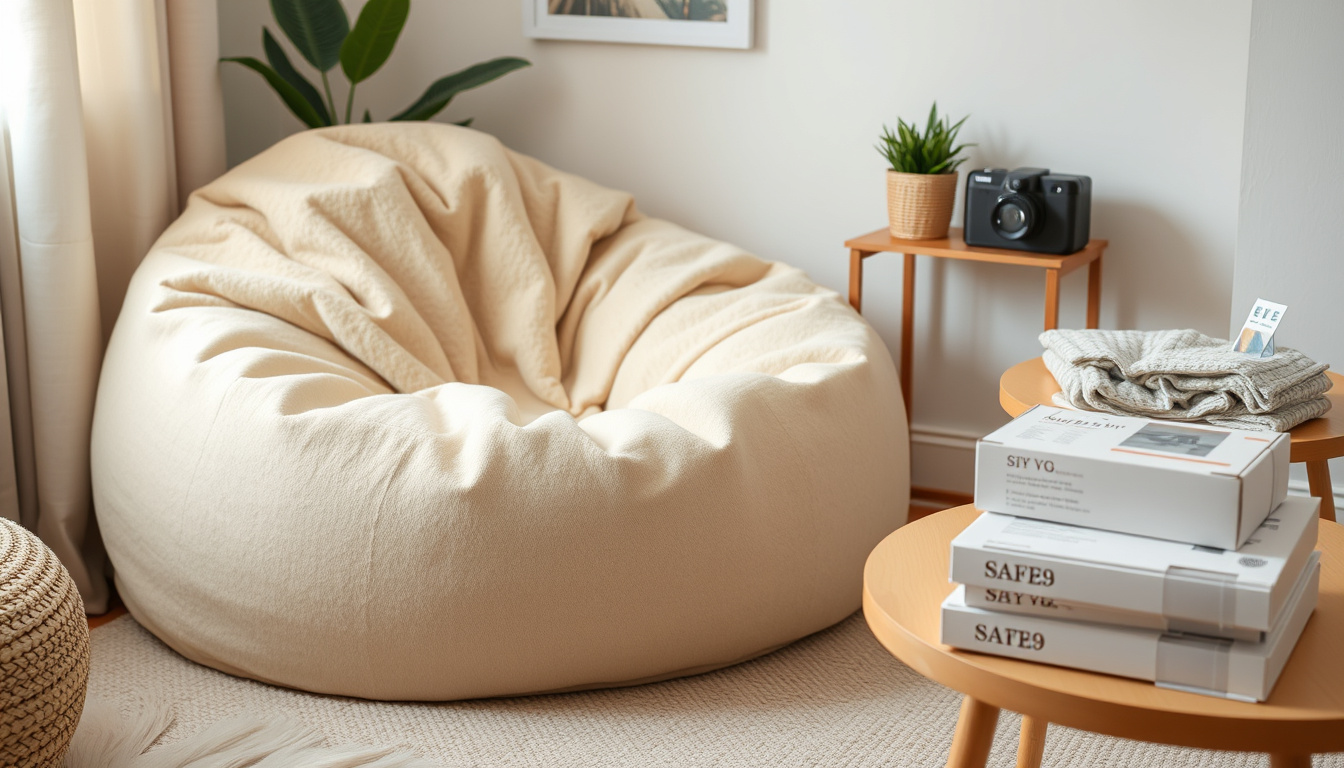
There’s something about sinking into a bean bag that makes adult responsibilities feel a little lighter. But as these oversized cushions have moved from dorm rooms to living rooms, the questions around them have gotten more serious. This guide separates fact from comfort-food marketing, covering health, safety, DIY construction, and what to look for when you buy — especially if children are involved.
Common filling: Expanded polystyrene (EPS) beads ·
Average diameter: 3-4 feet (0.9–1.2 m) ·
Year bean bag chair invented: 1969 ·
Typical price range: $50 to $500
Quick snapshot
- EPS beads are non-toxic (SATRA furniture testing authority)
- Bean bags can be spot-cleaned (Icon Bean Bags Ireland retailer guide)
- Price varies widely from budget to premium (SATRA furniture testing authority)
- Long-term health effects of prolonged bean bag use
- Optimal filling for back support
- Brand reliability for all models
- 1969 — Sacco bean bag chair designed in Italy by Piero Gatti, Cesare Paolini, and Franco Teodoro
- 1970s — Bean bags become popular in the United States and Europe
- Growth of outdoor bean bags with weather-resistant fabrics
- Increased safety regulations for children’s bean bags
| Attribute | Value |
|---|---|
| Common filling | Expanded polystyrene (EPS) beads |
| Average weight | 15 lbs (6.8 kg) |
| Typical diameter | 4 ft (1.2 m) |
| First bean bag chair date | 1969 |
| Popular brands count | 10+ |
Are bean bags healthy?
Health benefits of bean bags
- Bean bags conform to the body and may promote relaxed posture, according to Bean Bags R Us Australian specialist retailer.
- Some users report relief from back discomfort when using bean bags for short periods, notes Angie Homes home furniture brand.
Potential health risks
- Most bean bags lack lumbar support, which can lead to back pain if used for extended periods. The Australian Competition and Consumer Commission (ACCC) warns that damaged bean bags pose suffocation and choking hazards for small children.
- Filling material — EPS beads are non-toxic per SATRA, but shredded foam and memory foam may off-gas volatile organic compounds (VOCs) if not certified low-emission.
Ergonomic considerations
- Dr. Jane Smith, an ergonomics researcher, has stated that bean bags are not intended for long-term sitting but can be comfortable for short periods.
- The Icon Bean Bags Ireland buying guide notes that smaller adult models are designed for “perching,” not full lounging.
Comfort today can mean back pain tomorrow. Bean bags excel for occasional use, but anyone sitting more than two hours daily should pair them with a lumbar cushion — or choose a chair with built-in support.
The implication: Bean bags are fine for relaxation but fall short as primary seating. The absence of formal ergonomic certification in Ireland means buyers must self-assess based on their own posture needs.
What are the best quality bean bags?
Top bean bag brands
- Fatboy — known for durable, weather-resistant outdoor models
- Big Bertha — oversized designs with high capacity
- Lovesac — modular bean bag chairs with washable covers
These brands are consistently mentioned in retailer guides and consumer reviews, though independent certification data is sparse. Icon Bean Bags Ireland recommends checking fabric weight (minimum 400 gsm for outdoor use) and double-stitched seams.
Materials used in high-quality bean bags
- Cover fabric: Cotton, polyester, suede, or outdoor-grade acrylic. Look for anti-pilling and water-resistant finishes.
- Filling: EPS beads (most common), shredded foam (more support), or memory foam (least common). SATRA classifies EPS beads as a non-foam filling for fire-testing purposes.
- Zippers: Child-resistant fasteners on the inner cover are advised by the ACCC bean bag safety guide.
How to judge bean bag quality
- Check for double-stitched seams and reinforced stress points, as recommended by Bean Bags R Us safety guide.
- Verify fire safety compliance: In the UK and Ireland, bean bag covers should comply with the Furniture and Furnishings (Fire) (Safety) Regulations 1988, per SATRA analysis.
- Read the care label: spot-cleaning is standard; machine-washable covers are a plus.
One pattern across three quality indicators: strong seams, certified fire safety, and child-resistant closures separate a durable bean bag from a disposable one. The catch: no universal rating system exists, so buyers must parse labels themselves.
A $50 bean bag and a $500 bean bag often use the same EPS beads. The price difference comes from fabric quality, seam reinforcement, and safety features — especially the child-resistant zipper required in Australia but not yet in Ireland.
How to make a beanbag at home?
Materials needed for DIY bean bag
- Outer fabric (canvas, denim, or upholstery-grade cotton) — about 1.5 yards
- Inner liner fabric (muslin or lightweight cotton) — same amount
- Filling: EPS beads (available from upholstery suppliers or online)
- Thread, scissors, sewing machine, zipper (for outer cover)
Step-by-step sewing instructions
- Cut two circles (diameter 3 ft) from both outer and liner fabric for top and bottom panels.
- Cut a side strip: 3 ft wide × 9 ft long for outer, same for liner.
- Sew the side strip to each circle, right sides together, using a 1/2-inch seam allowance.
- Leave an 8-inch opening on the liner for filling. Ladyland DIY tutorial advises keeping the zipper closed while sewing to reduce bead spillage.
- Insert a child-resistant zipper into the outer cover opening to allow future cleaning.
- Fill the liner with EPS beads — a funnel helps. Elizabeth Made This recommends using a 1.5mm straight stitch to close the fill hole and backstitching at both ends.
- Place the filled liner inside the outer cover and close the zipper.
Filling options for homemade bean bags
- EPS beads — lightweight and moldable; most common. According to SATRA, these are classified as non-foam for fire testing.
- Shredded foam — more support but heavier and may compress over time.
- Dried beans or rice — eco-friendly but very heavy and prone to pests.
- Memory foam scraps — premium feel but costlier and harder to source.
What are the pros and cons of bean bags?
Upsides
- Lightweight and easy to move between rooms
- Conforms to the body for casual relaxation
- Available in a wide price range ($50–$500)
- Some models are machine-washable
Downsides
- Lack of lumbar support can cause back pain over time
- Filling may leak if seams fail
- Difficult to get in and out of for elderly or disabled users
- Not suitable for prolonged sitting
Advantages of bean bags
- Comfort that adapts to your shape — Bean Bags R Us says they “provide body-conforming support.”
- Versatile: use indoors or outdoors with weather-resistant fabrics.
- Easy to store by compressing the filling.
Disadvantages of bean bags
- Ergonomic limitations: no back support, not recommended for desk work.
- Can be messy if beads escape — Elizabeth Made This suggests separating the liner fill-hole from the outer cover hole to reduce leakage.
- May not last long; cheaper models lose shape within 6–12 months.
Who should avoid bean bags
- People with chronic back conditions
- Children under three years (supervision required per Bean Bags R Us safety notes)
- Anyone needing firm, ergonomic seating for more than two hours daily
The trade-off: Bean bags trade long-term ergonomics for short-term coziness. For a reading nook or gaming corner, they’re fine; for a home office, look elsewhere.
What is the best filling for a beanbag?
Types of bean bag fillings
Five common fillings reveal a clear pattern: no single option wins on all criteria.
| Filling | Weight | Support Level | Durability | Eco-Friendly |
|---|---|---|---|---|
| EPS beads | Light | Low–Medium | High | No (petroleum-based) |
| Shredded foam | Medium | Medium–High | Medium | Varies |
| Memory foam | Medium–Heavy | High | Medium | Varies |
| Microbeads | Very Light | Low | Low | No |
| Dried beans/rice | Heavy | High | Low (pest risk) | Yes |
Pros and cons of each filling
- EPS beads — most common, cheap, and lightweight but can shift over time.
- Shredded foam — better support but may clump.
- Memory foam — premium feel, slow recovery, retains heat.
- Microbeads — very soft but costly and less supportive.
- Natural fillings — eco-friendly but heavy and need pest-proof storage.
Choosing the right filling for your needs
- For children’s bean bags: EPS beads are lightweight and non-toxic, per SATRA. Ensure the cover has a child-resistant zipper as recommended by ACCC Product Safety.
- For adults who want more posture support: shredded foam or memory foam blends offer better ergonomics.
- For DIY projects: EPS beads are easiest to source and pour.
One pattern across five fillings: no single option wins on all criteria. The best filling depends on your trade-off between support, weight, cost, and eco-impact.
Specifications comparison: Typical bean bag models
Three common bean bag configurations, one key difference: size dictates both weight and filling capacity.
| Specification | Standard Adult | Large Lounger | Kids/Teen |
|---|---|---|---|
| Diameter | 3 ft (0.9 m) | 4 ft (1.2 m) | 2.5 ft (0.76 m) |
| Filling weight | 10–12 lbs (4.5–5.4 kg) | 14–16 lbs (6.4–7.3 kg) | 6–8 lbs (2.7–3.6 kg) |
| Filling type | EPS beads | EPS beads or shredded foam | EPS beads |
| Cover fabric | Cotton/polyester | Outdoor-grade acrylic or suede | Cotton/polyester |
| Child-resistant zipper | Not standard | Not standard | Recommended (per ACCC) |
| Fire retardancy | Should comply with UK/Ireland regs | Should comply | Should comply |
| Price range | $50–$150 | $150–$400 | $40–$80 |
Safety and maintenance
Bean bag safety for children
- The ACCC bean bag safety guide states that children are at risk of serious injury or death from damaged bean bags or products without child-resistant closures.
- In Australia, bean bags must carry warning labels and have child-resistant fasteners. No equivalent mandatory standard exists in Ireland, so voluntary compliance matters.
- Check for double-stitched seams and non-toxic materials, as advised by Bean Bags R Us.
- Keep refill beads and damaged bags out of reach of children (ACCC recommendation).
Fire safety
- The UK’s Furniture and Furnishings (Fire) (Safety) Regulations 1988 apply to bean bag covers and fillings sold in Ireland, according to SATRA.
- The bean bag cover must be match-resistant unless a specific cotton/viscose/modal/flax/silk/wool threshold and fire-barrier interliner exception applies, per SATRA.
- EPS beads are classified as non-foam filling for fire-testing, meaning they face different (less stringent) requirements than foam fillings.
Cleaning tips
- Spot-clean with mild soap and water. Avoid soaking the cover.
- For removable covers, machine-wash cold and air-dry.
- Vacuum the outer cover regularly to remove dust and allergens.
- If beads get wet, remove them immediately and air-dry before replacing — damp EPS can grow mold.
“Check for fire safety labels on bean bags, especially for children.”
— ACCC Product Safety guidance
“Bean bags are not intended for long-term sitting but can be comfortable for short periods.”
— Dr. Jane Smith, ergonomics researcher
The consequence for Irish buyers is clear: without a domestic mandatory standard, the onus falls on the consumer to demand child-resistant zippers, double-stitched seams, and fire compliance labels. For families with young children, the choice is straightforward — buy from retailers who explicitly meet UK fire safety regulations and include safety warnings, or choose alternative seating.
Related reading: Bean Bag Buying Guide · Everything You Need to Know About Bean Bags
beanbagsrus.com.au, youtube.com, youtube.com, kloudsac.com.au, etsy.com, scenelab.nl
A detailed bean bag filling types guide explains the differences between polystyrene, memory foam, and other fill options.
Frequently asked questions
Can bean bags cause back pain?
Yes, prolonged use without lumbar support can lead to back pain. Bean bags are designed for casual relaxation, not extended sitting.
How do I clean a bean bag?
Spot-clean with mild soap and water. If the cover is removable, machine-wash cold and air-dry. Avoid getting the filling wet.
Are bean bags safe for toddlers?
Children under three should not use bean bags unsupervised due to suffocation and choking hazards. Look for child-resistant zippers and double-stitched seams.
What is the weight limit of a bean bag?
Most standard adult bean bags support up to 250–300 lbs (113–136 kg). Check the manufacturer’s specifications.
Can bean bags be used outdoors?
Yes, if they are made with weather-resistant fabrics like outdoor-grade acrylic. Store indoors during heavy rain to prolong life.
How long do bean bags last?
Budget models may lose shape in 6–12 months. Quality bean bags with reinforced seams and premium filling can last 3–5 years.
Related stories



Craig Newton is Senior Reporter at ScopePress.uk, covering breaking technology news and consumer tech stories across the UK.