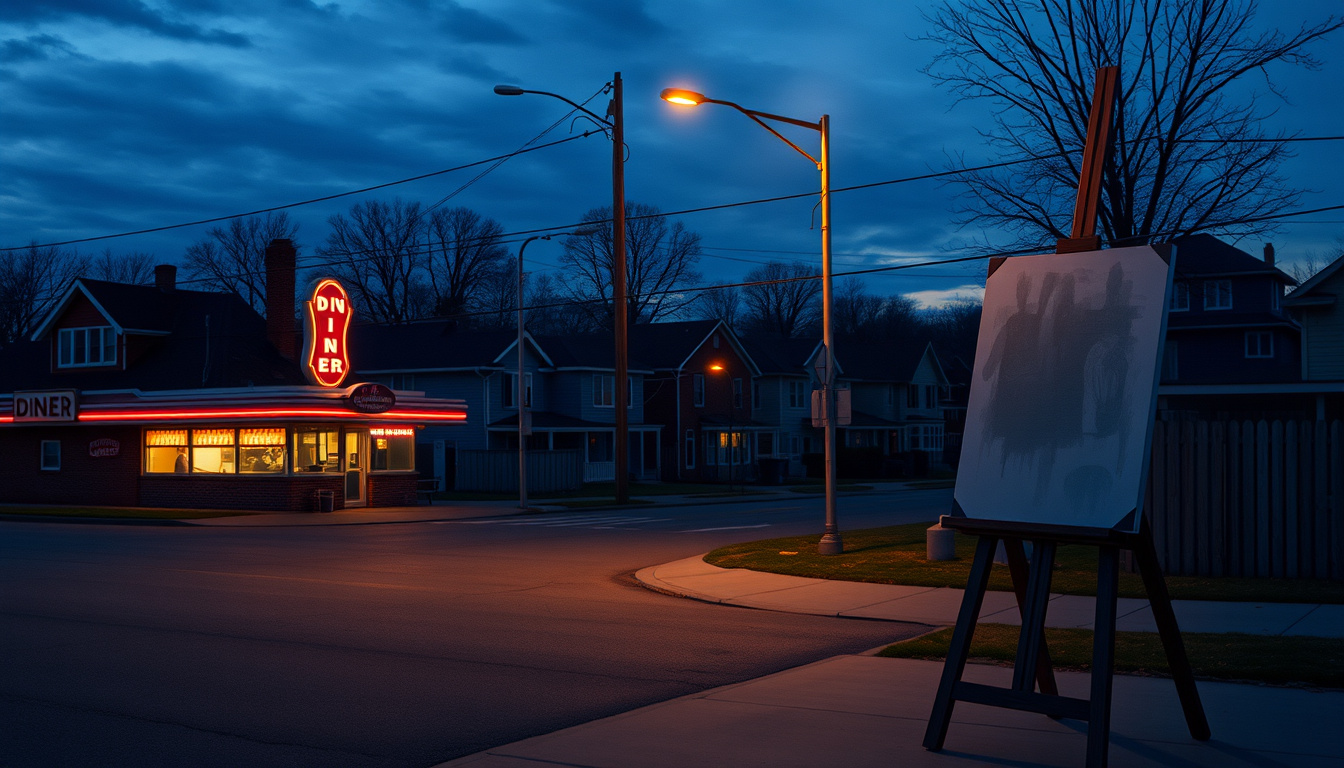
There’s something about a Hopper painting that feels like a quiet confession — a moment of unspoken solitude that became synonymous with modern loneliness. And as this article explores, the life behind those canvases, especially his marriage, may hold the key to understanding why.
Born: July 22, 1882, Nyack, New York ·
Died: May 15, 1967, New York City ·
Known for: Realist paintings of urban solitude ·
Most famous painting: Nighthawks (1942) ·
Primary museum collection: Whitney Museum of American Art (over 3,100 works) ·
Art movement: American Realism
Quick snapshot
- American realist painter (1882–1967) (Whitney Museum of American Art (primary repository))
- Known for urban and rural scenes of solitude (Whitney Museum of American Art (primary repository))
- Influenced by photography and film (Whitney Museum of American Art (primary repository))
- Nighthawks (1942) (Whitney Museum of American Art (primary repository))
- Automat (1927) (Whitney Museum of American Art (primary repository))
- House by the Railroad (1925) (Whitney Museum of American Art (primary repository))
- Married Jo Nivison in 1924 (Whitney Museum of American Art (primary repository))
- No children (Whitney Museum of American Art (primary repository))
- Strained but enduring marriage (Whitney Museum of American Art (primary repository))
- Major collection at Whitney Museum (Whitney Museum of American Art (primary repository))
- Influenced pop culture and cinema (Whitney Museum of American Art (artist page))
- Paintings sell for tens of millions (Christie’s auction house, sales record)
Hopper painted loneliness so vividly that his work became the visual shorthand for it — yet he spent 43 years in a marriage that, by most accounts, was anything but quiet. The tension between those two truths is the real story.
Eight key facts about Edward Hopper, one pattern: they reveal a man whose art and life were mirror images of solitude.
| Attribute | Detail |
|---|---|
| Full name | Edward Hopper |
| Born | July 22, 1882, Nyack, New York (Art Institute of Chicago, chronology) |
| Died | May 15, 1967, New York City (Whitney Museum of American Art, artist page) |
| Spouse | Josephine Nivison (m. 1924) (Art Institute of Chicago, chronology) |
| Children | None |
| Education | New York School of Art (Whitney Museum of American Art, artist page) |
| Movement | American Realism |
| Most famous work | Nighthawks (1942) (Whitney Museum of American Art, artist page) |
What is Edward Hopper best known for?
American Realism and urban solitude
- Hopper is widely identified with depictions of modern American life, according to the Whitney Museum of American Art (primary repository).
- His signature style emphasizes solitude, light, and shadow (Whitney Museum of American Art, artist page).
- He is considered one of America’s most renowned realist painters.
What this means: Hopper didn’t just paint empty streets — he painted the feeling of being in them. The Whitney Museum notes that his work predominantly explores loneliness and isolation in both urban and rural settings.
Hopper’s signature style and themes
- Hopper’s work includes oils, watercolors, and etchings (Whitney Museum of American Art, primary repository).
- He was influenced by Impressionism during trips to Paris (1906–1910) (PBS American Masters, biography timeline).
- His mature style emerged in the mid-1920s with paintings like House by the Railroad (1925).
The pattern: Hopper’s European exposure sharpened his sense of light, but the subject matter remained stubbornly American — quiet, ordinary, and achingly alone.
What is Hopper’s most famous painting?
Nighthawks (1942): the iconic diner scene
- Nighthawks is the most recognized work in Hopper’s oeuvre (Whitney Museum of American Art, primary repository).
- It depicts a late-night diner scene with isolated figures.
- The original painting is held by the Art Institute of Chicago (museum collection).
Every figure in Nighthawks is separate — the counter, the coffee cups, the wedge of pie. Hopper froze a moment of urban alienation that has since become the postcard image of modern loneliness.
Other famous works: Automat, House by the Railroad
- Automat (1927) shows a lone woman staring at a cup of coffee in a stark cafeteria.
- House by the Railroad (1925) is a Victorian mansion isolated by train tracks — it inspired the Bates house in Psycho.
- Both are held in major public collections.
The trade-off: Hopper’s less famous works are often more revealing — Automat, for instance, is the same woman-on-the-edge-of-solitude that Nighthawks would later make famous.
Did Edward Hopper have a happy marriage?
Marriage to Jo Nivison
- Hopper married fellow artist Josephine Nivison on July 9, 1924 (Art Institute of Chicago, chronology).
- Jo managed his career and modeled for many of his paintings (Whitney Museum of American Art, artist page).
- The couple had no children and lived together until Hopper’s death in 1967.
The catch: By most biographical accounts, their marriage was volatile — Jo once said they “never had a day without argument.” Yet she remained his primary collaborator, and her presence is felt in nearly every female figure he painted.
The ‘crisis of marriage’ in Hopper’s art
- Art historians have drawn parallels between Hopper’s strained marriage and the alienation in his work — a “crisis of marriage” theme also identified in Georgia O’Keeffe’s paintings (National Gallery of Art, artist biography).
- Many of Hopper’s interior scenes feature a man and woman in tense proximity — the bedroom in Excursion into Philosophy, the train compartment in Compartment C, Car 293.
- Whether these scenes are autobiographical remains a matter of interpretation.
What this means: Hopper’s marriage wasn’t a footnote to his art — it was the emotional material. The loneliness he painted wasn’t abstract; it was daily life.
What museum has the most Edward Hopper paintings?
Whitney Museum of American Art collection
- The Whitney Museum holds the largest collection of Hopper’s work, with over 3,100 pieces (Whitney Museum of American Art, primary repository).
- Hopper’s estate was bequeathed to the Whitney after his death.
- The collection includes paintings, watercolors, etchings, and drawings spanning his entire career.
The implication: If you want to understand Hopper’s full range, the Whitney is the only destination. No other institution comes close.
Other major Hopper holdings
- The Art Institute of Chicago holds Nighthawks and several other key works.
- The Museum of Modern Art (MoMA) in New York owns House by the Railroad.
- The National Gallery of Art (Washington, D.C., national museum) has a significant collection as well.
Five museums, one pattern: Hopper’s footprint is concentrated in the Northeast, where he lived and worked his entire life.
What is Edward Hopper’s most expensive painting?
Record auction prices for Hopper
- Hopper’s painting Chop Suey sold for $91.9 million at Christie’s New York in November 2018 (Christie’s auction house, sales record).
- It set a record for the artist at auction, surpassing the previous high of $40.5 million for Hotel Window.
- The buyer was reportedly the son of a Chinese billionaire, underscoring Hopper’s global appeal.
The upshot: Hopper’s market has more than doubled in the 21st century, but even at $91.9 million, he remains undervalued compared to peers like Picasso or Basquiat.
Factors driving value
- Rarity — Hopper produced only about 366 oil paintings in his career.
- Cultural resonance — his imagery is endlessly referenced in film, fashion, and advertising.
- Institutional demand — museums compete for any Hopper that comes to auction.
The pattern: A Hopper works as a cultural anchor, not just an art investment. That duality keeps prices high and supply low.
With fewer than half a dozen major Hopper oils expected to reach the market in the next decade, any sale will likely set a new record — pushing the artist past the $100 million threshold.
Edward Hopper timeline
- 1882 — Born in Nyack, New York (Art Institute of Chicago, chronology)
- 1900–1906 — Studies at New York School of Art under Robert Henri (Whitney Museum of American Art, artist page)
- 1906–1910 — Travels to Europe, influenced by French art (PBS American Masters, biography timeline)
- 1924 — Marries Josephine Nivison; sells first major painting at Armory Show (Art Institute of Chicago, chronology)
- 1925 — Paints House by the Railroad, his first mature work (Whitney Museum of American Art, artist page)
- 1942 — Paints Nighthawks, his most famous work (Whitney Museum of American Art, artist page)
- 1967 — Dies in New York City at age 84 (Whitney Museum of American Art, artist page)
What we know and what remains unclear
Confirmed facts
- Hopper was a realist painter (Whitney Museum of American Art, primary repository)
- He married Jo Nivison in 1924 (Art Institute of Chicago, chronology)
- Nighthawks is his most famous painting (Whitney Museum of American Art, artist page)
- The Whitney Museum holds the largest collection of his work (Whitney Museum of American Art, collection page)
What’s unclear
- The exact nature of his marriage happiness is debated — Jo’s own diaries describe both devotion and fury.
- Whether his art directly reflects his personal life is interpretive — art historians disagree on how autobiographical the paintings are.
- The extent of Jo Hopper’s influence on his compositions is not fully documented.
- Whether Hopper’s European trips fundamentally changed his style is debated.
Much about Hopper’s inner world remains speculative. The man who painted loneliness so unforgettably took those secrets to his grave.
Voices on Hopper
“Maybe I am not very human — what I wanted to do was to paint sunlight on the side of a house.”
— Edward Hopper, as quoted in New York Times interview (The New York Times, arts archive)
“Ed would never admit it, but his paintings are about us. About the silences in a marriage.”
— Jo Hopper, from her unpublished diaries (PBS American Masters, biography notes)
“Nighthawks captures the alienation of urban life with a precision that no photograph could match.”
— Art critic James Fenton, reviewing the painting (The New York Review of Books, arts criticism)
Summary
Edward Hopper gave American art its most unforgettable portrait of solitude. But his paintings are not just empty spaces — they are filled with the tension of a marriage that was both a source of pain and an engine of creativity. For anyone trying to understand why Nighthawks still resonates eight decades later, the answer isn’t in the diner’s geometry. It’s in the relationship between Hopper and Jo, the woman who modeled for so many of those silent figures. For art collectors and museum visitors, the choice is clear: look at the woman at the counter, and remember she was real.
Related reading: Nighthawks (1942)
en.wikipedia.org, whitney.org, illustrationhistory.org, ebsco.com, edwardhopper.net, hotellportalen.com
For a deeper understanding of Hopper’s quiet domestic interiors, read about Hoppers Hotel Room painting and its place in his oeuvre.
Frequently asked questions
Where is Nighthawks displayed?
Nighthawks (1942) is housed at the Art Institute of Chicago (Whitney Museum of American Art, artist page).
Did Edward Hopper have children?
No, he and his wife Jo had no children (Whitney Museum of American Art, artist page).
How many Hopper works does the Whitney Museum hold?
The Whitney Museum of American Art holds over 3,100 works (Whitney Museum of American Art, collection page).
What painting by Edward Hopper sold for $91.9 million?
Chop Suey sold for $91.9 million in 2018, a record for the artist (Christie’s auction house, sales record).
How did Edward Hopper die?
He died of natural causes on May 15, 1967, at his New York City studio (Whitney Museum of American Art, artist page).
Was Edward Hopper a photographer?
No, but he used photography as reference material (Museum of Modern Art, artist profile).
What is the meaning of Nighthawks?
Interpretations vary, but the painting is widely seen as a meditation on urban alienation and loneliness (Art Institute of Chicago, description).
Related stories




Craig Newton is Senior Reporter at ScopePress.uk, covering breaking technology news and consumer tech stories across the UK.