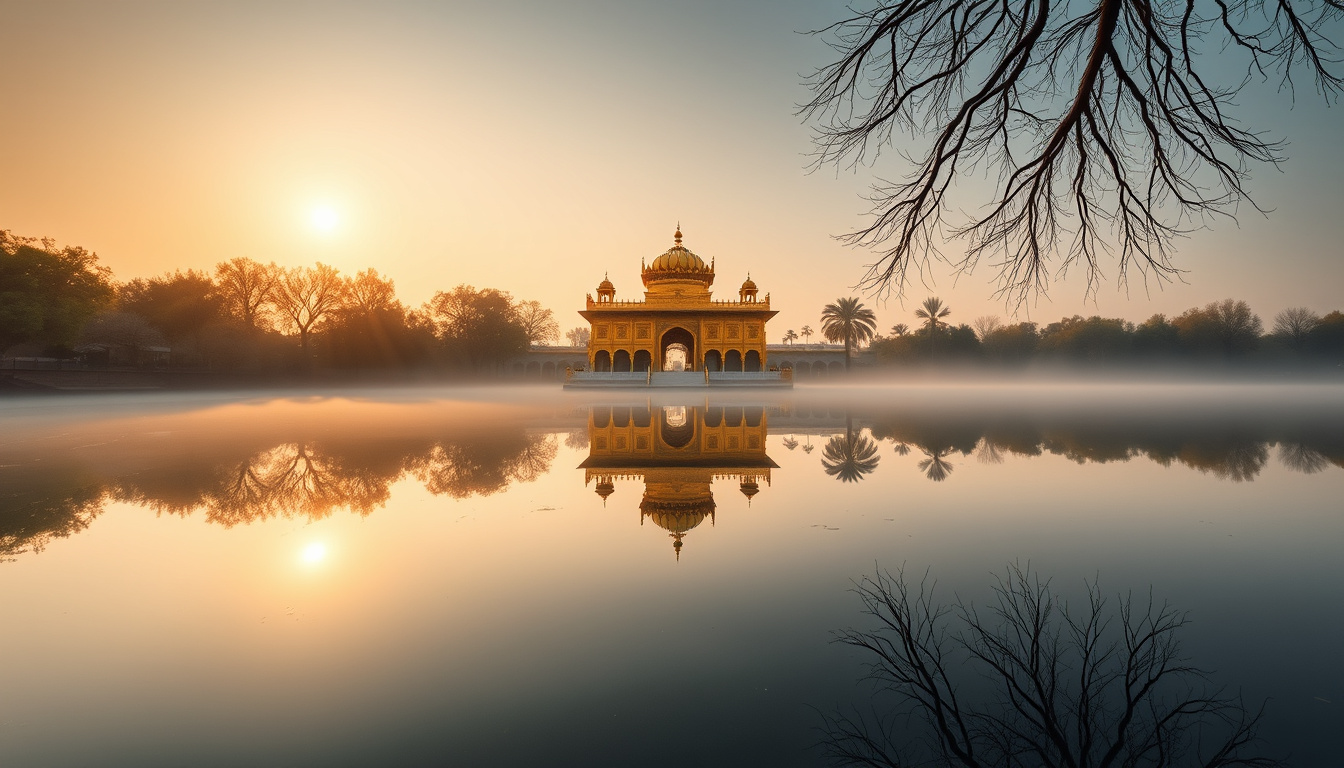
Imagine a teacher who spent more than two decades walking across Asia, determined to show people that spiritual truth doesn’t belong to any one religion. That was Guru Nanak, the founder of Sikhism, born in 1469 in what is now Pakistan.
Born: 1469 · Died: 1539 · Founder of: Sikhism · Hymns Composed: 974
Quick snapshot
- Guru Nanak was born in 1469 and died in 1539 (Encyclopaedia Britannica (reference work))
- He founded Sikhism (Encyclopaedia Britannica)
- He married Mata Sulakhni and had two sons (Wikipedia (user-contributed encyclopedia))
- He composed hymns that became part of the Guru Granth Sahib (Encyclopaedia Britannica)
- Exact details of the meat‑eating incident (Wikipedia)
- Whether Guru Nanak performed literal miracles or these are symbolic stories (SikhiWiki (Sikh community wiki))
- Authenticity of some Janamsakhi accounts (Wikipedia)
- Claims about multiple wives are not supported by reliable historical evidence (Encyclopaedia Britannica)
- The exact extent and duration of his travels are not fully documented (Internet Archive PDF: Guru Nanak His Life Time And Teachings (archival biography))
- 1469 – Born in Talwandi (now Nankana Sahib, Pakistan) (Encyclopaedia Britannica)
- 1499 – Enlightenment at the river Bein (Wikipedia)
- 1500‑1521 – First udasi (travel) across South Asia (Internet Archive PDF)
- 1521‑1539 – Settled in Kartarpur; established community (Encyclopaedia Britannica)
- 1539 – Died; appointed Guru Angad as successor (Encyclopaedia Britannica)
- Guru Nanak’s teachings continue to inspire interfaith dialogue and social reform worldwide (BBC Religion (public broadcaster))
- His legacy lives on through the ten Gurus and the Guru Granth Sahib (Wikipedia)
- Celebrated globally on Guru Nanak Gurpurab (SikhiWiki)
Seven key facts, one pattern: every statistic points to a life of consistent purpose.
| Attribute | Value |
|---|---|
| Born | 15 April 1469, Talwandi, Punjab (now Nankana Sahib, Pakistan) |
| Died | 22 September 1539, Kartarpur, Punjab (now Pakistan) |
| Founder of | Sikhism |
| Spouse | Mata Sulakhni |
| Children | Sri Chand and Lakhmi Das |
| Hymns in Guru Granth Sahib | 974 |
| Age at death | 70 |
What is Guru Nanak famous for?
Guru Nanak is best known as the founder of Sikhism, a monotheistic religion that emphasizes equality, service, and meditation on the divine name. BBC Religion (public broadcaster) calls him “one of the greatest religious innovators of all time.” His 974 hymns, preserved in the Guru Granth Sahib, form the core scripture of Sikhism.
What is Guru Nanak’s famous quote?
“There is no Hindu, there is no Muslim.”
– Guru Nanak, upon enlightenment
This succinct declaration cuts through centuries of religious division. Encyclopaedia Britannica (reference work) notes that Guru Nanak’s message “transcended the boundaries of Hindu and Muslim traditions.”
What did Guru Nanak say about Muhammad?
There is no verified direct statement from Guru Nanak about the Prophet Muhammad. Traditional Janamsakhi accounts sometimes include narratives where Guru Nanak acknowledges Islamic prophets, but these are not considered historically reliable by most scholars (Wikipedia (user-contributed encyclopedia)).
Did Guru Nanak talk to God?
Early hagiographical writings describe Guru Nanak’s encounter with the Divine at the river Bein. Encyclopaedia Britannica characterizes this experience as “a direct mystical union” rather than a literal conversation. The event is central to Sikh tradition but its exact nature remains a matter of faith.
Is there a real photo of Guru Nanak?
No contemporary portrait exists. The iconic image of Guru Nanak—seated in meditation, wearing a simple robe—is a later artistic rendering. SikhiWiki (Sikh community wiki) states that “no authentic image from his lifetime has survived.”
What miracles did Guru Nanak do?
Many miracle stories appear in the Janamsakhis: calming a storm, stopping a rolling stone, feeding the hungry. Yet BBC Religion emphasizes that “Sikhism focuses on Guru Nanak’s teachings rather than miracles.” The consensus among historians is that these tales are symbolic, not literal.
Bottom line: Guru Nanak is famous not for supernatural feats but for a radical message of human unity that still resonates today. For students of religion, the takeaway is his rejection of empty ritual; for believers, the core is devotion to one God.
Was Guru Nanak a Hindu?
Guru Nanak was born into a Hindu Khatri family in 1469 (Encyclopaedia Britannica (reference work)). But from an early age he challenged many Hindu practices, including idol worship and the caste system. BBC Religion (public broadcaster) describes him as “not a typical Sant” because he experienced the divine as both present within and beyond the self, breaking the mould of contemporary devotional movements.
Which God did Guru Nanak worship?
Guru Nanak taught the oneness of God (Ik Onkar), a singular creator beyond any specific deity. Encyclopaedia Britannica notes that Sikhism is explicitly monotheistic and “rejects the worship of any being other than the One God.” He did not worship Ram, Krishna, or any Hindu avatar as supreme.
Did Guru Nanak worship Ram?
No. Guru Nanak’s writings reference Ram as a manifestation of God in some hymns, but he consistently pointed toward the formless divine beyond all names (Wikipedia (user-contributed encyclopedia)). His goal was to unite, not to pick sides.
Bottom line: Guru Nanak was not a Hindu in the orthodox sense. His core teaching—that truth belongs to no single tradition—makes the question itself a bit of a trap. For those raised in either Hindu or Muslim homes, his path offered a third way: direct experience of the one God.
Why did Guru Nanak eat meat?
Accounts differ. Some Janamsakhi stories portray Guru Nanak as a vegetarian; others say he occasionally ate meat to challenge rigid dietary taboos. Wikipedia (user-contributed encyclopedia) notes that the issue “remains a matter of debate among Sikhs.” The meat‑eating incident is often cited to illustrate his teaching that inner purity matters more than external rules.
By breaking a religious food rule, Guru Nanak forced his followers to ask: is holiness about what you put in your mouth, or how you treat your neighbor? For modern Sikhs, the lesson is that compassion matters more than compliance.
How many wives did Guru Nanak have?
Historical consensus is that Guru Nanak married one woman, Mata Sulakhni. The couple had two sons, Sri Chand and Lakhmi Das (Encyclopaedia Britannica (reference work)). Wikipedia (user-contributed encyclopedia) states that “claims of multiple wives are not supported by reliable historical evidence.” Some later myths attribute extra wives, but these are dismissed by scholars as later fabrications.
What miracles did Guru Nanak do?
As noted earlier, miracle stories abound in the Janamsakhis. BBC Religion (public broadcaster) emphasizes that “Sikh tradition downplays miracles in favour of his teachings.” The pattern is consistent: the Guru himself warned against seeking supernatural powers.
If Guru Nanak were remembered mainly for miracles, his message of equality and service might have been forgotten. Instead, Sikhism flourishes because it prizes ethical living over spectacle.
Did Guru Nanak talk to God?
As mentioned, the river Bein experience is described as a mystical union. SikhiWiki (Sikh community wiki) says that after three days in the river, Nanak emerged with the words “There is no Hindu, there is no Muslim.” Whether this was a literal conversation remains a matter of faith, not historical proof.
Bottom line: For those curious about miracles, the real miracle is that one man’s ideas—without armies or money—created a world religion that today has over 25 million followers. The legacy is not the stories, but the practices of equality, honesty, and sharing.
Timeline of Guru Nanak’s life
Five critical junctures, one arc: from birth to enlightenment to community-building.
- 1469 – Born in Talwandi (now Nankana Sahib, Pakistan) (Encyclopaedia Britannica)
- 1499 – Enlightenment at the river Bein; declared “There is no Hindu, there is no Muslim” (Wikipedia)
- 1500–1521 – First udasi (travel) across South Asia and the Middle East (Internet Archive PDF: Guru Nanak His Life Time And Teachings)
- 1521–1539 – Settled in Kartarpur; established the first Sikh community and composed hymns (Encyclopaedia Britannica)
- 1539 – Died in Kartarpur; appointed Guru Angad as his successor (Encyclopaedia Britannica)
Bottom line: The timeline shows a clear arc from ordinary birth to global mission. For travelers, the lesson is that a single life, properly lived, can change the course of history without ever wielding a sword.
Clarity check
Confirmed facts
- Guru Nanak was born in 1469 and died in 1539 (Encyclopaedia Britannica).
- He founded Sikhism (Encyclopaedia Britannica).
- He married Mata Sulakhni and had two sons, Sri Chand and Lakhmi Das (Wikipedia).
- He composed 974 hymns that form part of the Guru Granth Sahib (Encyclopaedia Britannica).
What remains unclear
- Whether Guru Nanak performed literal miracles or these are symbolic stories (SikhiWiki).
- The exact details of the meat‑eating incident (Wikipedia).
- The authenticity of some Janamsakhi accounts (Wikipedia).
- Claims about multiple wives are not supported by reliable historical evidence (Encyclopaedia Britannica).
- The precise itinerary and duration of his extensive travels (Internet Archive PDF).
The pattern: historians agree on the core facts, but the details of miracles and personal choices remain contested — a reminder that even the holiest lives are filtered through the lens of storytelling.
Voices on Guru Nanak
“There is no Hindu, there is no Muslim.”
– Guru Nanak, upon enlightenment
“He is one of the greatest religious innovators of all time.”
– BBC Religion (public broadcaster) Source
What these voices share is a conviction that Guru Nanak’s message was not merely historical but a living challenge to divide.
Summary
Guru Nanak’s life—spanning just 70 years—produced a faith that now guides millions. He refused to let religion become a wall, insisting instead that truth belongs to no single tradition. For the modern world, where religious boundaries still spark conflict, Guru Nanak’s example is not a historical curiosity but a living challenge. For anyone seeking a path beyond tribalism, the choice is clear: embrace the oneness he taught, or remain trapped in the divisions he spent his whole life dismantling.
Related reading: Shreya Ghoshal: Biography, Age, Husband, and Career
britannica.com, britannica.com, scribd.com, dlshq.org, en.wikibooks.org, hi.wikipedia.org, vedantu.com
Frequently asked questions
What is the birthplace of Guru Nanak?
He was born in Rai Bhoi di Talwandi, now Nankana Sahib, Pakistan, in 1469 (Encyclopaedia Britannica).
How did Guru Nanak die?
He died in Kartarpur, Punjab (now Pakistan) on 22 September 1539, at age 70. His passing is called jyoti jot—the merging of his light with the Divine (Wikipedia).
What is the Mool Mantar?
The Mool Mantar is the opening verse of the Guru Granth Sahib, written by Guru Nanak. It begins “Ik Onkar” (One God) and summarizes the core beliefs of Sikhism (Encyclopaedia Britannica).
Who are the Ten Gurus of Sikhism?
The ten Gurus are the spiritual teachers of Sikhism, starting with Guru Nanak and ending with Guru Gobind Singh, who then installed the Guru Granth Sahib as the eternal Guru (BBC Religion).
What is the significance of Guru Nanak’s travels?
His travels (udasis) spread his message of equality and oneness across South Asia and the Middle East, planting the seeds for a global faith (Internet Archive PDF).
How is Guru Nanak’s birthday celebrated?
Guru Nanak Gurpurab is celebrated with processions, prayers, Langar (community meals), and hymn singing. It falls on Kartik Purnima in the Nanakshahi calendar (SikhiWiki).
These answers reflect the enduring curiosity about a figure whose life continues to inspire questions.
Related stories





Craig Newton is Senior Reporter at ScopePress.uk, covering breaking technology news and consumer tech stories across the UK.