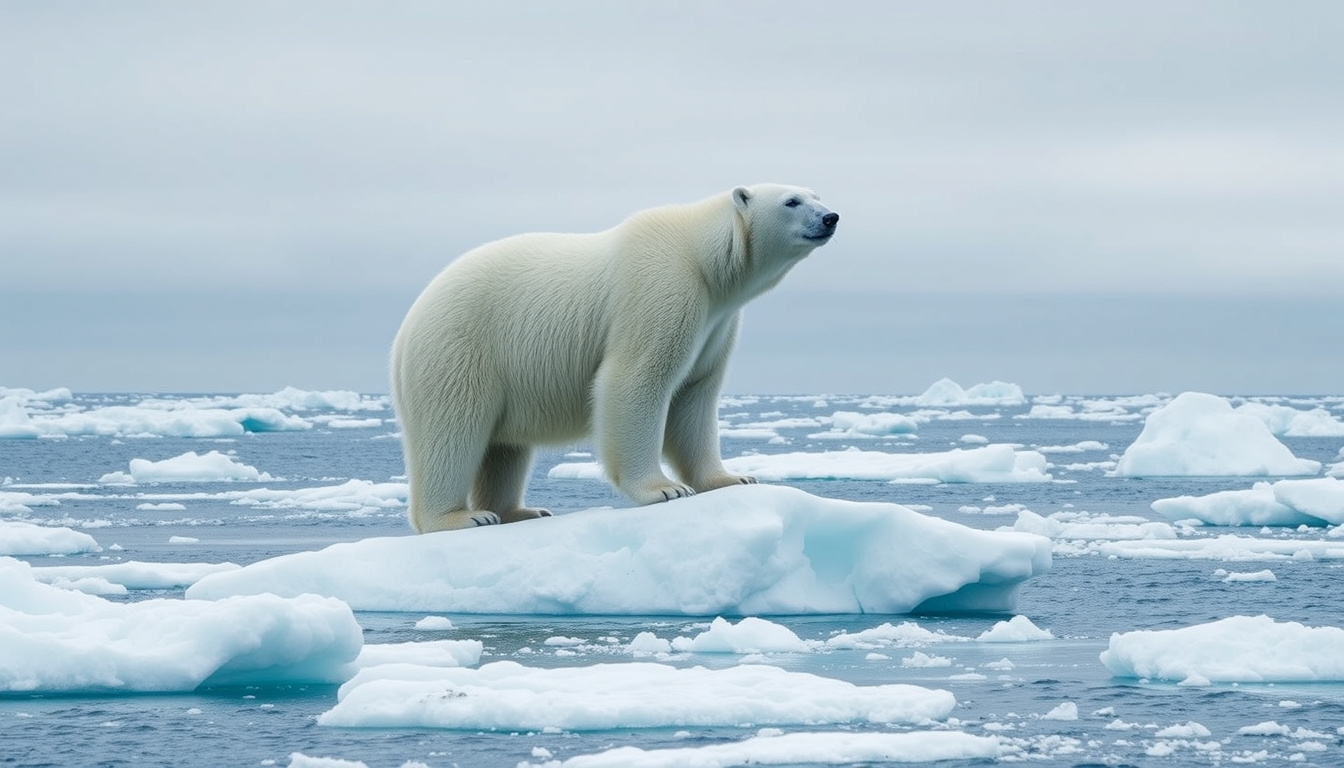
There’s a reason the polar bear is the Arctic’s undisputed heavyweight champion — but with the ice melting beneath its paws, even this king of the north is fighting for survival. Spanning nearly three meters from nose to tail and tipping the scales at 700 kilograms, Ursus maritimus is the largest land carnivore on Earth.
Adult male weight: 350–700 kg (770–1,540 lb) ·
Adult female weight: 150–300 kg (330–660 lb) ·
Current global population: ~26,000 (estimated) ·
IUCN Red List status: Vulnerable ·
Primary threat: Sea ice loss due to climate change ·
Top speed on land: 40 km/h (25 mph)
Quick snapshot
- Largest land carnivore — males up to 700 kg (Polar Bears International)
- Global estimate: 22,000–31,000 individuals (WWF)
- Exact trend across all 19–20 subpopulations varies (Polar Bear Agreement)
- How well polar bears can adapt to longer ice-free seasons (U.S. Marine Mammal Commission)
- 2008: Listed as Threatened under U.S. Endangered Species Act (U.S. Marine Mammal Commission)
- 2015: IUCN assesses as Vulnerable at ~26,000 (IUCN)
- Mid-century projections: >30% population reduction possible under severe warming (IUCN)
- Oil spills and industrial disturbance add pressure (U.S. Marine Mammal Commission)
Nine key numbers in one place — the table below captures the polar bear’s vital statistics at a glance.
| Attribute | Value |
|---|---|
| Scientific name | Ursus maritimus |
| Average male weight | 350–700 kg (770–1,540 lb) |
| Average female weight | 150–300 kg (330–660 lb) |
| Length (nose to tail) | 2.4–3.0 m (7.9–9.8 ft) |
| Shoulder height | 1.2–1.6 m (3.9–5.2 ft) |
| Lifespan | 25–30 years (wild) |
| Top speed (land) | 40 km/h (25 mph) |
| IUCN Red List status | Vulnerable (2015 assessment) |
| Estimated global population | 22,000–31,000 (approx. 26,000) |
What are 5 facts about polar bears?
Fact #1: Polar bears are the largest land carnivore on Earth. Adult males typically weigh 350–700 kg, with some exceptionally large individuals exceeding 800 kg. Females are about half that size at 150–300 kg.
Fact #2: Their entire survival depends on sea ice. Polar bears hunt seals — mainly ringed and bearded seals — from the ice platform. Without it, they cannot access their primary prey.
The polar bear’s specialization as a marine mammal that hunts from ice means that every degree of Arctic warming directly shrinks its hunting grounds — not just its range, but its food supply.
Fact #3: Their range is circumpolar. Polar bears inhabit the Arctic regions of Canada, Alaska (U.S.), Greenland (Denmark), Russia, and Norway (including Svalbard).
Fact #4: That white coat is a disguise. Polar bear fur appears white, but the individual hairs are transparent and hollow. Beneath it, the skin is black, which helps absorb solar radiation.
Fact #5: They are classified as Vulnerable by the IUCN. The 2015 assessment estimated the global population at roughly 26,000 individuals across 19 subpopulations, some of which are declining while others remain stable.
The pattern: every one of these facts ties back to a single constraint — ice. Polar bears are not generalists. They are hyper-specialized predators of a habitat that is shrinking year by year.
How many polar bears are left?
What is the current population estimate?
The commonly cited global population estimate is 22,000–31,000 polar bears, with the most frequently used midpoint around 26,000 individuals. The status page reports that the Arctic-wide total is approximately 26,000 across 20 subpopulations.
How many polar bears are there in each subpopulation?
Not all subpopulations are faring equally. Data from the Polar Bear Agreement shows that some subpopulations — such as the Western Hudson Bay group — have declined by an estimated 27% over five years. The Southern Beaufort Sea population reportedly dropped by about 40% between 2001 and 2010. Other subpopulations in less ice-impacted regions appear stable.
Are polar bears endangered or threatened?
Polar bears are listed as Vulnerable on the IUCN Red List (2015 assessment) and as Threatened under the U.S. Endangered Species Act (since 2008). The distinction matters: “Vulnerable” means the species faces a high risk of endangerment in the wild, while “Threatened” under U.S. law means it is likely to become endangered in the foreseeable future.
How does a polar bear compare to a grizzly bear?
Size and weight differences
Polar bears are the larger species by a significant margin. Adult male polar bears weigh 350–700 kg, while adult male grizzlies (brown bears) weigh 180–360 kg.
One key structural difference: grizzly bears have a prominent shoulder hump — a mass of muscle for digging — while polar bears have a longer neck, an adaptation for reaching seals on the ice.
| Attribute | Polar bear | Grizzly bear |
|---|---|---|
| Male weight range | 350–700 kg | 180–360 kg |
| Shoulder height | 1.2–1.6 m | 0.9–1.5 m |
| Body length | 2.4–3.0 m | 1.8–2.4 m |
| Diet | Primarily carnivorous (seals) | Omnivorous (berries, fish, mammals) |
| Shoulder hump | No | Yes |
| Neck length | Long, slender | Short, thick |
The implication: polar bears are built for ice hunting; grizzlies are built for terrestrial versatility.
Behavior and aggression
Grizzly bears are generally considered more aggressive when defending territory or cubs, while polar bears tend to avoid conflict on land — partly because they are less adapted for terrestrial combat. However, hungry polar bears are increasingly approaching human settlements for food.
Habitat and range overlap
The two species’ ranges overlap in parts of Canada and Alaska, particularly along the Arctic coast where tundra meets sea ice. As sea ice retreats, polar bears are forced onto land for longer periods, increasing the chance of encounters with grizzly bears.
The trade-off: polar bears are heavier and more specialized for marine hunting; grizzlies are faster, more defensive, and far more adaptable to different food sources. In a warming Arctic, adaptability may matter more than raw size.
What’s bigger, a Kodiak or a polar bear?
Kodiak bear size versus polar bear size
This is the heavyweight title match of the bear world. Polar bears are generally considered the largest bear species overall, but Kodiak bears — the largest subspecies of brown bear, confined to the Kodiak Archipelago in Alaska — can reach comparable weights.
Adult male Kodiaks average 450–680 kg, with the heaviest recorded specimens reaching 795 kg.
Record weights and measurements
The largest reliably recorded polar bear weighed 1,002 kg (2,209 lb) — a male shot in Alaska in 1960. The largest Kodiak on record weighed approximately 795 kg (1,753 lb). While individual Kodiaks can rival polar bears in sheer bulk, the polar bear’s average size — and its record maximum — gives it the edge.
What this means: on an average day, the polar bear is bigger. On the rare day a massive Kodiak male steps onto the scale, it’s close enough to call a draw. For anyone tracking body size as a survival advantage, the polar bear’s larger frame is offset by the Kodiak’s richer, more reliable food supply.
What is a polar bear’s worst enemy?
Natural predators and threats
Adult polar bears have no natural predators aside from humans. Cubs may occasionally be killed by wolves or other bears, but a full-grown polar bear sits at the top of the Arctic food chain.
Human impact and hunting
Humans pose the most direct threat through hunting (legal subsistence harvest and illegal poaching), lethal response to human-polar bear conflict, and industrial disturbance from oil and gas development.
Climate change as the primary long-term enemy
Climate change is the single biggest threat to polar bear survival. The IUCN’s 2022 assessment states that sea-ice habitat loss due to climate warming is the most serious long-term threat. The U.S. Marine Mammal Commission agrees, citing predicted sea-ice loss and associated prey-base loss as the primary concern.
Polar bears evolved for ice. The Arctic is warming nearly four times faster than the global average. For the polar bear, the enemy is not a predator — it is the disappearance of the platform that feeds it.
Oil spills, contaminants in the food chain, unsustainable removals, denning-habitat loss, disease, and increasing Arctic ship traffic add compounding pressure.
Timeline: Key moments in polar bear conservation
- 1973 — International Agreement on the Conservation of Polar Bears signed by five Arctic nations. (Polar Bear Handbook for Arctic Guides)
- 2008 — Polar bear listed as Threatened under the U.S. Endangered Species Act.
- 2015 — IUCN reassesses polar bear as Vulnerable; population estimate updated to ~26,000.
- 2020s — Multiple studies project significant decline by mid-century if sea ice loss continues.
- 2050 (projected) — Some models suggest a >30% population reduction possible under severe warming scenarios.
What’s confirmed — and what’s still unclear
Confirmed facts
- Polar bears are the largest land carnivore.
- Sea ice is essential for their seal hunting strategy.
- Global population is currently estimated at around 26,000.
- Climate change is the primary threat to their habitat.
What’s unclear
- Exact population trends across all 19–20 subpopulations remain uncertain.
- Precise year of potential extinction varies by climate model.
- How well polar bears can adapt to longer ice-free seasons.
Expert perspectives
“The loss of sea ice habitat from climate change is the biggest threat to polar bear survival.”
— WWF
“The single biggest threat to polar bear survival is sea-ice habitat loss from climate change.”
“The primary threat to polar bears is predicted sea-ice loss and associated prey-base loss.”
— U.S. Marine Mammal Commission
“New assessment highlights climate change [as] the most serious threat to polar bear survival.”
— IUCN, 2022 assessment
The consequence is not theoretical. Subpopulations in Western Hudson Bay and the Southern Beaufort Sea have already declined sharply. For the bears in the most ice-depleted regions, the question is no longer whether the ice will disappear — it is how fast, and how long they can last without it.
truenorthbrief.com, en.wikipedia.org, wwf.org.uk, thegwpf.org, ielc.libguides.com, gbif.org, czechobserver.com
Frequently asked questions
How fast can a polar bear swim?
Polar bears are strong swimmers, capable of reaching speeds of about 10 km/h (6 mph) in water. They have been recorded swimming continuously for hundreds of kilometers in search of ice or land.
What do polar bears eat besides seals?
While ringed and bearded seals make up the bulk of their diet, polar bears are opportunistic scavengers. They will eat bird eggs, carrion, small mammals, and even vegetation when seals are unavailable — but they are physiologically adapted for a high-fat, protein-rich marine diet.
How long do polar bears live?
In the wild, polar bears typically live 25–30 years. In captivity, some have survived into their early 40s.
Where do polar bears sleep?
Polar bears sleep on the sea ice or on land, digging shallow depressions in the snow or earth. During storms, they curl up with their back to the wind to conserve heat.
Do polar bears hibernate?
Only pregnant females enter a true hibernation-like state — denning in snow caves over winter to give birth and nurse cubs. Males and non-pregnant females remain active year-round, though they may enter a state of “walking hibernation” during food scarcity.
Can polar bears survive in warmer climates?
Polar bears are highly specialized for cold: their dense fur, thick blubber layer, and black skin for heat absorption make them poorly suited to sustained warm temperatures. Overheating is a genuine risk when they are forced onto land in summer.
What is the difference between a polar bear and an ice bear?
“Ice bear” is an informal name for the polar bear (Ursus maritimus), referring to its reliance on sea ice. There is no separate species — the same animal by a different name.
Related stories





Craig Newton is Senior Reporter at ScopePress.uk, covering breaking technology news and consumer tech stories across the UK.