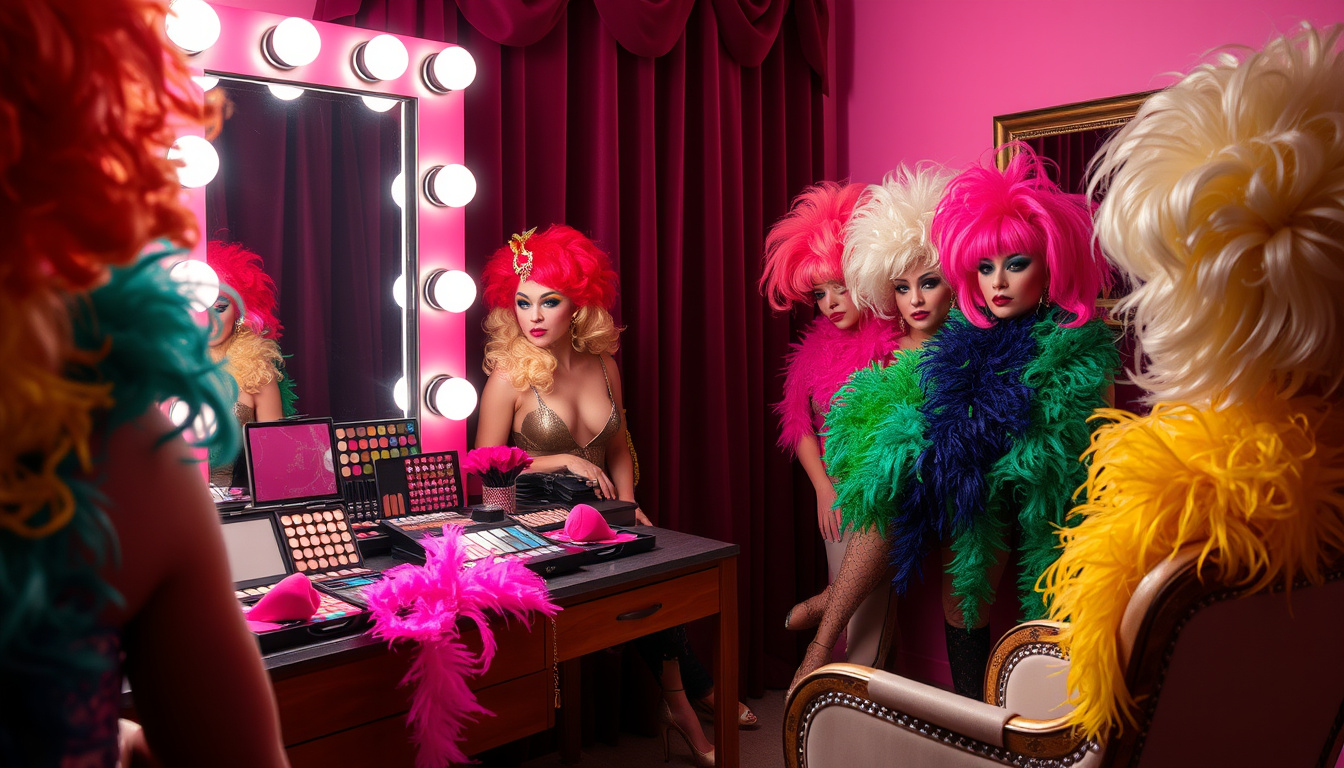
You’ve probably seen a drag queen on TV, at a pride parade, or in a headline — but the line between performance art and personal identity often blurs. Drag has roots that stretch back centuries, yet today it sits at the center of heated legal debates. This guide breaks down what a drag queen actually is, where the term came from, and why misconceptions persist — with facts you can trust.
Definition: A drag queen is a person who uses clothing and makeup to exaggerate female gender signifiers for entertainment. ·
Etymology: The term “drag” likely originated from 19th-century theater slang for wearing women’s clothing, as in “wearing a drag.” ·
Legal status: Drag shows are protected under the First Amendment as artistic expression.
Quick snapshot
- A drag queen is a performer who exaggerates female gender signifiers (BBC Bitesize (educational resource))
- Not necessarily transgender or gay (National Center for Lesbian Rights (LGBTQ+ legal advocacy))
- Roots in 19th-century theater, balls, and performance (National Geographic (history and culture publication))
- Modern popularity surged with RuPaul’s Drag Race (GLAD Law (LGBTQ+ legal organization))
- Protected as free speech under the First Amendment in the U.S. (Columbia Journal of Law & the Arts (academic legal journal))
- Recent anti-drag legislation in several states (Harvard Law Review (legal scholarship))
- Drag queens and transgender women are different (GLAD Law (LGBTQ+ legal organization))
- Drag shows usually do not involve stripping (National Center for Lesbian Rights (LGBTQ+ legal advocacy))
Four facts about drag, one pattern: every claim connects performance, identity, and legal rights — yet gets tangled in public conversation.
| Label | Value |
|---|---|
| Etymology | Term “drag” from 19th-century theater slang (BBC Bitesize, educational resource) |
| First documented performance | 1860s American minstrel shows (female impersonators) (National Geographic, history and culture publication) |
| Legal protection | First Amendment (U.S.) (Harvard Law Review, legal scholarship) |
| Famous drag queen | RuPaul (global icon) (GLAD Law, LGBTQ+ legal organization) |
What is a drag queen?
Core definition
- A drag queen is a performer who uses exaggerated feminine clothing, makeup, and mannerisms for entertainment, protest, or artistic expression (BBC Bitesize, educational resource).
- The National Center for Lesbian Rights describes drag as “many things” but not inherently tied to sexual orientation or gender identity (National Center for Lesbian Rights (LGBTQ+ legal advocacy)).
Drag queens exist in a space where performance and identity meet, but the public often conflates the two. The first step to understanding is separating the act from the person.
Characteristics of a drag queen
- Drag queens typically adopt a stage name and persona, often with hyper-feminine presentation.
- Performances involve lip-syncing, comedy, dance, and spoken word — rarely stripping (National Center for Lesbian Rights, LGBTQ+ legal advocacy).
- GLAD Law highlights drag as a “transgressive art form tied to resistance against traditional gender norms” (GLAD Law (LGBTQ+ legal organization)).
Historical emergence
Modern drag traces important roots to 19th-century and early-20th-century performance traditions including vaudeville, burlesque, and female impersonation acts (National Geographic (history and culture publication)). Late-19th-century Harlem balls hosted by Black performers are described as a key origin point for modern drag culture. The Hamilton Lodge ball in Harlem, dating to 1867, is identified as a possible first drag competition (Struthers Library Theatre (arts archive)).
The implication: drag did not emerge from a single source but grew across continents and communities, each adding a layer to what we now recognize as drag culture.
Why is it called drag?
Theatrical origins
- The term “drag” likely came from 19th-century theater slang for wearing women’s clothing, as in “wearing a drag” (BBC Bitesize, educational resource).
- British history sources identify Princess Seraphina as an early historical drag figure in England (BBC Bitesize, educational resource).
Alternative theories
Some suggest the term originated from the sensation of a long dress “dragging” on the floor, but this is speculative. The exact origin of the term is unclear (BBC Bitesize, educational resource).
What this means: even the word “drag” carries a theatrical past that predates modern associations with LGBTQ+ identity.
Is drag part of the LGBTQ community?
Historical ties
- Drag has been integral to LGBTQ+ culture since at least the early 20th century. Stonewall in 1969 is widely described as a pivotal moment that included drag queens among the people resisting police raids (BBC Bitesize, educational resource).
- Police raids on queer spaces through the mid-20th century often targeted drag queens, trans women, and others who defied gender norms (GLAD Law, LGBTQ+ legal organization).
Drag as queer expression
Advocacy groups widely recognize drag performers as a visible part of LGBTQ+ culture and a vehicle for acceptance and expression (National Center for Lesbian Rights, LGBTQ+ legal advocacy). However, drag itself is not synonymous with being gay, lesbian, bisexual, or transgender — it is a performance art.
Drag and trans identity
A common confusion: drag queens are not necessarily transgender women. Transgender women are people who identify as women, while drag queens adopt exaggerated femininity as a role. GLAD Law notes that conflating the two erases both the performance aspect of drag and the lived experience of trans people (GLAD Law, LGBTQ+ legal organization).
The pattern: drag thrives within LGBTQ+ spaces because it challenges gender norms — but it is not an identity marker by itself.
Who can do drag? Women, straight men, and others
Can a straight woman do drag?
- Yes. Women can perform as drag queens, often called bio queens or AFAB queens (BBC Bitesize, educational resource).
- Drag is not limited by gender or sexuality. The National Center for Lesbian Rights states that drag “belongs to anyone who chooses to perform it” (National Center for Lesbian Rights, LGBTQ+ legal advocacy).
Can a woman be a drag queen?
Yes — though the term “drag king” is more common for performers who adopt exaggerated masculine presentation, some women do identify as drag queens. The key distinction is performance, not biological sex.
Are drag queens usually straight men?
No single rule applies. Many drag queens are gay men, but heterosexual men also perform. Sexual orientation varies widely among drag performers. The only constant is the performance of exaggerated gender (National Center for Lesbian Rights, LGBTQ+ legal advocacy).
The trade-off: the word “queen” implies femininity, not sexuality — a nuance that often gets lost.
Do drag shows involve stripping?
Typical drag performances
- Most drag shows do not involve stripping; they focus on lip-sync, comedy, and dance (National Center for Lesbian Rights, LGBTQ+ legal advocacy).
- Stripping may occur in adult revues but is not inherent to drag.
Legal distinctions
This distinction matters for legal battles. Anti-drag legislation often relies on conflating drag with “adult cabaret” performances. Columbia’s legal analysis points out that Tennessee’s law targeted “male or female impersonators” in public settings, which a federal court found likely unconstitutional because it discriminated against viewpoints related to gender identity (Columbia Journal of Law & the Arts (academic legal journal)).
Why this matters: the myth of stripping is often used to justify censorship. The data shows drag is primarily theatrical, not sexual.
Can ladyboys get pregnant?
Understanding ladyboys (kathoey)
- Ladyboys, or kathoey, are a third-gender category in Thailand typically describing transgender women or effeminate gay men (Wikipedia (encyclopedic reference)).
- They are not drag queens. Drag queens are performers; ladyboys are a cultural gender identity.
Myths about transgender pregnancy
Pregnancy is not biologically possible for male-assigned individuals. The question arises from confusion between drag and transgender identity — a distinction that needs clarity in public discourse (GLAD Law, LGBTQ+ legal organization).
The catch: myths like this persist because the line between performance, identity, and biology is rarely explained plainly.
Timeline of drag queen history
- 19th century — Pantomime dames and female impersonators in theater (National Geographic, history and culture publication)
- 1920s–1930s — Drag balls in Harlem, underground queer culture (National Geographic, history and culture publication)
- 1970s — Mainstream visibility with Rocky Horror Picture Show
- 1990s — RuPaul reaches mainstream fame (GLAD Law, LGBTQ+ legal organization)
- 2020s — Anti-drag bills introduced in multiple U.S. states (Harvard Law Review (legal scholarship))
What’s clear and what’s not
Confirmed facts
- Drag queens are performers who exaggerate female gender signifiers (BBC Bitesize, educational resource)
- Etymology from 19th-century theater slang (BBC Bitesize, educational resource)
- Drag is protected speech under the First Amendment (Harvard Law Review, legal scholarship)
What’s unclear
- Exact origin of the term “drag” (BBC Bitesize, educational resource)
- Number of active drag queens worldwide
Voices on drag
“A drag queen is commonly understood as a performer who adopts exaggerated gender presentation, usually feminine, for entertainment, protest, or artistic expression.”
“Drag is many things — a crime is not one of them. Drag shows are expressive conduct protected by free speech principles.”
— National Center for Lesbian Rights (LGBTQ+ legal advocacy)
For LGBTQ+ advocates and performers, the choice is clear: continue defending drag as protected expression, or risk losing ground in the ongoing fight for free speech.
myresourcecenter.org, reddit.com, lgbtqandall.com, pmc.ncbi.nlm.nih.gov, facebook.com, noticiasdirecto.com
For a deeper look at the definition and history of drag queens, this article provides additional context on famous performers and the evolution of the art form.
Frequently asked questions
What is the difference between a drag queen and a cross-dresser?
A drag queen performs exaggerated femininity as an art form, while cross-dressing simply means wearing clothing of another gender, often not for performance.
Do drag queens identify as transgender?
Not necessarily. Many drag queens are cisgender men who perform as a character — their gender identity is separate from their stage persona.
How do drag queens choose their stage names?
Stage names often involve wordplay, puns, or references to pop culture. Many queens adopt a first and last name that creates a memorable impression.
Are drag shows appropriate for children?
Many drag shows are family-friendly and focus on comedy, lip-sync, and empowerment. Content varies by event, and organizers usually specify age suitability.
What are the most famous drag queens of all time?
RuPaul is the most globally recognized. Other icons include Divine, Lady Bunny, and performers from RuPaul’s Drag Race like Bianca Del Rio and Bob the Drag Queen.
How has drag influenced mainstream fashion?
Drag aesthetics — dramatic makeup, wigs, extravagant costumes — have influenced runway shows, music videos, and red-carpet looks, blurring the line between camp and couture.
What is the ballroom scene in drag culture?
Ballroom is a queer subculture originating in Harlem, where participants compete in categories like realness, voguing, and runway. It has influenced drag but is a distinct community with its own history.
Related stories





Craig Newton is Senior Reporter at ScopePress.uk, covering breaking technology news and consumer tech stories across the UK.