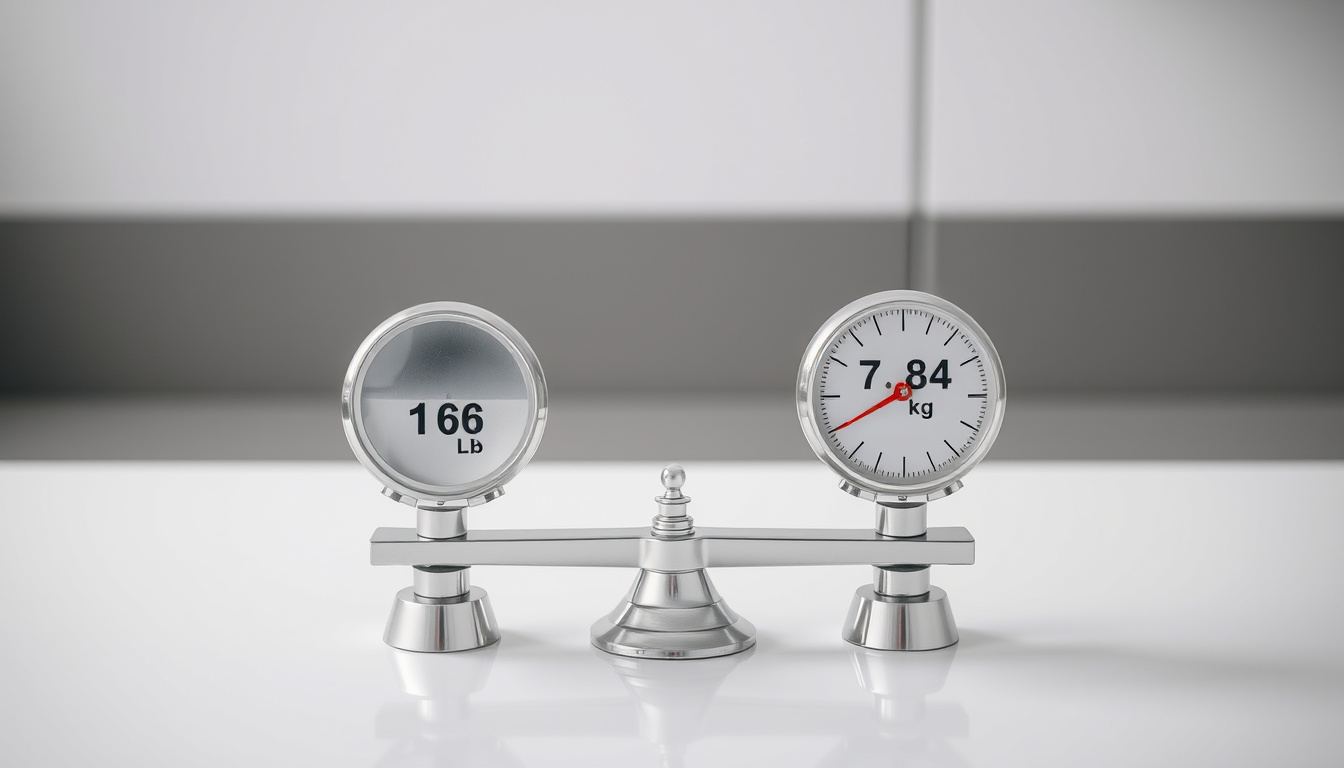
If you’ve ever found yourself staring at a scale in pounds while your doctor or a fitness app works in kilograms, you’re not alone. Converting 165 pounds to kilograms gives you 74.84 kg—and that’s just the starting point. This guide covers the stones equivalent, a direct BMI snapshot for someone 5’4″ tall, and what the numbers actually mean for your health.
165 lbs to kg: 74.84 kg · 165 lbs in stones: 11 stone 11 lbs · 75 kg to lbs: 165.35 lbs · 12 stone to lbs: 168 lbs · 14 stone to lbs: 196 lbs
Quick snapshot
- 165 lbs = 74.8427 kg (CalculateMe.com)
- 1 lb = 0.45359237 kg (CalculateMe.com)
- 1 stone = 14 lbs (Neil’s Toolbox)
- Individual health advice without full medical context
- Muscle mass and frame size variations not captured by BMI alone
- Athlete-specific or pediatric BMI adjustments
- BMI categories standardized: Overweight 25–29.9 (DollarTimes)
- Imperial BMI multiplier 703 in ongoing use (Calculat.io)
- Use the formulas below to convert any weight between systems
- Apply the BMI formula with your own height to find your category
- Consult a healthcare provider for personalized health advice
Three related conversions and the BMI classification for this specific weight-height pairing appear across most conversion charts and health references.
Here are the key data points from verified sources:
| Label | Value |
|---|---|
| 165 lbs to kg | 74.8427 kg |
| Stones and pounds | 11 st 11 lb |
| Reverse: 75 kg to lbs | 165.35 lbs |
| BMI for 5’4″ 165 lbs | 28.3 (overweight) |
How many kg is a 165 lb person?
Conversion formula
The conversion from pounds to kilograms uses a fixed international agreement value: 1 pound equals exactly 0.45359237 kilograms. Multiply any weight in pounds by this factor to get kilograms, or divide kilograms by it to get pounds.
Step-by-step calculation
Formula: kg = lbs × 0.45359237
To convert 165 pounds to kilograms:
- Step 1: Take the weight in pounds (165 lbs)
- Step 2: Multiply by the conversion factor (0.45359237)
- Step 3: 165 × 0.45359237 = 74.8427 kg
The result: 165 pounds equals 74.8427 kilograms (CalculateMe.com). Rounded to two decimal places, that is 74.84 kg—the figure you’ll typically see on conversion charts.
The implication: if you’re converting for medical or fitness purposes where precision matters, use 74.8427 kg. For everyday use, 74.84 kg is perfectly adequate.
What is 165 lbs in stones and pounds?
Stones breakdown
The stone is a traditional UK and Ireland weight unit equal to 14 pounds. To convert 165 lbs to stones, divide by 14: 165 ÷ 14 = 11 remainder 11. That means 165 lbs equals 11 stone 11 lbs (Neil’s Toolbox).
UK weight chart reference
UK weight charts often list ideal weights in stones. For someone 5’4″ (64 inches) tall, the ideal weight range is 7 stone 10 lbs to 10 stone 6 lbs. At 11 stone 11 lbs, 165 lbs sits above that range.
What this means: if you’re used to thinking in stones, 165 lbs is just under 12 stone—roughly 2 stone above the upper end of the healthy range for this height.
Is 165 lbs overweight for 5’4″?
BMI calculation
Body Mass Index (BMI) divides weight by height squared to estimate body fat. The formula differs slightly between imperial (US) and metric units.
Imperial BMI formula: (weight lbs ÷ height inches²) × 703
For someone 5’4″ (64 inches) tall weighing 165 lbs:
- Step 1: Square the height: 64 × 64 = 4,096
- Step 2: Divide weight by height squared: 165 ÷ 4,096 = 0.0403
- Step 3: Multiply by 703: 0.0403 × 703 = 28.32
That gives a BMI of 28.32 (Calculat.io), placing this weight in the overweight category.
A BMI of 28.32 is 3.42 points above the overweight threshold of 25, according to the DollarTimes classification system. For a 5’4″ adult, the healthy weight ceiling is 145.7 lbs—meaning this weight exceeds it by about 19 lbs.
Height-weight categories
BMI categories apply to adults aged 20 and older regardless of sex (DollarTimes):
The standard BMI classification ranges are:
| Category | BMI Range |
|---|---|
| Underweight | Below 18.5 |
| Normal | 18.5 – 24.9 |
| Overweight | 25 – 29.9 |
| Obese | 30 and above |
The pattern: BMI does not distinguish between muscle and fat, so athletes or those with larger frames may score high without health risks. That said, for the general population, a BMI of 28.32 signals being above the healthy range for someone 5’4″ tall.
For comparison, 10 stone 5 lbs (145 lbs) at the same height gives a BMI of 24.9—right at the top of the normal range (Neil’s Toolbox). Losing roughly 19–20 lbs would bring this weight into the healthy zone.
What is 75 kg in lbs?
Reverse conversion
Working backward from the metric side: if 165 lbs equals 74.84 kg, then 75 kg is slightly heavier. Converting 75 kg to pounds: 75 ÷ 0.45359237 = 165.35 lbs.
The catch: 75 kg and 165 lbs are nearly identical, with 75 kg being just 0.35 lbs heavier. This near-equivalence makes it easy to confuse the two directions of conversion—always verify which unit system you’re working in.
Related weights
For quick reference, here are common stone-to-pound equivalents alongside the 75 kg figure:
- 12 stone (UK) = 168 lbs
- 14 stone (UK) = 196 lbs
- 75 kg = 165.35 lbs
Why this matters: when comparing UK weight norms (stones) to US norms (pounds) or metric norms (kg), these equivalences help you navigate different health resources without confusion.
Is 165 pounds a good weight for a woman?
BMI for women
BMI calculation does not differ by sex. The American Cancer Society confirms the same formula applies to men and women. What changes is how individuals interpret the result based on their frame size, muscle mass, and health goals.
Healthy ranges by height
At 5’4″ (64 inches), the healthy weight range spans 107.8 lbs to 145.7 lbs (Calculat.io). For someone 5’5″ (65 inches), the ideal range shifts slightly to 111–150 lbs.
What this means: whether the weight is “good” depends entirely on height and body composition. At 5’4″, 165 lbs falls in the overweight BMI range. At 5’7″ or taller, the same weight might fall in the normal range.
The trade-off: BMI is a screening tool, not a diagnostic. A healthcare provider considers muscle mass, waist circumference, family history, and lifestyle when assessing weight health.
BMI does not account for muscle density, bone mass, or fat distribution. A muscular athlete could easily score overweight or obese by BMI standards despite being in excellent health, according to the Harvard Health BMI chart guidelines.
Step-by-step: How to convert any weight
Whether you’re converting pounds to kilograms for recipes, shipping, or health tracking, the method stays the same.
- Step 1: Identify the weight in pounds you want to convert.
- Step 2: Multiply by 0.45359237 to get kilograms (or divide by 2.20462).
- Step 3: Round to the precision you need—two decimal places for most practical purposes.
For reverse conversion (kg to lbs): multiply kilograms by 2.20462.
- Example: 80 kg × 2.20462 = 176.37 lbs
- Example: 165 lbs × 0.45359237 = 74.84 kg
For stones: divide pounds by 14. The whole number is stones; multiply the remainder by 1 to get remaining pounds.
- Example: 165 ÷ 14 = 11 remainder 11, so 11 stone 11 lbs
- Example: 196 ÷ 14 = 14 exactly, so 14 stone
Confirmed facts
- Conversion factor: 1 lb = 0.45359237 kg
- 165 lbs = 74.8427 kg (verified across multiple calculators)
- 1 stone = 14 pounds
- 165 lbs = 11 st 11 lbs
- BMI overweight threshold: 25
- BMI obese threshold: 30
- Imperial BMI multiplier: 703
- 75 kg = 165.35 lbs (near-identical to 165 lbs)
What remains unclear
- Personalized health advice requires individual medical context
- Muscle mass and frame size adjustments to BMI not included in standard formulas
- Athlete-specific or pediatric BMI calculations differ from standard ranges
“BMI = (your weight in pounds × 703) ÷ (your height in inches × your height in inches).”
— American Cancer Society (health organization, cancer risk prevention guidance)
“Weight 165 lbs is 19.34 lbs more than Healthy Zone Range for Height 5 Feet 4 Inches.”
— Calculat.io (BMI calculator, direct calculation for this weight-height pairing)
For anyone tracking weight in multiple unit systems, the practical choice comes down to the metric system for scientific and medical contexts, the imperial system for US everyday use, and stones for UK traditional contexts. The numbers are all interchangeable once you know the conversion factors. If your health depends on these numbers, work with a provider who can interpret them alongside your full health picture—not just a BMI chart.
Related reading: A3 Size in CM Dimensions · 28 Weeks in Months
neilstoolbox.com, thecalculatorsite.com, calculateme.com, bupa.co.uk, ilbs.in, perinatology.com, calculatorsoup.com
Conversions in this range, such as the 167 lbs to kg yielding 75.75 kg, rely on the same international avoirdupois standard for accuracy.
Frequently asked questions
Is 75 kg heavy for a woman?
Whether 75 kg is heavy depends entirely on height. At 5’4″ (164 cm), 75 kg gives a BMI of about 28.5—overweight. At 5’10” (178 cm), the same weight falls in the normal range. Use the BMI formula with your own height to assess your category.
Is 75 kg overweight?
For an average-height adult (around 5’6″ or 168 cm), 75 kg typically produces a BMI around 26.5, which falls in the overweight category (25–29.9). Taller individuals may find 75 kg falls in their normal range.
Is 11 stone 70 kg?
11 stone 11 lbs equals 165 lbs, which is approximately 75.3 kg. So 11 stone is slightly above 70 kg (70 kg = 10 stone 13.3 lbs). The two units are not interchangeable but are close in value.
What is 12 stone in lbs?
12 stone equals 168 lbs (12 × 14 = 168). This weight at 5’4″ gives a BMI of about 28.8—still in the overweight category, just slightly higher than 165 lbs.
What is 14 stone in pounds?
14 stone equals 196 lbs (14 × 14 = 196). At 5’4″ tall, 14 stone translates to a BMI of about 33.6, placing it in the obese category.
Is 5’4″ and 165 lbs obese?
At 5’4″ (64 inches) and 165 lbs, the BMI is 28.32, which falls in the overweight category (25–29.9), not obese. The obese category starts at BMI 30. However, BMI is a screening tool—individual health assessments should include other factors.
Related stories





Samuel Hart is Devices & Reviews Editor at ScopePress.uk, covering smartphones, laptops, hardware and hands-on reviews.