Every few years, a new generation of fans discovers that Bugs Bunny was playing with identity before anyone had a clean label for the process. Wikipedia’s character history dates Bugs’s proper debut to 1940, but the same history points earlier to 1938’s Porky’s Hare Hunt as a frequent “first” among prototypes. What follows is a tour of that messy record—the confirmed details, the queer-culture commentary, and the gaps that still make Bugs harder to explain than he looks.
First proper debut: 1940 · Earliest prototype: 1938 · Signature phrase: “What’s up, Doc?” · Catchphrase role: greeting, not insult
The fastest way to see why Bugs’s history confuses people is to line up the details that usually get named in the same paragraph.
| Detail | What the record says |
|---|---|
| First proper debut | 1940, according to Wikipedia’s character history. |
| Earliest prototype | Porky’s Hare Hunt (1938) is often cited as the first cartoon to feature what would become Bugs Bunny. |
| Signature phrase | “What’s up, Doc?” is best read as a greeting, not a put-down. |
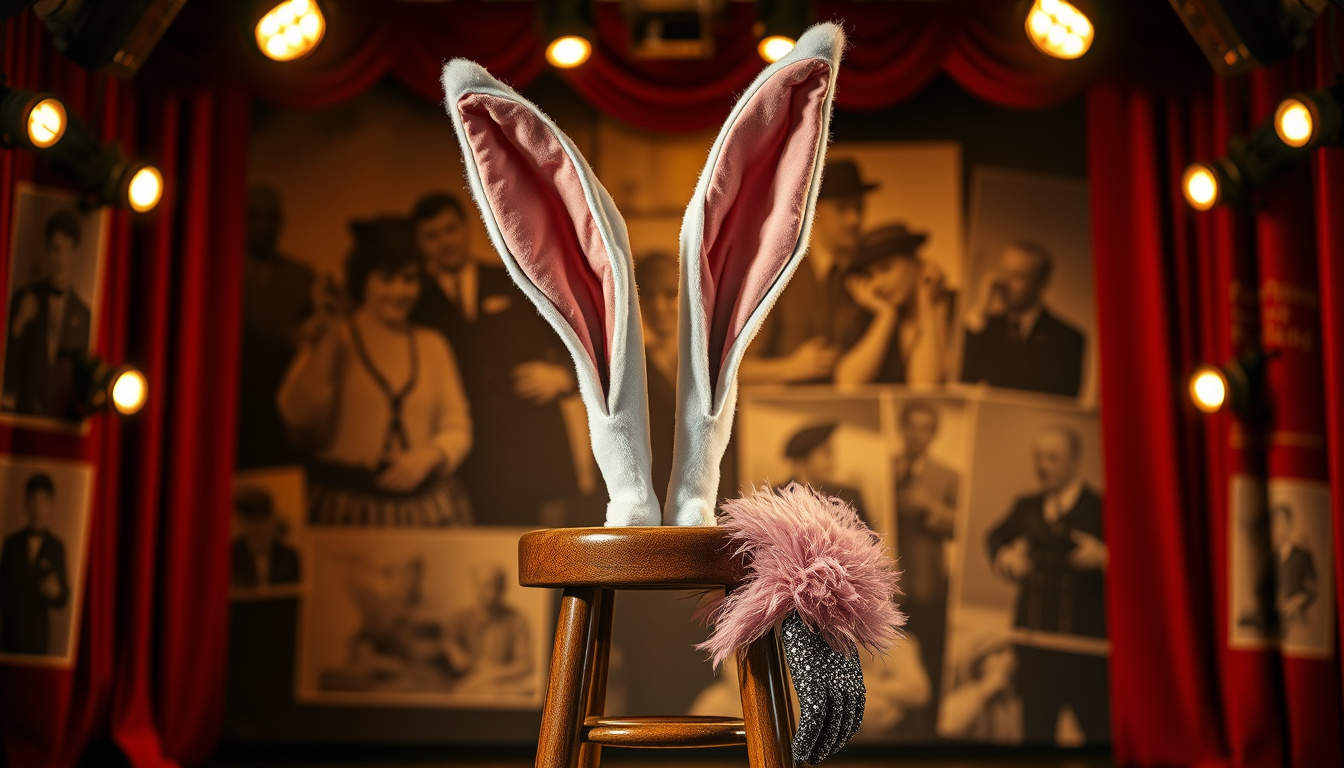
| Standard outfit | Gloves, rabbit feet, and no other clothes. |
| Gender-play history | A 2022 Them.us report says Chuck Jones later used dated language to describe Bugs’s gender. |
| Postage stamp | The same Them.us report notes that a USPS stamp once put Bugs in the Brunhilde costume from “What’s Opera, Doc?” |
The pattern explains itself: Bugs’s biography has always been a production story, not a single clear biography.
Confirmed facts
Porky’s Hare Hunt is often cited as the first cartoon to feature what would become Bugs Bunny, according to Wikipedia’s character history.
The standard historical account places Bugs’s full appearance in 1940, even as earlier cartoons kept shaping his design and gags.
Highsnobiety’s queer-cartoon history points to A Corny Concerto as one example of Bugs in feminine-coded performance clothing.
Them.us reports that Chuck Jones later described Bugs using historical language that has since aged poorly.
From “Porky’s Hare Hunt” to “A Wild Hare”: Sorting Out the Origin
The confusion over “first appearance” starts with the word “appearance” itself. Bugs did not arrive as a finished character; he was assembled across several shorts.
What the record actually says
- 1938’s Porky’s Hare Hunt is often treated as the start of the character model.
- 1940 is the date most often attached to Bugs’s proper debut, according to the same character history.
- Early writers and animators kept changing his design, his voice, and his catchphrase before “What’s up, Doc?” clicked.
So when someone asks when Bugs “really” began, the honest answer is: earlier than you think, and messier than a single title card.
A quick timeline of the familiar beats
- 1938: Porky’s Hare Hunt provides an early rabbit prototype.
- 1940: Bugs comes into his own for the first time in the standard history.
- Later: The catchphrase, the gloves, and the rabbit feet become the recognizable uniform.
That timeline also makes the “What’s up, Doc?” moment feel smaller than it should. The greeting is a line, not a plot. Treating it that way keeps Bugs from shrinking into a single pop-culture catchphrase.
Bugs in Drag: What the Commentaries Actually Say
Bugs’s drag moments do not appear only in fan conversations. Culture outlets, LGBTQ+ publications, and animation histories all keep circling the same short list of examples.
The moments critics name
- Highsnobiety points to Bugs’s feminine-coded performance clothing as a recurring joke.
- Them.us highlights Bugs as Brunhilde in “What’s Opera, Doc?” as an image strong enough to make it onto a stamp.
- Business Insider’s history of queer characters in kids’ animation treats the drag gags as an early example of queerness hiding in plain sight.
The sharpest pattern in the coverage is that different outlets keep returning to the same handful of Bugs moments.
| Moment | What appears on screen | How it gets framed |
|---|---|---|
| A Corny Concerto | Bugs in feminine-coded performance clothing | Highsnobiety cites it as part of a larger pattern, not a one-off joke. |
| “What’s Opera, Doc?” | Bugs performing as Brunhilde | Them.us treats the image as central enough to define a stamp. |
| Bugs Bunny Nips the Nips | Wartime caricatures that have not aged well | Business Insider flags the short as a reminder that the same character archives can both please and offend. |
The comparison matters because it keeps the conversation honest. The same Bugs who could read as a queer icon could also be used in wartime propaganda that modern audiences find uncomfortable.
The Problem Shorts and the Limits of the Label
A better conversation about Bugs as a queer icon has to include the parts that make the label complicated. That does not erase the queer readings; it just places them next to the era’s uglier jokes.
Why “just a cartoon” is not enough
- Business Insider reports that Chuck Jones described some of Bugs’s behavior as comedy rather than character biography.
- That explanation keeps appearing in coverage whenever a modern viewer asks what the animators “meant.”
- Chuck Jones later used dated language when talking about Bugs’s gender, according to Them.us.
Chuck Jones later said he always imagined Bugs as a transexual, using historical language that has since fallen out of favor.
Reported by Them.us
Business Insider reads Jones’s explanation as an attempt to make Bugs funny, not as an official statement about identity.
Based on Business Insider’s animation history
Those two details do not cancel each other out. They explain why “queer icon” and “product of his time” can both be true.
Confirmed vs. Still Debatable: A Cheat Sheet
Bugs’s coverage tends to mix three different categories: production facts, creative intent, and audience interpretation. Separating them helps.
Confirmed in the popular record
- Porky’s Hare Hunt (1938) is frequently named as an early prototype (per Business Insider).
- 1940 is the usual date for Bugs’s proper debut (per Wikipedia).
- Bugs’s standard look includes gloves, rabbit feet, and no other clothes (per character design references).
- “What’s up, Doc?” is usually treated as a greeting, not an insult (per general usage).
What’s unclear or speculative
- Whether Bugs “counts” as part of LGBTQ+ animation history depends on how much weight you put on costumes and performance.
- Neurodivergent-coded readings of Bugs—his fast patter, his obsessive focus on one adversary, his refusal to follow ordinary social rules—are interpretive, not canonical.
- Even the famous “arrested in one episode” detail stays an episode detail, not a running formula.
If a future explainer wants to give readers a fair map, it should mark those boundaries the same way: confirmed facts first, interpretation second, contested context somewhere in between.
What’s Missing From the Bugs Bunny Conversation
The best available coverage is spread across encyclopedia pages, queer-cartoon histories, and nostalgic retrospectives. What does not yet exist is a single guide that separates those threads cleanly.
What a good Bugs Bunny guide would need to include
- A timeline that treats Porky’s Hare Hunt and the 1940 debut as separate moments, not competing winners.
- A section on the problematic shorts, including Bugs Bunny Nips the Nips, with context from Business Insider’s history.
- A clear explanation of how Chuck Jones’s later comments are themselves a historical detail, not an ending.
- Room for “What’s up, Doc?” as a greeting, because so many fans encounter it long before they have seen a full short.
- An honest note that fan interpretations—including neurodivergent and queer readings—are interpretations, not promotional talking points.
That last section is not just a tool for archivists. It decides whether a new fan walks away knowing Bugs only as a catchphrase machine or as one of the most complicated characters in animation history.
Why This Still Matters
How Bugs is described today will shape which old shorts get shown, which jokes get revisited, and whether a new generation hears this as a celebration or a warning. The best outcome is not to remove Bugs from the LGBTQ+ history conversation; it is to keep that conversation careful enough that the history stays visible—including the parts that are hard to defend.
Is Bugs Bunny officially LGBTQ+?
Warner Bros. has not published a single authoritative biography that settles the question. The queer readings come from film history, drag performances, and queer-culture commentary such as Highsnobiety’s retrospective and Business Insider’s history.
What was Bugs Bunny’s first appearance?
Porky’s Hare Hunt (1938) is often described as the first cartoon to feature what would become Bugs Bunny, while the 1940 debut is usually treated as the character’s proper start.
What did Chuck Jones actually say about Bugs’s gender?
According to Them.us, Jones later described Bugs using language that is now considered dated. The statement says more about the era than it does about modern identity labels.
Why do some old Bugs Bunny cartoons get flagged today?
Several wartime shorts, including Bugs Bunny Nips the Nips, rely on caricatures and stereotypes. Business Insider flags those shorts as a reminder that Bugs’s archive contains both breakthroughs and blind spots.
Does “What’s up, Doc?” mean anything?
In popular usage, the line works as a casual greeting—Bugs saying hello in his own confident way, not a joke meant to insult anyone.
Does Bugs Bunny wear clothes?
Bugs usually wears only gloves and rabbit feet in his classic design. Costume and drag performances are the exceptions that turn him into a different kind of comic figure.
cbr.com, britannica.com, messynessychic.com, msumadvocate.com, en.wikipedia.org, srf.ch, lwlies.com, thehardtimes.net
Related stories



Craig Newton is Senior Reporter at ScopePress.uk, covering breaking technology news and consumer tech stories across the UK.