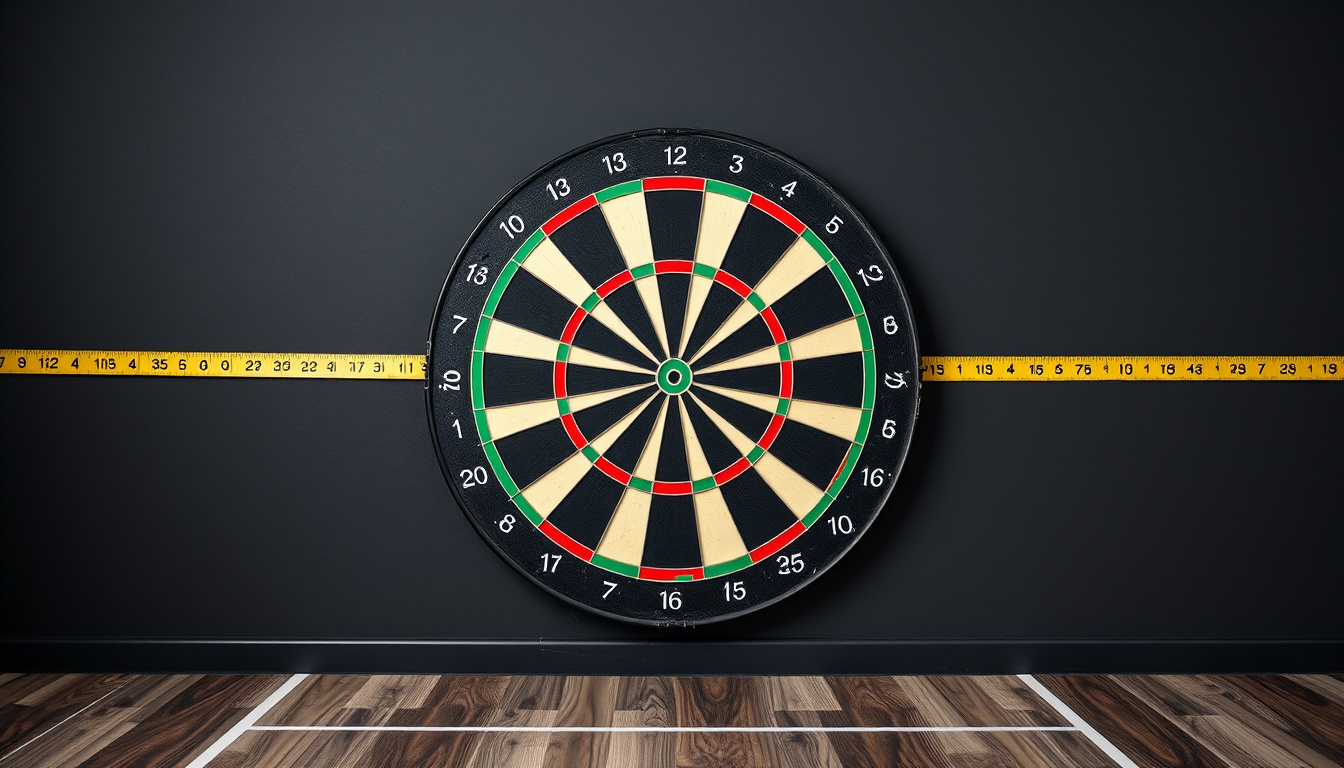
There’s something quietly satisfying about setting up a dartboard perfectly—that first thud of a steel tip hitting the bullseye just where it should. But if you’ve ever stood in a hallway, tape measure in hand, second-guessing whether it’s 237 centimeters or 238, you’re not alone. The good news: getting a regulation setup right is simpler than most guides make it sound, once you know the exact reference points. This guide walks you through the official distance, height, and measuring method for steel-tip, soft-tip, and wheelchair darts, with a few practical details that most quick guides skip.
Steel-tip distance
237 cm (7 ft 9.25 in)
From face of board to front of oche
Soft-tip distance
244 cm (8 ft)
From face of board to front of oche
Bullseye height
173 cm (5 ft 8 in)
From floor to center of bullseye
Reference point
Center of bullseye
Used for both height and horizontal distance
If you’re setting up a board for the first time, the most common mistake is measuring from the wall or from the back of the board, which adds a couple of centimeters and throws off your throw. The official rule is clear: the distance is measured from the face of the board—the surface you actually throw at—to the front edge of the oche.
Official dartboard measurements at a glance
| Measurement | Official Value | Notes |
|---|---|---|
| Official throwing distance (steel-tip) | 237 cm (7 ft 9.25 in) | Measured horizontally from the face of the board to the oche (throw line). |
| Official board height (center of bullseye) | 173 cm (5 ft 8 in) from the floor | Measured vertically from the floor to the center of the bullseye—not the top or bottom of the board. |
| Distance to oche (throw line) | Varies by game type | Steel-tip: 237 cm; soft-tip: 244 cm (8 ft); wheelchair: 244 cm (8 ft) with a modified stance allowance. |
| Standard measurement reference | Center of the bullseye | The bullseye center is the reference point for both height and horizontal distance. |
| In feet and inches (steel-tip) | 7 ft 9.25 in | Often rounded to “7 ft 9.25 in” or “7 ft 9 in” in casual guides. |
| Measurement point | Front face of the board | Not the wall behind it—measure from the playing surface, not the mounting hardware. |
The oche: why 237 cm is the magic number for steel-tip
For steel-tip darts, the official throwing distance is 237 cm (7 ft 9.25 in) from the face of the board to the front edge of the oche. This measurement is used in official tournaments and is the standard reference for competitive play.
There’s a common misconception that the distance might be different for soft-tip darts. For soft-tip, the official distance is 244 cm (8 ft), which is slightly longer than steel-tip. If you’re setting up a board for both games, you’ll need to either mark two different oche positions or use a movable oche stick.
For wheelchair users, the official setup changes subtly: the board height remains 173 cm, but the throwing distance is 244 cm (8 ft) from the board face to the front edge of the oche. Some wheelchair darts variations may use a reduced bullseye height of 137 cm (4 ft 6 in) while keeping the throwing distance at 237 cm (7 ft 9.25 in), depending on the league rules.
Some guides specify the oche as the front edge of the throw line, not its back edge. This distinction matters: if you measure from the back edge, you’ll add a couple of centimeters to your throwing distance, which can subtly change your throw’s angle and accuracy. The rule is simple: measure from the front of the oche—the edge you’re not allowed to cross—to the face of the board.
Board height: the 173 cm bullseye rule
The regulation height for a dartboard is measured from the floor to the center of the bullseye, not from the top or bottom of the board. The official value is 173 cm (5 ft 8 in) for all dart types—steel-tip, soft-tip, and wheelchair setups. This measurement is consistent across boards, and it’s the reference point used by most setup guides for vertical measurement.
It also means the board’s center aligns with the most comfortable sightline for most players, whether you’re a beginner or a seasoned competitor. The measurement is taken from the floor, not from the top of the board—so if you’re using a cabinet or a wall-mounted bracket, always check from the floor to the center of the bullseye, not from the top edge of the board.
One detail that often trips people up: the bullseye center must be 173 cm from the floor, and the board surface should be flush against the wall, not tilted. A tilted board changes the effective distance and the angle of your throw, which is why the regulation setup emphasizes a perfectly vertical board. According to Darts Guides (a UK-based setup reference), the vertical measurement is taken from the floor to the center of the bullseye, and any tilt—even a few degrees—can alter the throw line’s perceived distance.
How to measure: step-by-step
To get a regulation setup right, follow these steps:
- Use a laser level or a tape measure from the floor to the bullseye center, not the top of the board. The bullseye center must be 173 cm (5 ft 8 in) from the floor.
- From the face of the board (not the wall), measure horizontally to the point where you want the front edge of the oche to be. For steel-tip, that’s 237 cm; for soft-tip and wheelchair, it’s 244 cm.
- Ensure the board is perfectly vertical. A tilted board changes the distance from the oche to the bullseye and affects your throw.
If you’re using a cabinet or a surround, remember that the measurement is from the board’s playing face—the surface you throw at—not from the back of the cabinet. The front face of the board is the reference point, regardless of the mounting hardware.
There’s also the question of whether the distance is measured from the bullseye or from the board’s center. In practice, the bullseye is the center of the board, so measuring from the center of the bullseye to the oche is the standard approach. The measurement is taken from the front face of the board, not the wall behind it, and the oche is the line you must not cross with your feet.
Soft-tip and wheelchair darts: the distance difference that matters
If you’re setting up a soft-tip board, the distance changes to 244 cm (8 ft). This is a significant difference—about 7 cm more than steel-tip—and it affects your aim and throwing power. The board height remains 173 cm, but the throwing distance is 244 cm (8 ft). The key is to keep the board height consistent at 173 cm, and adjust only the throwing distance.
Some home setups use a slightly lower or higher bullseye for comfort, but if you’re playing by official rules, 173 cm is non-negotiable. The measurement is taken from the floor to the center of the bullseye, not from the top of the board. If you’re using a wall-mounted bracket, check the distance from the floor to the bullseye center, not the top edge of the board.
If you’re measuring from the floor, use a laser level to ensure the tape measure is perfectly vertical. A slight angle in the tape measure can add a few millimeters, which is enough to make a difference in a competitive setting. And if you’re using a cabinet with a surround, remember that the measurement is from the playing face of the board, not from the back of the surround.
Common measurement mistakes to avoid
Even experienced players make measurement errors, especially when setting up a board in a new location. Here are the most common pitfalls:
- Measuring from the wall instead of the board face: If your board is mounted on a bracket or a foam surround, the distance from the wall to the board face can be 2-3 cm. Always measure from the playing surface.
- Not accounting for board tilt: A board that’s tilted even slightly will change the distance from the oche to the bullseye. Ensure the board is perfectly vertical.
- Measuring the bullseye height from the top of the board: The height is measured from the floor to the center of the bullseye, not the top edge. If you’re using a tape measure, be precise.
One question that occasionally comes up is whether the distance can be measured from the center of the bullseye to the oche in a straight line, rather than horizontally. The answer is no—the official measurement is a horizontal line from the face of the board to the front of the oche. A diagonal measurement (often cited as about 9 ft 7⅜ in to 9 ft 7½ in, roughly 2.93 m) can be used as a quick verification check, but it is not the official measurement method.
There’s also a myth that the distance should be measured from the back of the board’s cabinet. This is incorrect—the cabinet is just the housing, and the playing face is the reference point. The front face of the board is the only surface that matters for the throw line measurement.
Confirmed facts
To cut through the noise, here are the confirmed facts from the official guides and reputable sources:
- The official throwing distance for steel-tip darts is 237 cm (7 ft 9.25 in), measured from the face of the board to the front of the oche.
- The official board height for all darts is 173 cm (5 ft 8 in) from the floor to the center of the bullseye.
- The distance is measured from the front face of the board—the playing surface—not from the wall behind it.
- For soft-tip darts, the distance is 244 cm (8 ft), which is longer than steel-tip.
- For wheelchair darts, the board height remains 173 cm, and the throwing distance is 244 cm (8 ft), with some variations allowing a lower bullseye height of 137 cm (4 ft 6 in) depending on league rules.
If you’re setting up a board for tournament play, these are the numbers to use.
Why the measurements are what they are
While the basic setup is straightforward, there are a few details that most guides skip. For example, why is the steel-tip distance 237 cm and not a round number? The reason is historical: the distance is derived from the original British standard of 7 ft 9.25 in, which converts to approximately 236.86 cm—often rounded to 237 cm in metric guides. Some guides state the exact metric conversion as 2.3688 m rather than the rounded 2.37 m.
Another detail: the measurement is taken from the center of the bullseye, not from the top or bottom of the board. This is why many guides say “center of the bullseye” rather than “center of the board.” The bullseye is the reference point for both height and distance, and it’s the point you’re aiming at, so it makes sense as the reference.
There’s also the question of whether the board should be tilted slightly for a better view. The official rule is no—the board must be perfectly vertical. This is why the board’s height can feel higher than you expect—you’re aiming at the center, not the top. Several setup guides describe the regulation board as 451 mm in diameter, which is a detail worth knowing if you’re mounting a board in a tight space.
Related reading: Adidas Shoes: Complete Guide for Women, Men & Ireland Buyers · Personal Trainer Costs in Ireland: Rates, Worth & Frequency
gldproducts.com, dartrankings.co.uk, networldsports.com, apollostemplates.com, thedartguide.com, dartsdaily.net, anglejournal.uk, globaldatabase.ecpat.org, anglepress.co.uk, maximillianogameroom.net, pandataps.com, britishreport.uk
Frequently asked questions
What is the official distance for steel-tip darts?
The official distance for steel-tip darts is 237 cm (7 ft 9.25 in) from the face of the board to the front edge of the oche.
What height should the bullseye be from the floor?
The center of the bullseye must be 173 cm (5 ft 8 in) from the floor, measured vertically from the floor to the center of the bullseye.
How is the distance measured—from the wall or the board face?
The distance is measured from the front face of the board—the playing surface—not from the wall behind it. The board face is the reference point for all horizontal measurements.
Is the distance different for soft-tip darts?
Yes. Soft-tip darts use a longer throw line of 244 cm (8 ft), which is about 7 cm longer than steel-tip. The board height remains 173 cm.
Are wheelchair dartboard measurements different?
For wheelchair darts, the board height remains 173 cm, and the throwing distance is 244 cm (8 ft). Some wheelchair variations may use a lower bullseye height of 137 cm (4 ft 6 in) while keeping the throwing distance at 237 cm, depending on the league rules.
What is the diagonal measurement for a quick check?
The diagonal check measurement often cited for steel-tip setup is about 9 ft 7⅜ in to 9 ft 7½ in (roughly 2.93 m), measured from the bullseye center to the front edge of the oche. This is a verification tool, not the official measurement.
Bottom line: A regulation dartboard setup is straightforward once you know the reference points: bullseye at 173 cm from the floor, oche at 237 cm (steel-tip) or 244 cm (soft-tip/wheelchair) from the board face. Measure from the bullseye center, not the top of the board, and always from the board’s play surface—not the wall. Keep the board perfectly vertical, and you’ll have a setup that meets official standards.
Related stories




Craig Newton is Senior Reporter at ScopePress.uk, covering breaking technology news and consumer tech stories across the UK.