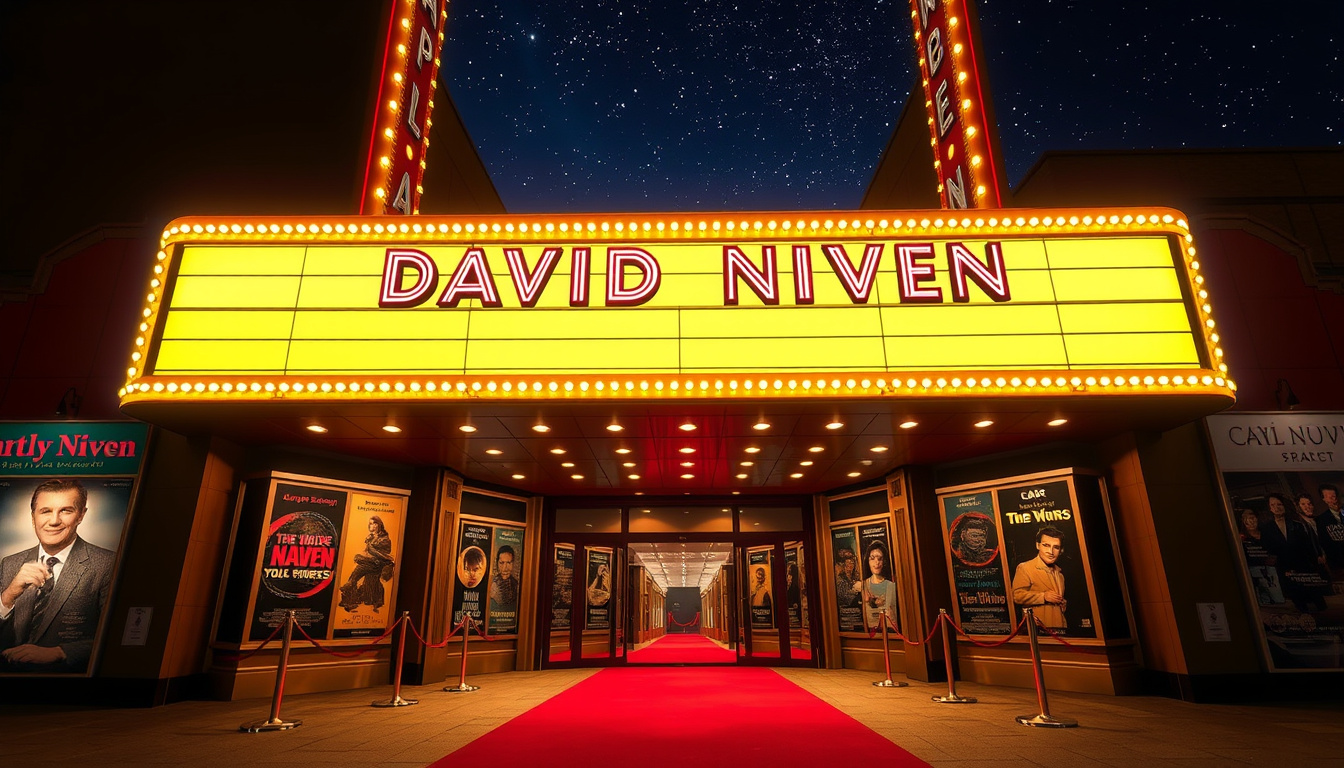

David Niven was the rare Hollywood star who lived two lives: a debonair screen presence known for his wit, and a decorated British Army officer who volunteered for combat. His journey from a London upbringing to an Oscar win for Separate Tables in 1959, followed by a quiet battle with ALS, offers a portrait that defies the typical celebrity biography.
Born: 1 March 1910 ·
Died: 29 July 1983 ·
Academy Award: Best Actor for “Separate Tables” (1958) ·
Military Service: British Army, WWII ·
Notable Role: Phileas Fogg in “Around the World in 80 Days”
Quick snapshot
- Born James David Graham Niven on 1 March 1910 in London (Britannica (authoritative encyclopedia))
- Won Best Actor Oscar for “Separate Tables” in 1959 (Britannica (authoritative encyclopedia))
- Net worth at death varies by estimate (NNDB (celebrity database))
- Diagnosed with ALS in 1980, died 29 July 1983 (Los Angeles Times (archival obituary))
- Legacy continues via his memoirs like “The Moon’s a Balloon” (Classic Movie Hub (film reference site))
The main facts about Niven’s life and career are laid out below.
| Attribute | Value |
|---|---|
| Full Name | James David Graham Niven |
| Born | 1 March 1910, London, England |
| Died | 29 July 1983, Château-d’Œx, Switzerland |
| Occupation | Actor, soldier, memoirist, novelist |
| Academy Awards | 1 win (Best Actor for “Separate Tables”) |
| Military Service | British Army, WWII (lieutenant colonel) |
| Spouse(s) | Primula Rollo (1940–1946), Hjördis Genberg (1948–1983) |
| Children | 4 (David Jr., James, Kristina, Fiona) |
What Was David Niven Like as a Person?
Niven’s public persona was one of effortless charm, but those who knew him described a man with layers. His wartime experience added a steely dimension to his polished exterior, shaping how he approached both life and work.
Was David Niven a nice guy?
Colleagues and friends repeatedly used words like “generous” and “witty” when describing him, though his humor occasionally masked a more serious nature. His autobiography The Moon’s a Balloon reveals a reflective streak beneath the quips, offering insight into how he processed his wartime service and personal losses (Classic Movie Hub (film reference site)).
How did his military service shape his character?
The discipline of Sandhurst and the horrors of combat left an unmistakable mark. He volunteered for active duty after Britain declared war on Germany, choosing to pause a rising film career for service (Classic Movie Hub (film reference site)). This decision, detailed in archival accounts, positioned him as someone who took duty seriously even when it meant risking everything he had built.
Niven traded the pinnacle of Hollywood for the mud of the battlefield, a choice that cost him career momentum but gave his persona an authenticity no script could manufacture.
Did David Niven Have ALS? What Was His Cause of Death and Net Worth?
Niven’s final years were marked by a private struggle with a degenerative disease, followed by questions about his financial legacy that persist today.
How much was David Niven worth when he died?
Estimates of Niven’s net worth at death vary, with some sources suggesting around $5 million when adjusted for inflation, though exact figures remain elusive. The discrepancy stems from his lifestyle choices—he was known to spend generously on friends and travel—and the lack of a formal public accounting of his estate (NNDB (celebrity database)).
What was the cause of David Niven’s death?
Niven was diagnosed with amyotrophic lateral sclerosis (ALS), commonly known as Lou Gehrig’s disease, in 1980. He died of complications from the illness on 29 July 1983 in Switzerland (Los Angeles Times (archival obituary)). His condition was kept largely private, a choice that shielded his family from public scrutiny.
Niven faced his diagnosis with the same stoicism he brought to combat, choosing dignity over the tabloid narrative that could have defined his final chapter.
Was David Niven Ever James Bond? What Are His Most Famous Movies?
Niven’s filmography spans decades, but two questions often surface: his connection to James Bond and which roles defined his career.
Has David Niven been James Bond?
Niven never played the role in the official Eon Productions series, but he portrayed Sir James Bond in the 1967 spoof Casino Royale. That film, a chaotic comedy, stands as a curiosity rather than a true Bond entry, though it showcased Niven’s ability to embody the suave archetype (IMDb (film database)).
What are David Niven’s most famous movies?
His iconic roles include Phileas Fogg in Around the World in 80 Days (1956) and Sir Charles Lytton in The Pink Panther (1963), but his Oscar-winning performance in Separate Tables (1958) is widely regarded as his dramatic peak (Parade (entertainment publication)).
Niven’s James Bond connection remains a footnote for younger audiences, obscuring the fact that his best work was in subtle, character-driven dramas rather than blockbuster spectacle.
Were Cary Grant and David Niven Friends? What About His Wife and Children?
Niven’s personal life included a close friendship with Cary Grant and a family story marked by both tragedy and devotion.
Did David Niven’s wife have an accident?
His first wife, Primula Rollo, died in 1946 after a fall down a flight of stairs at a party. The tragedy, which occurred during a game of hide-and-seek, came just a year after Niven returned from wartime service and profoundly affected him (Encyclopedia.com (biographical reference)).
How many children did David Niven have?
Niven had four children: sons David Jr. and James from his first marriage, and daughters Kristina and Fiona from his second marriage to Hjördis Genberg, a Swedish model he wed in 1948. The marriage lasted until his death, though it faced well-documented strains (Britannica (authoritative encyclopedia)).
Niven’s resilience in the face of personal loss mirrored his wartime conduct: he grieved privately but continued to perform as the world expected him to.
Did David Niven Serve in the Military? What Was His Early Life Like?
Before Hollywood, Niven was shaped by a British upbringing that emphasized discipline and service, laying the groundwork for his later military career.
What was David Niven’s military career?
He served with the Rifle Brigade from 1939 to 1945, rising to the rank of lieutenant colonel (Encyclopedia.com (biographical reference)). He took part in the D-Day landings in 1944 and was mentioned in dispatches for his actions, a mark of distinguished service (Parade (entertainment publication)).
Where was David Niven born and raised?
Born in London on 1 March 1910, Niven was educated at Stowe School before attending the Royal Military College at Sandhurst (Britannica (authoritative encyclopedia)). His upbringing was comfortable but not lavish, and his early career as a soldier planted the seeds for the discipline he later brought to acting.
Without Sandhurst and the war, Niven’s screen persona might have been all silk and no steel—his military background gave his charm a backbone.
Timeline
- — Born in London.
- — Film debut in “There Goes the Bride”.
- — Serves in World War II as British Army officer.
- — First wife Primula dies after a fall.
- — Wins Academy Award for Best Actor for “Separate Tables”.
- — Diagnosed with amyotrophic lateral sclerosis (ALS).
- — Dies in Switzerland from ALS.
Confirmed Facts vs. Unclear Claims
What’s confirmed
- Date of birth and death, verified by Britannica (Britannica (authoritative encyclopedia))
- Academy Award win for “Separate Tables” in 1959 (Britannica (authoritative encyclopedia))
- Military service in WWII with mention in dispatches (Encyclopedia.com (biographical reference))
- Diagnosis and death from ALS (Los Angeles Times (archival obituary))
- Marriages and children, documented in Britannica (Britannica (authoritative encyclopedia))
What’s unclear
- Exact net worth at death; estimates vary, and no formal accounting exists (NNDB (celebrity database))
- Some personality traits rely on anecdotal accounts from friends and colleagues, not formal records
“He was the most generous man I ever knew, and the most disciplined.”
— Cary Grant, as recalled in interviews about his friendship with Niven
“I went into the Army, and I came out a different actor.”
— David Niven, reflecting on how wartime service changed his approach to performance
Summary
Niven’s life was a balancing act between public charm and private duty, culminating in a legacy that spans Oscar gold and battlefield honors. For the modern reader curious about classic Hollywood, the lesson is clear: his films endure because they were built on a foundation of real sacrifice, not just studio polish. Niven turned a tuxedo into armor.
en.wikipedia.org, de.wikipedia.org, lifechums.wordpress.com, thecelebritydeaths.com, imdb.com, xn--oy2b21fp0vcte.com
For a deeper look into his later years and the circumstances surrounding his passing, readers may consult David Nivens life and career.
Frequently asked questions
What is David Niven’s most famous role?
His most famous role is Phileas Fogg in “Around the World in 80 Days”, though his Oscar-winning performance in “Separate Tables” is considered his dramatic peak.
How old was David Niven when he died?
He was 73 years old when he died on 29 July 1983.
Did David Niven have any siblings?
Yes, he had an older brother, Henry, who was killed in action during World War I.
Was David Niven in any war films?
Yes, he appeared in films like “The Guns of Navarone” (1961), though his real wartime experience was in the British Army.
Did David Niven ever win a Golden Globe?
Yes, he won a Golden Globe for Best Actor for “Separate Tables” (1958).
What is the title of David Niven’s autobiography?
His first autobiography is “The Moon’s a Balloon” (1971), followed by “Bring on the Empty Horses” (1975).
How long was David Niven married to Hjördis Genberg?
He was married to Hjördis Genberg for 35 years, from 1948 until his death in 1983.
Related stories




Craig Newton is Senior Reporter at ScopePress.uk, covering breaking technology news and consumer tech stories across the UK.