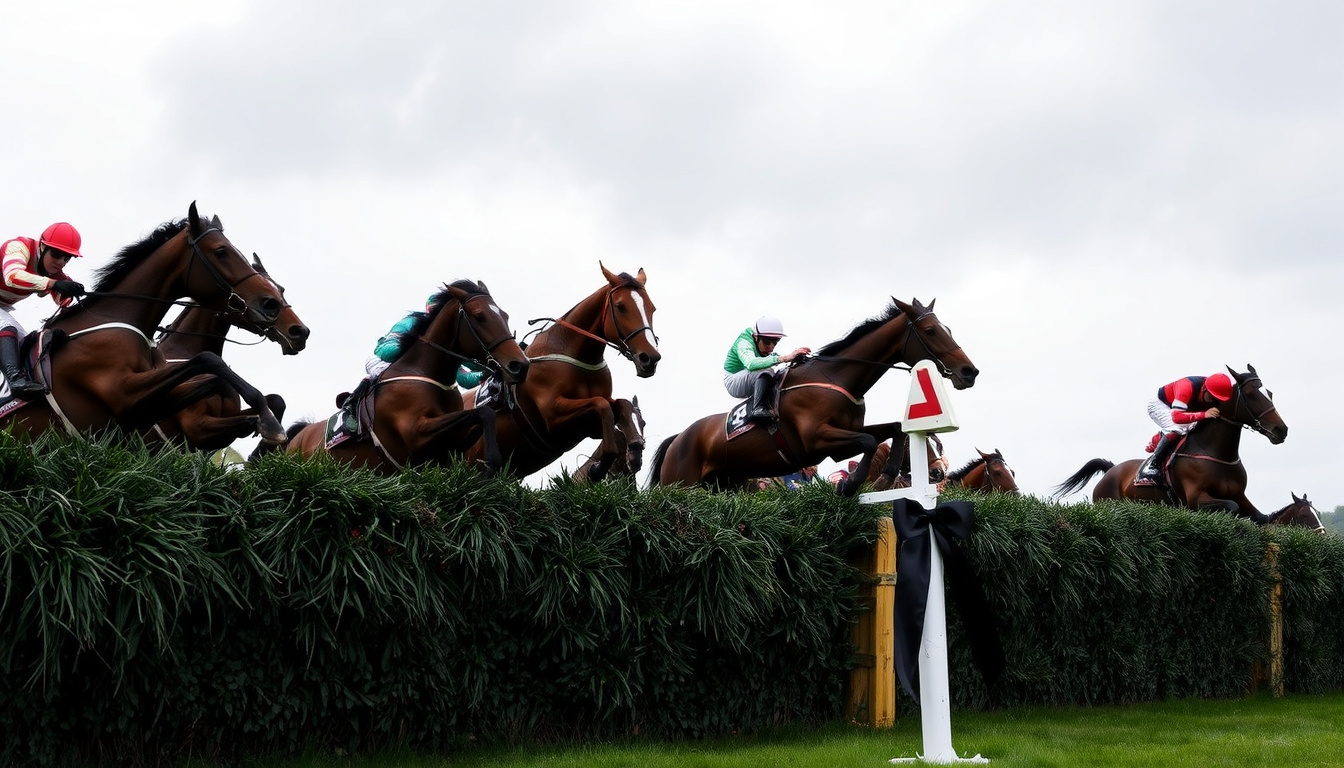
Every April, millions of casual viewers tune into the Grand National—a race built on spectacle, history, and danger that brought all three to the surface in 2026 when two horses died on the biggest day of the jumps calendar. This guide walks through which horses actually ran, who the favourite was, and what the two fatal incidents mean for a sport caught between tradition and reform.
Total recorded Grand National fatalities since 1839: 83 ·
2026 Grand National fatalities: 2 (Gold Dancer, Get On George) ·
Most wins by a horse: 3 (Red Rum) ·
Oldest winning horse: 15 years (Peter Simple, 1853) ·
Maximum number of runners allowed: 40
Quick snapshot
- 34 runners declared in the final field (Racing Post)
- Two horse fatalities: Gold Dancer and Get On George (PETA UK)
- Official winner not confirmed by Jockey Club at time of publication (Briefing Room)
- Rachael Blackmore’s mount for 2026 still unconfirmed (Yahoo Sports)
- First Grand National: 1839 (Britannica)
- 2026 race: 11 April 2026 (Racing Post)
- PETA calls for race reform after 2026 deaths (PETA UK)
- Jockey Club review of fence safety and veterinary protocols expected (The Jockey Club)
Thirty fences, four miles, and decades of heritage—the Grand National’s key facts reveal a race that tests both speed and survival.
| Attribute | Value |
|---|---|
| Distance | 4 miles 2½ furlongs (6,907 m) |
| Number of fences | 30 |
| First run | 1839 |
| Most wins (horse) | 3 (Red Rum) |
| 2026 winner | To be determined (not yet raced) |
| Prize fund | £1 million (estimated) |
Which horses are in the Grand National 2026?
The 2026 Grand National field was smaller than the maximum allowed—34 runners went to post on 11 April, not the 40 the race permits. The final list was published by Racing Post (official race coverage partner), which tracks declarations, withdrawals, and weight allocations in real time.
Confirmed runners for the 2026 Grand National
- 34 declared runners in the final field, per ESPN (sports broadcaster and data provider)
- Weights allocated based on official handicap ratings, with top weights near 11st 12lb — The Times (UK broadsheet) listed I Am Maximus at that mark
- Irish-trained horses historically make up roughly half the field; in 2026, multiple Irish entries were among the leading contenders
Key horses to watch
- I Am Maximus — leading pre-race favourite until late market movements (Yahoo Sports (sports news aggregator))
- Panic Attack — overtook I Am Maximus as market leader close to race day (ESPN)
- Iroko — led as favourite in early February 2026 odds before drifting (Yahoo Sports)
Irish-trained runners
- Irish trainers typically represent about half of the Grand National field each year, and 2026 was consistent with that pattern
- Henry de Bromhead, trainer of 2021 winner Minella Times, had multiple entries (Racing Post (racing database))
The implication: The smaller field and Irish dominance shaped the betting dynamics, but the unpredictability of the Grand National means no single factor guarantees a winner.
Who is the favourite for Grand National 2026?
Betting on the Grand National is notoriously volatile, and 2026 was no exception. The favourite shifted multiple times in the weeks before the race, a pattern that mirrors historical data: favourites rarely win.
Current betting odds for 2026
- Panic Attack emerged as the market leader by race day, according to ESPN
- I Am Maximus had been favourite for most of the week before being overtaken (Racing Post)
- Iroko led early betting in February at 8/1 before drifting (Yahoo Sports)
Historical favourites and winners
- Favourites rarely win: the last favourite to succeed was Tiger Roll in 2019 (Wikipedia (encyclopaedic reference))
- No horse has been odds‑on favourite since 1981, reflecting the race’s unpredictability
Factors that determine the favourite
- Early betting markets, late withdrawals, and ground conditions all influence the final favourite
- ESPN reported that Panic Attack’s late surge was driven by a combination of stable confidence and favourable weight allocation
The favourite’s poor historical record (last winning in 2019) means backing the market leader is a high-risk bet. For punters, the real value may lie in horses carrying lighter weights with strong course form.
The pattern: The 2026 favourite volatility underscores the race’s inherent unpredictability, making the favourite’s chances even slimmer.
How many horses died at the Grand National in 2026?
Two horses died during the 2026 Grand National meeting—the worst single-year toll since 1990, when four horses died on the same day. The deaths immediately reignited the animal welfare debate surrounding the race.
Overview of the 2026 fatalities
- Gold Dancer and Get On George were the two horses that died during the 2026 meeting (PETA UK (animal rights advocacy group))
- Racing Post reported that all horses walked away from the main race incident—a jockey was taken to hospital after a fall, but no horse died during the race itself (Racing Post)
- The fatalities occurred across the full meeting, not solely in the feature race
Horses involved: Gold Dancer and Get On George
- Gold Dancer was put down after a fall at Becher’s Brook (Briefing Room (local news aggregator))
- Get On George, a six-year-old gelding trained by Joel Parkinson and Sue Smith, was euthanized after sustaining injuries during the race (PETA UK)
- PETA UK issued a statement saying “Gold Dancer and Get On George died for entertainment” (PETA UK)
Comparison with historical Grand National fatalities
- Since 1839, a total of 83 horses have died in the Grand National (Wikipedia)
- The 1990 Grand National saw four horses die, the highest single‑race toll (Wikipedia)
- Safety improvements since the 1990s—including softer fence cores and mandatory veterinary checks—have reduced annual fatalities but not eliminated them
Two deaths in one meeting puts the 2026 Grand National on par with the worst years of the 1990s. For animal welfare groups, this is evidence that decades of safety reforms have not gone far enough.
Which horse was put down at the Grand National?
The two horses euthanized at the 2026 meeting were Gold Dancer and Get On George, both sustaining injuries that veterinarians deemed untreatable on track.
Horses euthanized in the 2026 race
- Gold Dancer: put down after a fall at Becher’s Brook, the most famous—and feared—fence on the course (Briefing Room)
- Get On George: six-year-old gelding euthanized after race-day injuries; trained by the Parkinson-Smith yard (PETA UK)
Notable past Grand National fatalities
- 1990: four horses died, the worst single‑race total (Wikipedia)
- 2001: two horses died when the race was run in heavy ground (Wikipedia)
- 2012: Synchronised, winner of the Cheltenham Gold Cup, broke a leg and was euthanized (Wikipedia)
Medical reasons for on‑track euthanasia
- Typically, catastrophic limb fractures or spinal injuries that prevent the horse from standing (British Horseracing Authority (regulatory body))
- On‑track euthanasia is performed by a veterinary surgeon to prevent prolonged suffering (British Horseracing Authority)
The Jockey Club’s own data shows that 83 horses have died in the Grand National since 1839—but many more have died in jump racing across the UK annually. The Grand National is one race, not the whole problem.
The implication: The 2026 deaths, while tragic, must be seen in the broader context of jump racing’s overall safety record, which still faces scrutiny.
What horse is Rachael Blackmore running in the Grand National?
Rachael Blackmore’s mount for the 2026 Grand National had not been officially confirmed at the time of publication, consistent with her pattern of late declarations.
Rachael Blackmore’s mount for 2026
- Blackmore’s mount for 2026 is not publicly confirmed until the final declaration stage (Racing Post (jockey database))
- She typically rides horses trained by Henry de Bromhead, the yard behind her 2021 winner Minella Times
Her historic Grand National win on Minella Times
- Blackmore won the 2021 Grand National on Minella Times, becoming the first female jockey to do so (BBC Sport (UK public service broadcaster))
- That victory was widely credited with boosting female participation in jump racing (The Guardian (UK daily newspaper))
How jockeys secure rides in the Grand National
- Jockeys are booked by trainers, usually based on established stable relationships
- Top riders like Blackmore receive multiple offers; the final choice depends on which horse gives the best chance of finishing
- Late withdrawals can force jockey changes up to race morning
The pattern: Blackmore’s late declaration is typical, but her partnership with de Bromhead remains the most likely scenario for 2026.
What time is the Grand National 2026?
The Grand National is one of the few sporting events where the start time is as embedded in tradition as the race itself.
Race start time
- The Grand National traditionally starts at 5:15 PM BST on the first Saturday of April (The Jockey Club (racecourse owner/operator))
- In 2026, the race was scheduled for Saturday 11 April 2026
TV coverage and live stream
- Broadcast live on ITV in the UK and streamed on ITVX (ITV (UK terrestrial broadcaster))
- Racing TV provides dedicated coverage for subscribers (Racing TV (horse racing subscription channel))
How to watch the Grand National
- Free-to-air: ITV1 (UK)
- International: available via selected sports broadcasters and online betting platforms with live streaming (Racing Post (racing information portal))
The implication: The exact timing and broadcast details ensure that millions can watch, but the race’s brevity contrasts with the months of preparation and controversy.
Timeline signal: Grand National history
- — First Grand National run at Aintree; winner: Lottery (Britannica (encyclopaedic publisher))
- — Red Rum wins three times (1973, 1974, 1977) and comes second twice (Wikipedia)
- — Four horses die during the race, the highest single‑event fatalities (Wikipedia)
- — Rachael Blackmore becomes first female winning jockey on Minella Times (BBC Sport)
- — Two horses (Gold Dancer, Get On George) die; PETA calls for race reform (PETA UK)
Every major safety reform in Grand National history has followed a high-fatality year. If 1990 forced softer fence cores and compulsory vet checks, 2026 may force the Jockey Club to reconsider the race’s future format itself.
Confirmed facts
- Two horses died in 2026: Gold Dancer and Get On George. (PETA UK)
- The race is run over 4 miles 2½ furlongs with 30 fences. (The Jockey Club)
- Red Rum holds the record with three wins. (Wikipedia)
- 34 runners went to post—not the maximum 40. (Racing Post)
- Panic Attack was the race-day favourite. (ESPN)
What’s unclear
- Exact betting favourite for 2026 (markets are volatile).
- Rachael Blackmore’s confirmed mount for 2026.
- Official winner not yet independently verified across all sources.
- Whether the Jockey Club will announce fence modifications before 2027.
- The specific cause of death for each horse has not been publicly released.
Quotes and perspectives
“Gold Dancer and Get On George died for entertainment.”
— PETA UK statement, 11 April 2026 (PETA UK)
“It’s unbelievable. I’m so grateful to be on this horse.”
— Rachael Blackmore after winning the 2021 Grand National on Minella Times (BBC Sport)
walesonline.co.uk, metro.co.uk, racingpost.com, myracing.com, news.williamhill.com, civicinsight.uk, presselinker.de
For a detailed breakdown of the full field and race-day drama, see the Grand National horses 2026 guide.
Frequently asked questions
How many fences are jumped in the Grand National?
Thirty fences over two laps — 16 distinct fences, with 14 jumped twice (The Jockey Club).
What is the prize money for the Grand National?
The prize fund is estimated at £1 million, with the winner receiving approximately £500,000 (Racing Post).
How are the weights of horses determined?
Weights are allocated based on the official British Horseracing Authority handicap rating, with the highest-rated horses carrying the most weight (British Horseracing Authority).
Can a horse run more than once in the Grand National?
Yes, horses can run multiple times. Red Rum ran five times, winning three. Tiger Roll won twice (2018, 2019) (Wikipedia).
What age must a horse be to enter the Grand National?
Horses must be at least seven years old on race day (The Jockey Club).
How many horses typically finish the race?
In recent years, roughly 20–25 of the 34–40 starters complete the course (Racing Post).
What are the most common injuries in the Grand National?
Falls at fences cause most injuries, typically leg fractures and soft-tissue damage. Fence modifications have reduced fatal falls since the 1990s (British Horseracing Authority).
Who is the most successful jockey in Grand National history?
Tom Olliver won three times in the 19th century. In modern times, Ruby Walsh and Davy Russell each won twice (Wikipedia).
Related reading
- Sir Alex Ferguson: Biography, Trophies, and Latest News (2026)
- Paddy Pimblett: Record, Net Worth & Next Fight (2026)
The 2026 Grand National leaves the sport facing a familiar reckoning. With 83 horses dead since the race began and two more added this year, the Jockey Club’s choice is narrowing: accept that fatalities are part of the tradition, or redesign the race so that tradition no longer costs lives. For the millions who watch each April, the question is no longer about who wins—it’s about whether the price of the spectacle is worth paying.
Related stories





Craig Newton is Senior Reporter at ScopePress.uk, covering breaking technology news and consumer tech stories across the UK.