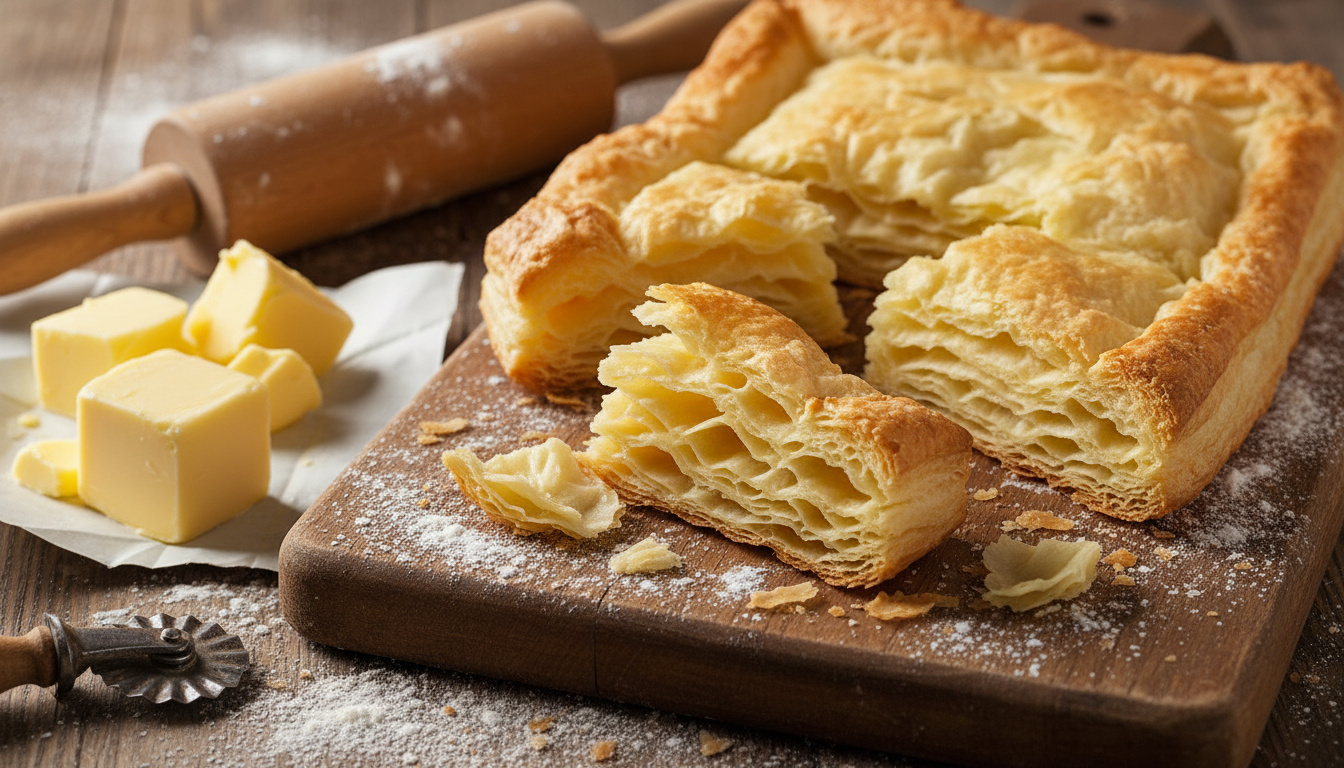
Puff pastry transforms simple ingredients into hundreds of delicate, flaky layers through a precise mechanical process rather than chemical leavening. Creating this laminated dough at home requires patience, cold butter, and a methodical folding technique that traps steam between layers.
While traditional recipes demand hours of careful rotation and chilling, modern rough puff methods reduce active preparation to under an hour without sacrificing the signature rise. Understanding the fundamental mechanics of lamination helps home bakers avoid common pitfalls like dense, tough textures or butter leakage during baking.
How to Make Puff Pastry from Scratch: Step-by-Step
Rough Puff Method
Quick alternative using 4 folds and distributed chilling. Active time: 30-60 minutes. Yields approximately two commercial sheets.
Traditional Full Puff
Classic technique requiring 6+ turns and a separate butter block. Total time: 3-4 hours with intensive chilling.
Store-Bought vs. Homemade
One batch of rough puff matches two standard store-bought sheets while eliminating preservatives and emulsifiers.
Vegan Adaptation
Plant-based variations using margarine or shortening exist, though specific formulas and hydration ratios were not verified in available research.
- Butter integrity determines height: Cold butter creates steam pockets that force layers apart during baking.
- Resting prevents shrinkage: Chilling between folds solidifies butter and relaxes gluten.
- Minimal mixing preserves flakiness: Over-processing develops gluten that creates tough, shrinking dough.
- Rotation ensures even layers: Turning the dough 90 degrees after each fold distributes stress uniformly.
- Rough puff accessibility: Beginner-friendly method produces equivalent results to store-bought versions.
- Equipment flexibility: Food processors, stand mixers, or hand-mixing all produce viable results when monitored carefully.
| Component | Measurement (Standard Batch) | Function |
|---|---|---|
| All-purpose flour | 3⅓ cups (approx. 420g) | Provides gluten structure |
| Unsalted butter | 2-2½ cups (450-570g), frozen | Creates steam layers for lift |
| Ice-cold water | ½-¾ cup (120-180ml) | Hydrates without warming butter |
| Fine sea salt | 1-1½ teaspoons | Enhances flavor and strengthens gluten |
| Food processor | 1 unit (optional) | Quick butter incorporation |
| Stand mixer | 1 unit with paddle (optional) | Alternative mechanical mixing |
| Rolling surface | Lightly floured counter | Prevents sticking during lamination |
| Plastic wrap | 2-3 meters | Wraps dough for chilling phases |
Key Techniques: Folding and Laminating Puff Pastry
Initial Mixing Methods
Bakers may combine ingredients using three distinct approaches. A food processor pulses flour with salt, adds three-quarters of the cold butter cubes for 10-12 pulses, then incorporates the remaining butter with 2-3 brief pulses before adding water. Alternatively, hand-mixing involves gently tossing flour with ¼-inch butter slices and briefly rubbing the mixture to combine—avoiding over-processing that would break down the fat too thoroughly. A stand mixer with a paddle attachment offers a middle ground, requiring approximately five minutes of initial mixing before the first chill period.
The Lamination Sequence
Lamination refers to the folding and rolling process that distributes butter throughout the dough matrix. For rough puff pastry, the sequence involves rolling the chilled dough into a 12-by-24-inch rectangle, folding both short ends toward the center until they meet, then folding the dough in half again like a book. Rotating the dough 90 degrees before the next roll ensures layers develop evenly in all directions. Complete four full turns, chilling for 20-30 minutes between each session to maintain butter solidity.
If butter begins to soften during rolling, immediately return the dough to the refrigerator. Warm butter absorbed into the flour prevents proper steam separation during baking, resulting in flat, dense pastry.
Rough Puff vs Full Puff Pastry: Which to Choose?
The Rough Puff Advantage
Rough puff pastry eliminates the traditional separate butter block used in full puff methods. Instead, small butter pieces are distributed throughout the initial dough, then flattened and folded to create flaky layers mechanically. This approach makes homemade puff pastry accessible to beginners and produces results equivalent to store-bought sheets—one recipe yields approximately two standard commercial sheets. What Does Retinol Do
Traditional Full Puff Complexity
Full puff pastry requires encasing a solid block of butter within the détrempe (dough envelope), then performing six or more book folds with precise alignment. The method demands extended chilling between turns and careful temperature management throughout the three-to-four-hour process. While the layer definition may be slightly more refined, rough puff achieves comparable height and flakiness for most home applications.
Common Mistakes and How to Fix Them
Diagnosing Density and Shrinkage
The primary failures in homemade puff pastry stem from two mechanical errors: overworking the dough and allowing butter to warm during preparation. Excessive kneading or mixing develops gluten networks that cause the dough to shrink violently during rolling and baking, while warm butter melts into the flour matrix rather than remaining in distinct layers, preventing steam from creating separation.
Butter that softens during lamination becomes absorbed into dough layers instead of remaining intact. Sources confirm that this prevents the steam expansion necessary for characteristic puffing. Freeze butter for 30 minutes before starting, and chill dough immediately if resistance decreases during rolling.
Available research does not specify optimal flour protein percentages for homemade puff pastry. While all-purpose flour is standard, the precise gluten content required for ideal lamination remains unverified in tested sources.
Some practitioners recommend grating frozen butter directly into the flour mixture using a box grater. This method increases surface area while maintaining low temperature, accelerating the rubbing-in process for hand-mixed batches.
How Long Does Homemade Puff Pastry Preparation Take?
Preparation times vary significantly between rough and traditional methods. Rough puff pastry requires approximately one hour and twenty minutes total: twenty minutes of active preparation plus one hour of distributed chilling between folds. Traditional methods extend to three or four hours with additional resting periods.
- Initial mixing and formation: 10-20 minutes to combine ingredients and shape dough disk. Billy Parisi
- First chill period: 20 minutes minimum to solidify butter before rolling. Baking a Moment
- First fold sequence: 5-10 minutes rolling and folding, followed by 20-30 minutes chilling.
- Subsequent turns: Repeat rolling, folding, and chilling three additional times for rough puff (four total turns).
- Final rest: Minimum 30 minutes refrigeration before baking or storing.
What Definitely Works vs. What Remains Uncertain
| Established Techniques | Unverified or Unclear Information |
|---|---|
| Cold butter (frozen 30 minutes prior) is essential for layer separation. | Specific protein content percentages for ideal flour selection were not established in reviewed sources. |
| Four turns produce viable rough puff pastry equivalent to commercial products. | Long-term freezer storage durations and optimal thawing procedures were not detailed in available research. |
| Overworking develops excess gluten causing shrinkage. | Vegan adaptations using plant-based fats lack verified formulas in the research corpus. |
| Rotation between folds ensures even layer distribution. | Precise oven temperature thresholds for optimal rise remain unconfirmed. |
Why Make Puff Pastry at Home?
Commercial puff pastry often contains preservatives, emulsifiers, and flavor stabilizers that alter the final taste profile. Homemade versions allow precise control over butter quality—using European-style cultured butter or local dairy—which significantly impacts the aromatic complexity of the finished product. The rough puff method specifically offers cost efficiency, producing two full sheets at a fraction of the price of premium store-bought brands while eliminating packaging waste. For a delicious puff pastry recipe, check out this guide: Recette poule au pot facile.
Beyond economics, the process develops tactile awareness of dough consistency and temperature management transferable to other laminated doughs like croissants or Danish pastry. How to Cast from Phone to TV represents another technical skill that, like lamination, requires understanding device compatibility and signal flow to achieve optimal results.
Expert Sources and Professional Insights
“Lamination is the folding and rolling process that incorporates butter throughout the dough, creating flaky layers.”
— Sugar Spun Run
“Rough puff pastry is the easier homemade variation… without requiring a separate laminated butter layer.”
— Sally’s Baking Addiction
“Chill for 20-30 minutes between folds to keep the dough cold and workable.”
— Billy Parisi and Sense and Edibility
Key Takeaways for Home Bakers
Successful puff pastry depends on thermal management and mechanical restraint. Freeze butter before incorporation, limit gluten development through minimal mixing, and maintain strict chilling protocols between each of the four rough-puff turns. While homemade preparation requires approximately ninety minutes of intermittent attention, the resulting flakiness and butter flavor surpass most commercial alternatives. How to Cast from Phone to TV
Frequently Asked Questions
Can you make puff pastry without a mixer?
Yes. Hand-mixing by rubbing frozen butter into flour with fingertips produces excellent results and is recommended for rough puff methods to avoid over-processing.
What ingredients do you need for puff pastry?
Essential ingredients include all-purpose flour, cold unsalted butter (2-2½ cups per batch), salt, and ice-cold water. Optional equipment includes a food processor or stand mixer.
Is homemade puff pastry better than store-bought?
Homemade offers superior flavor control and lacks preservatives, though it requires significant time investment. Rough puff methods produce results equivalent to commercial sheets.
How long does homemade puff pastry last?
Research confirms immediate use after final chilling (30+ minutes), but specific long-term refrigeration or freezer storage timelines were not detailed in available sources.
How to make vegan puff pastry?
Verified vegan formulas were not included in the research corpus. Plant-based adaptations typically substitute margarine or shortening for butter, though specific hydration ratios remain unverified.
Related stories





Samuel Hart is Devices & Reviews Editor at ScopePress.uk, covering smartphones, laptops, hardware and hands-on reviews.