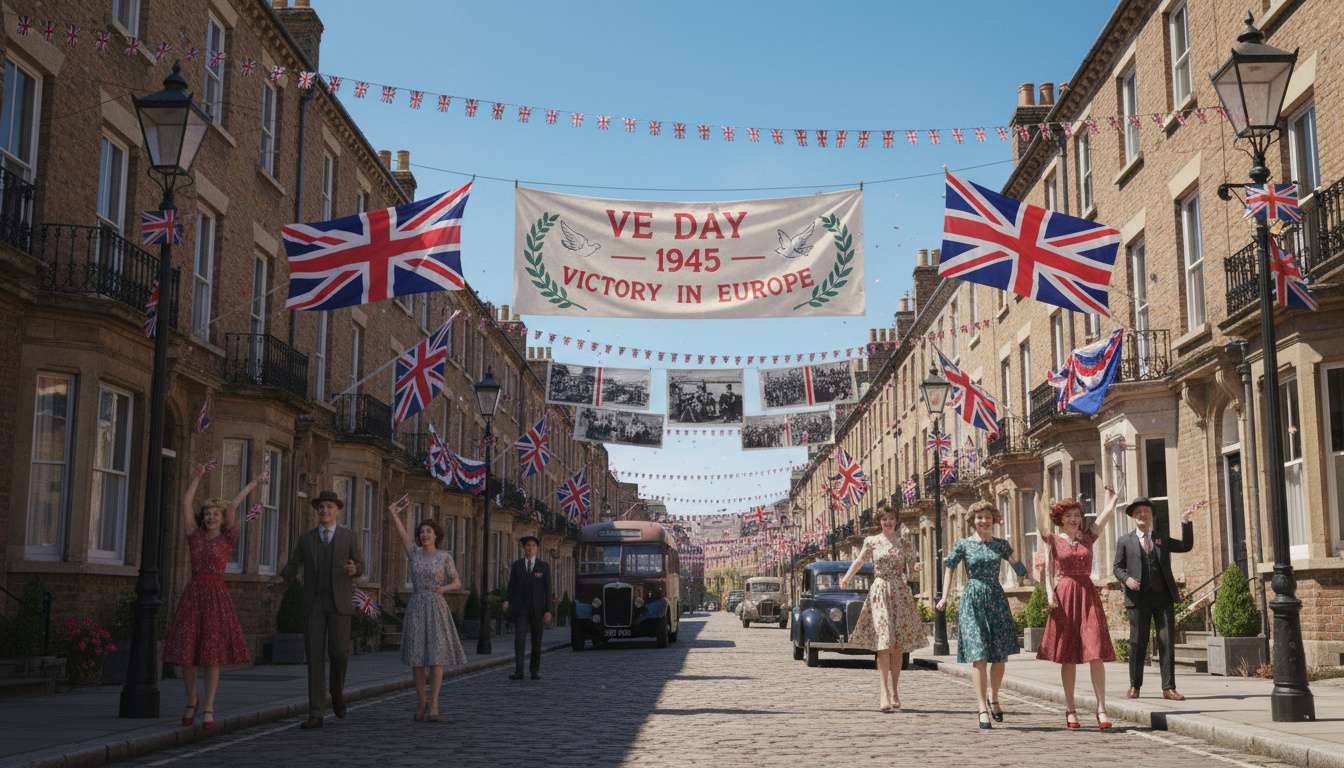

Victory in Europe Day represents one of the most significant military and civilian milestones of the twentieth century. On May 8, 1945, Allied powers formally accepted Nazi Germany’s unconditional surrender, concluding nearly six years of devastating conflict across the continent. The announcement triggered spontaneous celebrations throughout Britain and liberated territories, marking the end of Hitler’s regime and the beginning of a fragile peace.
The historical significance extends beyond mere calendar notation. While crowds gathered in London’s streets and public squares, military operations continued elsewhere. The Pacific War raged on against Japan, creating a bittersweet atmosphere for many service members and civilians who understood that global peace remained elusive. This complex reality shaped how nations chose to commemorate the victory and influences modern observances.
Contemporary commemorations honor both the relief felt in 1945 and the sacrifices required to achieve it. Understanding when VE Day occurs annually, its historical origins, and its distinction from other wartime anniversaries provides essential context for anyone seeking to grasp this pivotal moment in world history.
What is VE Day?
Victory in Europe Day, commonly abbreviated as VE Day, marks the formal conclusion of World War II hostilities in the European theater. The designation specifically commemorates the Allies’ acceptance of Nazi Germany’s unconditional surrender on May 8, 1945, following six years of conflict that claimed millions of lives and reshaped the continent’s political landscape. Encyclopedic records document the military and diplomatic processes leading to this capitulation.
- Fixed date annually on May 8 in Western nations
- Not a global public holiday, though widely recognized
- 80th anniversary occurred in 2025
- Primary focus remains remembrance and historical education
- Marks Nazi Germany’s formal military surrender only
- Time zone differences create May 9 observances in Russia
- Distinct from VJ Day, which ended the Pacific conflict
| Fact | Details |
|---|---|
| Original Date | May 8, 1945 |
| Annual Date | May 8 |
| Significance | Nazi Germany’s unconditional surrender |
| Surrender Signing | May 7, 1945 (Reims) & May 8, 1945 (Berlin) |
| UK Bank Holiday | Yes |
| Alternative Name | Victory in Europe Day |
| Related Event | VJ Day (August 15, 1945) |
| Soviet Observance | May 9 (Victory Day) |
When is VE Day Celebrated?
The annual observance occurs every May 8 in the United Kingdom and most Western Allied nations. This fixed date maintains consistency with the original 1945 announcement, ensuring commemorative ceremonies align with the historical calendar. Schools, museums, and military organizations typically organize events on this specific date rather than moving observances to create long weekends.
When is VE Day 2025?
The 80th anniversary falls on Thursday, May 8, 2025. Specific national events for this milestone were not detailed in available archival sources at the time of publication, though historical precedent suggests major anniversaries typically feature enhanced ceremonial programming across the UK and Europe.
What is the date of VE Day UK?
Britain consistently observes the anniversary on May 8, regardless of the day of the week. Unlike some commemorative occasions that shift to adjacent weekends, VE Day maintains its strict historical dating. Historical UK archives confirm that both May 8 and 9, 1945, were declared public holidays immediately following the surrender announcement.
Is VE Day a holiday?
May 8 remains a bank holiday in the United Kingdom when it falls on a weekday, though it does not automatically create a three-day weekend unless calendar alignment permits. The original 1945 celebrations benefited from dedicated public holiday status, with authorities ensuring ample beer supplies and distributing unrationed red-white-blue bunting for street decorations.
While VE Day falls on May 8 annually, the day of the week varies. When the date lands on a weekend, Monday observances may occur for bank holiday purposes, though formal ceremonies typically maintain the May 8 date regardless.
When Did VE Day Originally Occur?
The original Victory in Europe Day unfolded across May 7-8, 1945, marked by two distinct surrender ceremonies and a cascade of public announcements. Germany’s military collapse became inevitable following the meeting of Allied and Soviet forces at the Elbe River on April 25, 1945, creating the logistical and political conditions for formal capitulation.
The Surrender Signings
General Alfred Jodl signed the initial act of surrender in Reims, France, on May 7 at 02:41 CET. However, Soviet demands for a second ceremony in Berlin resulted in Field Marshal Wilhelm Keitel signing a duplicate surrender document on May 8 at 22:43 local time, effective 23:01 CET. Aviation historians note this dual-signing protocol created the time zone discrepancies that still affect modern observances.
Churchill’s Announcement
Prime Minister Winston Churchill broadcast the official announcement at 15:00 BST on May 8, declaring the date as VE Day while praising military and civilian sacrifices. His address explicitly noted the ongoing conflict against Japan, tempering celebration with strategic reality. Imperial War Museums maintain archives of this pivotal broadcast.
Public Reaction
Over one million people gathered in London’s Trafalgar Square and outside Buckingham Palace, where the royal family and Churchill appeared on the balcony. Similar jubilation erupted across Europe and North America, though prisoners of war in Pacific theater camps remained in harsh conditions, creating the day’s characteristic mixture of joy and solemnity.
VE Day vs VJ Day: Key Differences
Understanding the distinction between Victory in Europe Day and Victory over Japan Day remains essential for accurate historical comprehension. While both mark Allied triumphs, they represent separate theaters, different dates, and distinct strategic conclusions to World War II.
VE Day concluded only the European conflict. VJ Day, occurring on August 15, 1945 (or September 2 for the formal surrender ceremony), marked the actual end of World War II globally following Japan’s defeat.
The temporal gap between these anniversaries—approximately three months—reflects the military reality that Nazi Germany’s collapse did not immediately produce Pacific peace. The National WWII Museum maintains extensive documentation of both ceremonies, noting that many service members transferred from European campaigns to Pacific operations during this intervening period.
Commemorative practices differ accordingly. VE Day emphasizes European liberation, the end of the Blitz, and the collapse of fascist regimes. VJ Day memorializes Pacific theater sacrifices, including naval operations and island campaigns that continued through July 1945. US War Department records show President Harry Truman specifically tempered VE Day celebrations with reminders of ongoing Pacific combat.
Modern observers frequently conflate these dates. Remember: May 8 marks European victory only, while August 15 (or September 2) represents total WWII conclusion. The Soviet Union observes Victory Day on May 9 due to time zone differences, not because of separate surrender events.
How Did VE Day 1945 Unfold?
The chronological progression of May 8, 1945, followed a precise sequence of military confirmations and public communications. Understanding this timeline clarifies why celebrations began before formal Berlin ceremonies concluded.
- : Allied and Soviet forces meet at the Elbe River, sealing Germany’s military encirclement. Wikipedia historical records document this strategic convergence.
- : General Alfred Jodl signs surrender act at Reims, France, in General Dwight D. Eisenhower’s headquarters.
- : Confirmation of Reims surrender spreads through Allied command channels, though the Berlin signing remains pending.
- : Winston Churchill broadcasts to the British nation, officially declaring May 8 as VE Day.
- : King George VI addresses the nation via radio, thanking armed forces and civilians for their endurance.
- : Field Marshal Wilhelm Keitel signs second surrender document in Berlin, effective 23:01 CET.
- : Massive street parties erupt across London, New York, and European capitals, with over one million gathering at Trafalgar Square and Buckingham Palace.
What Is Certain About VE Day?
Despite decades of historical study, certain misconceptions persist regarding VE Day’s date, scope, and significance. Separating established facts from common uncertainties helps maintain accurate historical understanding.
| Established Information | Information That Remains Unclear |
|---|---|
| VE Day occurs annually on May 8 in the UK and Western Allied nations | Specific 2025 commemorative events were not detailed in available sources at publication time |
| The surrender marked end of WWII in Europe only, not globally | Future bank holiday status depends on parliamentary decisions beyond historical scope |
| Soviet Union observes Victory Day on May 9 due to time zone differences (surrender effective 00:01 Moscow time) | Exact global participation rates in modern VE Day commemorations vary annually without comprehensive tracking |
| Original 1945 celebrations occurred May 8-9 as public holidays | Long-term archival preservation of civilian diaries from the specific date remains incomplete |
Why Does VE Day Matter Today?
The anniversary serves as more than historical nostalgia. It represents the concrete moment when systematic Nazi aggression ceased in Europe, ending the Holocaust’s industrial-scale murder and the military occupation of continental nations. Military history archives emphasize the day’s role in marking the transition from total war to reconstruction.
Contemporary relevance extends to educational imperatives. As the 80th anniversary approaches in 2025, direct personal memory of the conflict fades with the passing of the wartime generation. Commemorations now bear responsibility for transmitting lessons about coalition-building, civilian sacrifice, and resistance to totalitarianism. The Channel Islands, Britain’s only occupied territory, particularly emphasize liberation narratives in their annual observances.
Strategically, the date reminds modern audiences that military victory represents not merely battlefield dominance but the preservation of civic institutions. The What Is Critical Thinking – Definition, Skills and Development Guide provides useful frameworks for analyzing how societies process complex historical events involving both triumph and ongoing conflict.
What Did Leaders Say on May 8, 1945?
Primary source documentation reveals the careful balance leaders struck between celebration and solemnity. These contemporary voices provide unfiltered access to the period’s emotional complexity.
“We may allow ourselves a brief period of rejoicing; but let us not forget for a moment the toil and efforts that lie ahead. Japan, with all her treachery and greed, remains unsubdued.”
— Winston Churchill, May 8, 1945, 15:00 BST broadcast
“The war in Europe is won. But the struggle for peace and freedom continues. We must work to earn the peace we have won.”
— King George VI, radio address, May 8, 1945
“This is a solemn but a glorious hour. I wish that Franklin D. Roosevelt had lived to see this day. General Eisenhower informs me that the forces of Germany have surrendered to the United Nations.”
— Harry S. Truman, VE Day address to the American people
Key Points to Remember
VE Day falls annually on May 8, commemorating the 1945 Allied acceptance of Nazi Germany’s surrender and the end of World War II in Europe. The date remains fixed in the UK and Western nations, distinct from Russia’s May 9 Victory Day observance and from VJ Day’s August 15 Pacific conclusion. While 2025 marks the 80th anniversary, the day continues to serve as both celebration of liberation and reminder of sacrifices required to defeat totalitarian aggression. For geographical context on Allied nations, see What Continent Is Jamaica In – North America Explained.
Frequently Asked Questions
How is VE Day commemorated today?
Annual commemorations include military parades, memorial services at cenotaphs, and educational programming in schools. The UK observes ceremonies at the Cenotaph and nationwide two-minute silences, while museums exhibit wartime artifacts and oral histories.
Why is VE Day celebrated?
The day marks the end of Nazi Germany’s military aggression in Europe, concluding nearly six years of occupation, bombing campaigns, and the Holocaust. It honors both military victory and civilian endurance during the Blitz and rationing.
What happened on VE Day in 1945?
Massive crowds gathered in London’s streets, particularly at Trafalgar Square and Buckingham Palace. Winston Churchill and the royal family appeared on the palace balcony before crowds, while street parties erupted across Britain despite continuing rationing.
Is VE Day a bank holiday every year?
May 8 is a bank holiday when it falls on a weekday. When the date lands on a weekend, the following Monday may become the bank holiday, though formal ceremonies typically occur on May 8 regardless.
Why does Russia celebrate on May 9?
Time zone differences meant the surrender became effective at 00:01 Moscow time on May 9, 1945. The Soviet Union and some former Soviet states maintain this date as Victory Day rather than May 8.
Related stories





Samuel Hart is Devices & Reviews Editor at ScopePress.uk, covering smartphones, laptops, hardware and hands-on reviews.