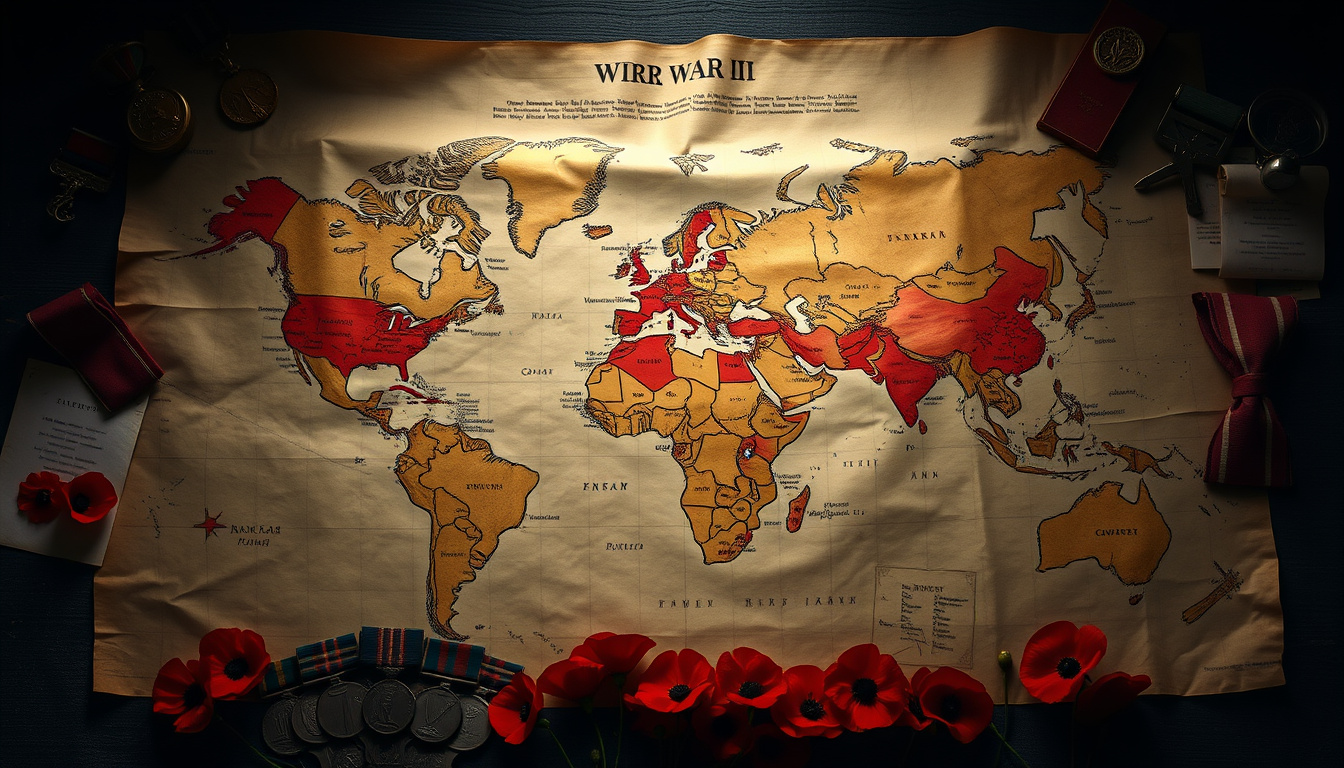
World War II remains the deadliest conflict in human history, with most authoritative sources placing the total death toll between 70 and 85 million. Estimates vary by tens of millions depending on what is counted — direct war deaths, disease, famine, or population-level excess mortality.
Total Deaths (Direct): 50–56 million ·
Additional Disease/Starvation: 19–28 million ·
Battle Deaths: 15 million ·
Civilian Deaths: 45 million ·
Military Deaths: 24.8 million
Quick snapshot
- Soviet Union bore the heaviest toll at 24 million dead, per the National WWII Museum (primary institutional source)
- Military deaths globally totaled roughly 24.8 million per World Population Review (data aggregator)
- Two-thirds of all WWII deaths were civilians, per Statista (statistics provider)
- Chinese civilian deaths from famine and Japanese persecution remain rough estimates (~7.5 million)
- Ethnic-specific breakdowns for Soviet Union are disputed across sources
- Smaller colonies like Malaya and Nauru lack reliable figures
- War began September 1939 with the invasion of Poland
- Pacific Theatre escalated December 1941 with Pearl Harbor
- Highest single-period casualties occurred on the Eastern Front 1941–1945
- Continue below for country-by-country breakdowns and military vs civilian comparisons
- See the comparison section for WWII vs WW1 scale difference
- Review the FAQ for answers to the most common reader questions
The global death toll from World War II is staggering in every sense. Across six years and multiple continents, an estimated 70–85 million people perished — a figure that represents roughly 3% of the world’s 1939 population. The table below summarizes the most authoritative estimates for the hardest-hit nations.
| Country | Total Deaths | Military Deaths | Civilian Deaths |
|---|---|---|---|
| Soviet Union | 24,000,000 | 8,800,000–10,700,000 | ~13–15 million |
| China | 20,000,000 | 3–4 million | ~16 million |
| Germany | 7,700,000 | 5,533,000 | ~2–3 million |
| Poland | 5,600,000 | ~500,000–1 million | ~4.5–5 million (incl. 3.2M Jewish) |
| Japan | 2,850,000 | 2,120,000 | ~730,000 |
| France | 567,600 | 217,600 | ~350,000 |
| United Kingdom | 450,700 | 383,600 | ~67,100 |
| United States | 418,500 | 416,800 | ~1,700 |
What country has the most deaths in World War II?
The Soviet Union suffered the highest national death toll of any combatant — approximately 24 million people lost between 1939 and 1945, according to the National WWII Museum (leading WWII research institution). China came second with around 20 million dead, also per the National WWII Museum. These two nations account for more than half the war’s global mortality.
Poland’s losses were proportionally catastrophic even if the absolute number was smaller: 5.6 million dead, representing 17.22% of its 1939 population, per World Population Review (data aggregator). Belarus’s death rate was even higher — 25.3% of its pre-war population, the highest percentage loss of any nation.
The pattern across Eastern Europe reflects both the scale of battles on the Eastern Front and the deliberate targeting of civilian populations during occupation and the Holocaust.
Soviet Union toll
The Soviet military lost between 8.8 and 10.7 million soldiers, per the National WWII Museum. Civilian deaths, however, vastly outnumbered military losses — the result of sieges, starvation policies, and atrocities conducted by Nazi Germany across occupied territories.
China casualties
China’s 20 million dead span both the full Sino-Japanese War (beginning 1937) and World War II proper. Roughly 7.5 million civilians died from Japanese persecution, including the Nanjing Massacre, biological warfare experiments, and forced labor programs, per Wikipedia (comprehensive reference). Famine and disease inflated the civilian toll further, with estimates potentially undercounted.
Germany losses
Germany lost 7.7 million people total per World Atlas (geographic reference), including 5.533 million military personnel per the National WWII Museum. Postwar population transfers and expulsions of ethnic Germans from Eastern Europe added additional deaths not always counted in wartime figures.
How many died in WWII vs WW1?
World War II was roughly four times deadlier than its predecessor. Where WWI claimed an estimated 15–22 million lives (both military and civilian combined), WWII killed 70–85 million — a range reflecting the methodological disputes discussed above.
The key difference lies in civilian casualties: WWI was predominantly a military engagement, while WWII saw massive urban bombings, deliberate starvation policies, occupation atrocities, and the Holocaust. Two-thirds of WWII deaths were civilian, per Statista (statistics provider), compared to roughly half in WWI.
The technological drivers of escalation also differed: mechanized warfare, strategic bombing, and nuclear weapons in WWII created kill zones that simply did not exist in the earlier conflict.
WWII total estimates
The most widely cited direct-death figure is 50–56 million from the Defense Casualty Analysis System (official US government records), with an additional 19–28 million deaths attributable to war-related disease and famine.
WW1 totals
World War I claimed approximately 9–11 million military dead and 6–7 million civilian dead, per Britannica (encyclopedic reference), for a total of 15–22 million when including pandemic influenza deaths linked to the war.
Key differences
The shift in warfare philosophy — from targeting opposing armies to targeting enemy populations and industrial capacity — drove the civilian-to-military death ratio dramatically upward. This pattern would define all major conflicts after 1945.
How many Russians died in WWII?
As noted, Soviet deaths reached approximately 24 million per the National WWII Museum. Of these, military deaths ranged from 8.8 to 10.7 million. The remainder were civilian: prisoners of war who starved in German camps, inhabitants of besieged cities like Leningrad and Stalingrad, and populations in occupied Ukraine and Belarus subjected to systematic starvation and mass execution.
Regional impacts varied enormously: Ukraine lost 6.8 million people (15%+ of its population) per World Population Review, while other republics experienced proportionally lower but still devastating losses.
Military vs civilian
Soviet military deaths accounted for roughly 40–45% of the total toll, with civilians comprising the majority. German POW mortality and civilian famine during and after the war contributed additional numbers not always counted in pre-1945 figures.
Excess mortality
The “excess mortality” approach — counting deaths above peacetime baselines — produces higher figures than direct conflict counts alone, as it captures those who died from disrupted healthcare, malnutrition, and delayed consequences of wartime conditions.
Regional impacts
The Battle of Stalingrad alone killed approximately 2 million people over five months. Leningrad’s siege claimed roughly 1 million civilian lives over 872 days. These single events exceeded the total war dead of most participating nations.
How many Germans died in WWII?
Germany lost 7.7 million people total per World Atlas, with military deaths of 5.533 million per the National WWII Museum. Civilian deaths of 1–2 million include those from strategic bombing campaigns against Hamburg, Dresden, and other cities, as well as the final months of ground fighting on German soil.
Postwar deaths from the forced expulsion of ethnic Germans from Poland, Czechoslovakia, and other Eastern European territories added 1–2 million more, though historical records for these events remain incomplete.
Wehrmacht losses
The Wehrmacht (German armed forces) suffered approximately 5.533 million military deaths, a figure that includes those killed in action, died of wounds, captured and executed, and those who died in Allied captivity.
Civilian deaths
Allied strategic bombing of German cities killed an estimated 350,000–500,000 civilians between 1940 and 1945. The final battles on German territory added tens of thousands more.
Expulsions
Between 12 and 14 million ethnic Germans were expelled from Eastern Europe after 1945, with death toll estimates ranging from 500,000 to 2 million, per World Population Review — a figure often excluded from “wartime” casualty counts.
How many civilians died in WW2?
Civilian deaths in World War II are estimated between 45 and 52 million per World Population Review, with the majority dying not from battlefields but from deliberate policies, aerial bombing, and war-induced famine. This makes WWII the first war in modern history in which civilians formed the majority of casualties.
Almost two-thirds of all deaths due to WWII were civilian, per Statista — a ratio that reflects both the expansion of strategic bombing and the regime-targeted extermination campaigns, most notably the Holocaust.
Holocaust
The Holocaust alone — the systematic Nazi genocide of European Jews — claimed approximately 6 million Jewish lives, per multiple sources. This single atrocity accounts for a substantial share of the global civilian death toll.
Strategic bombing
Allied bombing campaigns over Europe and Japan killed an estimated 1–2 million civilians, primarily through area bombings targeting residential districts rather than specific military installations.
Famines
Bengal famine in British India (1943–1944) killed 2–3 million, while food seizures and deliberate starvation policies in occupied territories — particularly the Soviet Union and Dutch East Indies — claimed millions more.
WWII vs WW1 by the numbers
Eight nations with comparable data show the scale difference between the two wars: where WWI rarely exceeded 1 million dead per country even among the hardest-hit, WWII produced six nations above that threshold and two above 20 million.
| Conflict | Estimated Total Dead | Military Dead | Civilian Dead | Civilian % |
|---|---|---|---|---|
| World War II | 70–85 million | 24.8 million | 45–52 million | ~65% |
| World War I | 15–22 million | 9–11 million | 6–7 million | ~35% |
| Ratio (WWII/I) | ~4× | ~2.5× | ~7× | — |
What this means: civilian deaths in WWII grew at nearly seven times the WWI rate, driven by bombing campaigns and targeted extermination, while military deaths only grew by roughly 2.5× — still catastrophic, but disproportionately smaller relative to the overall toll.
Key periods of highest casualties
Invasion of Poland — war begins in Europe, 100,000+ deaths in first campaign
Pearl Harbor — Pacific War escalates, bringing Asian and Pacific theaters into global conflict
Eastern Front — highest-intensity fighting in history, ~30 million total deaths across all campaigns
D-Day invasion — Western Front opens, accelerating Germany’s two-front war collapse
Atomic bombings of Hiroshima and Nagasaki — approximately 200,000 immediate deaths, hastening Japanese surrender
Formal surrender — World War II officially ends
The Soviet Union alone lost more people than the entire US military force that served in the Pacific. For context: the US deployed 16 million soldiers across all theaters and lost 416,800. The USSR mobilized approximately 30 million and lost 8.8–10.7 million military dead alone — without counting the additional 13–15 million civilians.
Poland’s death rate of 17.22% of its 1939 population means roughly 1 in 6 Poles did not survive the war. This is not a rounding error or margin of error — it is a demographic catastrophe that reshaped the nation’s age structure, family patterns, and cultural memory for generations.
What we know — and what we don’t
Confirmed facts
- Military deaths globally around 24.8 million (World Population Review)
- Soviet Union suffered approximately 24 million total deaths (National WWII Museum)
- Two-thirds of WWII deaths were civilian (Statista)
- China lost roughly 20 million people (National WWII Museum)
Remains unclear
- Exact civilian famine deaths in China and Soviet Union may be underestimated
- Ethnic-specific breakdowns for Soviet regions disputed across sources
- Small colonial territories (Malaya, Nauru) lack reliable figures
- Postwar border changes complicate subnational attribution
What experts and institutions say
“Almost two-thirds of all deaths due to the Second World War were of civilians.”
— Statista (Statistics Provider)
“China is estimated to have endured the second-highest number of total casualties in WWII. Roughly 20 million people died in China.”
— World Population Review (Data Aggregator)
“Poland’s death toll includes an estimated 3.2 million Jewish civilians who died in Nazi concentration and death camps.”
— World Population Review (Data Aggregator)
These three statements, from two institutional sources, capture the three defining features of WWII mortality: the civilian majority, the concentration of losses in the Soviet Union and China, and the Holocaust’s specific and documented contribution to Poland’s toll.
The nations that suffered most were not the ones that initiated the conflict — they were the ones caught between major powers or targeted for conquest, occupation, or extermination. Germany started the war but suffered fewer proportional losses than Poland or Belarus, while the Soviet Union, which signed the pact that enabled the invasion, bore the single largest national toll.
What these numbers mean together
When historians debate whether WWII claimed 70 million or 85 million lives, the difference — 15 million — roughly equals the total death toll of World War I. That margin reflects genuine uncertainty about civilian deaths in China, the Soviet Union, and Southeast Asia, where disrupted record-keeping and contested borders complicate enumeration.
What is not uncertain is the direction: every reliable source places WWII at four to six times the WWI death toll, and every source agrees that civilians — not soldiers — bore the larger share of that burden. The era of “gentlemanly war” between armies had ended, replaced by total war against populations.
For researchers, this means no single institution holds the complete answer. The National WWII Museum offers the most detailed country-level military and civilian splits for Western combatants; World Population Review provides percentage-of-population context that neither museum nor government records attempt; Statista and Britannica offer global aggregates that sacrifice granularity for scope. Using all three in tandem, as this article does, provides the most reliable available picture.
Related reading: VE Day
Breakdowns from sources like Wellington Review’s total toll breakdown consistently cite 70-85 million deaths across WW2.
Frequently asked questions
How many soldiers died in WW2?
Military deaths are estimated at approximately 24.8 million globally, per World Population Review. The largest shares came from the Soviet Union (8.8–10.7 million), Germany (5.533 million), and China (3–4 million).
How many people died in WW2 percentage?
Global deaths represented roughly 3% of the 1939 world population. Proportionally, Poland lost 17.22% of its people (World Population Review), Belarus 25.3%, and China approximately 10% of its 1939 population.
How many people died in ww2 allies?
Allied nations (excluding the Soviet Union) lost approximately 2.5 million military dead in Western Europe and North Africa, with civilian deaths varying widely: UK 67,000, US 1,700, Canada under 1,000. Soviet Allied losses were approximately 20–27 million military and civilian combined.
How many people died in ww2 in europe?
Europe alone suffered approximately 36 million deaths across all nations, per multiple institutional estimates. This includes military and civilian losses across Western, Eastern, and Southern Europe.
What was the deadliest place in WWII?
The Eastern Front — particularly the Battle of Stalingrad, the siege of Leningrad, and the occupied territories of Ukraine and Belarus — produced the highest single-event and cumulative casualties of any theater in human history.
How many people died in WW1?
World War I claimed approximately 15–22 million lives total, per Britannica (encyclopedic reference), making it roughly four times smaller than WWII. Military deaths were 9–11 million; civilian deaths were 6–7 million.
How many people died in WW2 by ethnicity?
The Holocaust specifically killed approximately 6 million Jewish Europeans — a figure documented through Nazi records, postwar trials, and demographic reconstruction. Other ethnic and population groups targeted during the war (Roma, disabled persons, LGBTQ individuals, political prisoners) add several hundred thousand more to targeted-death totals.
Related stories





Samuel Hart is Devices & Reviews Editor at ScopePress.uk, covering smartphones, laptops, hardware and hands-on reviews.