
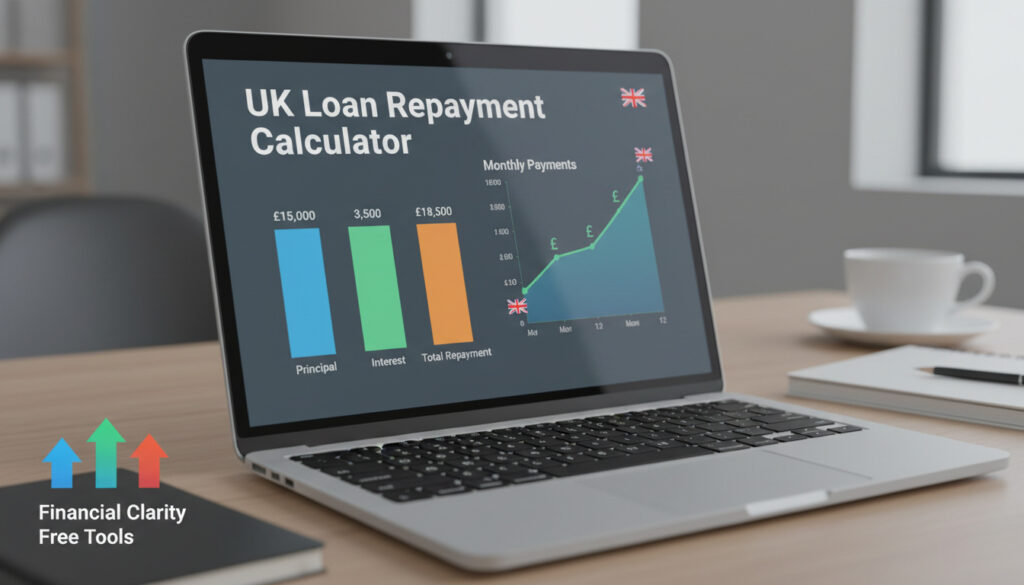
Free online loan repayment calculators have become essential planning tools for UK borrowers navigating personal finance decisions. These digital instruments, available from comparison platforms and high street banks alike, generate instant estimates of monthly obligations and total borrowing costs without triggering credit checks or affecting credit scores.
The landscape spans from aggregator sites like Moneyfacts and MoneySuperMarket to proprietary tools offered by NatWest, HSBC, and TSB. Each operates on standard amortisation formulas, applying fixed interest rates across terms typically ranging from one to seven years. Understanding how these calculators function—and where their limitations lie—enables borrowers to approach lenders with realistic expectations about affordability.
How Do I Calculate Loan Repayments in the UK?
British borrowers access calculator functions through web-based interfaces requiring three primary inputs: the principal loan amount, the annual percentage rate (APR), and the repayment term in months or years. The underlying calculation applies compound interest methodology, determining fixed monthly payments that cover both principal reduction and interest accrual across the loan lifecycle.
| Input Category | Typical Range/Value | Impact on Estimate |
|---|---|---|
| Loan Amount | £1,000 – £25,000 | Directly proportional to monthly payment |
| APR Range UK | 3.9% – 36.4% | Determines interest component significantly |
| Term Options | 12 – 84 months | Inverse relationship with monthly amount |
| Est. Monthly Payment | £80 – £250+ (typical) | Final output for budgeting purposes |
Key Insights for Borrowers
- Free calculators from Moneyfacts, MoneySuperMarket and major banks provide instant estimates without affecting credit scores.
- A borrower with good credit might pay £154.97 monthly on £5,000 over three years at 7.5% APR, while poor credit scenarios at 30% APR push payments to £202.85.
- Extending a £5,000 loan from three to seven years reduces monthly payments by nearly half but adds over £1,000 in total interest.
- Reverse calculators allow users to input affordable monthly amounts to determine maximum borrowable sums.
- Representative APRs advertised by NatWest, HSBC and other FCA-regulated lenders apply to only 51% of approved customers.
- Actual rates depend on hard credit checks and affordability assessments that calculators cannot fully replicate.
- TSB and other lenders offer repayment holiday options, though these extend the loan term and increase total interest.
Repayment Scenarios by Credit Profile and Term
| Scenario | Loan Amount | Term | APR | Monthly Payment | Total Repayable |
|---|---|---|---|---|---|
| Good Credit | £5,000 | 3 years | 7.5% | £154.97 | £5,578.80 |
| Fair Credit | £5,000 | 3 years | 15% | £171.03 | £6,157.04 |
| Poor Credit | £5,000 | 3 years | 30% | £202.85 | £7,302.78 |
| Standard Term | £5,000 | 3 years | ~8% | £160.11 | £5,764.02 |
| Extended Term | £5,000 | 5 years | ~8% | £104.95 | £6,297.23 |
| Long Term | £5,000 | 7 years | ~8% | £81.66 | £6,859.59 |
| Larger Loan | £12,000 | 5 years | 7% | £236.40 | £14,182.93 |
What Factors Affect Loan Repayments?
How Does APR Shape Your Total Cost?
The Annual Percentage Rate represents the total cost of borrowing expressed as a yearly rate, incorporating both interest and mandatory charges. UK calculators distinguish between representative APR—the rate offered to at least 51% of successful applicants—and personal APR, which reflects individual circumstances. For a £5,000 principal, the divergence between a 7.5% rate and a 30% rate generates approximately £1,724 in additional interest over three years.
Credit scoring mechanisms drive this variation. Lenders assess historical repayment behaviour, current debt-to-income ratios, and electoral roll registration to determine risk tiers. High-street banks such as NatWest and HSBC typically reserve their lowest advertised rates for borrowers with exemplary credit histories and stable employment records.
What Loan Term Should You Choose?
Term length directly influences both monthly affordability and aggregate interest paid. A three-year term on a £5,000 loan at 8% APR produces monthly payments of £160.11 with total interest of £764.02. Extending to seven years reduces the monthly obligation to £81.66 but escalates total interest to £1,859.59—an additional £1,095 for the same principal.
Choosing between a three-year and seven-year term involves balancing monthly cash flow against total interest. While a seven-year term reduces monthly payments on a £5,000 loan from £160 to roughly £82, the total interest paid increases from £764 to £1,860. Borrowers should calculate whether the monthly savings justify the long-term cost.
What Is the Best Loan Repayment Calculator UK?
Comparison Sites vs Bank Tools
Aggregator platforms provide broad market visibility. Moneyfacts and MoneySuperMarket enable side-by-side APR comparisons across dozens of lenders simultaneously, including functionality to reverse-calculate borrowable amounts from affordable monthly figures. These tools prove particularly valuable for initial market scanning.
Bank-specific calculators—such as those from Novuna, Nationwide, and Tesco Bank—offer personalised quotes that may include institution-specific features like repayment holidays or loyalty rate discounts. TSB explicitly models the impact of permitted payment holidays, showing how two skipped payments per year extend the term and increase total interest.
Options for Bad Credit Scenarios
Borrowers with impaired credit histories require calculators displaying maximum APR ceilings rather than headline representative rates. Novuna caps maximum monthly payments at approximately £244 for a £7,500 loan over five years, though actual rates from high-cost lenders may reach 36.4%. MoneySuperMarket provides sliders adjusting for credit tier estimates, allowing users to model payments between 3.9% and 29.9% APR.
Borrowers with adverse credit histories should use calculators displaying maximum APR scenarios. Novuna caps maximum monthly payments at approximately £244 for a £7,500 loan over five years, though actual rates from other lenders may reach 36.4%.
The APR displayed on calculator results represents the rate offered to at least 51% of successful applicants. Individual offers may differ significantly based on credit history, income verification, and current debt obligations.
What UK Regulations Apply to Loan Calculators?
FCA Affordability Requirements
The Financial Conduct Authority mandates that regulated lenders perform robust affordability assessments extending beyond credit scoring algorithms. These evaluations examine whether repayments remain sustainable without causing financial strain, considering existing debt obligations and disposable income. Calculators provide preliminary estimates, but lenders must verify income documentation and conduct hard credit searches before finalising offers.
Representative APR Rules
UK consumer credit regulations require that advertised representative APRs reflect the rate offered to at least 51% of successful applicants. No lender may guarantee specific rates through calculator tools alone. Maximum APRs vary by institution, with caps typically ranging between 22.9% and 36.4% for mainstream unsecured personal loans.
What Is the Timeline From Estimate to First Repayment?
- Initial Estimate: Borrower inputs desired amount and term into free online calculators from Moneyfacts or MoneySuperMarket; no credit impact occurs.
- Eligibility Check: Soft search tools assess likelihood of acceptance without leaving visible footprints on credit files.
- Formal Application: Hard credit check triggered; lender accesses full credit report from reference agencies.
- Affordability Assessment: FCA-mandated review of income, outgoings, and existing debt commitments.
- Binding Offer: Specific APR and terms provided; may differ from initial calculator estimates.
- Cooling-Off Period: 14-day statutory window allowing cancellation without penalty.
- First Repayment: Direct debit initiated, typically one month after funds transferred.
How Accurate Are Online Loan Calculators?
| Established Information | Variables Affecting Accuracy |
|---|---|
| Calculators use standard compound interest formulas assuming fixed rates throughout the term | Actual APR depends on hard credit check results and individual risk assessment |
| Monthly payment figures account for principal and interest only | Arrangement fees or early repayment charges may apply depending on lender |
| Representative APRs legally required to reflect rates offered to 51% of customers | Personal APR may exceed representative rate by significant margins for poor credit |
| Rounding differences typically limited to £8 or less across the loan term | Changes in Bank of England base rates could affect variable rate products |
Why Do Loan Calculators Matter in the Current UK Market?
The UK personal lending market operates within an environment of rate sensitivity linked to Bank of England monetary policy. As base rates fluctuate, the spread between prime borrower rates (3.9%-7.5%) and subprime ceilings (up to 36.4%) widens or contracts. Free calculator tools enable consumers to model these variations against household budgets before committing to applications that generate hard credit searches.
Government-backed guidance services align with these digital tools, emphasising budgeting discipline. Financial planning extends across currency domains; for instance, those monitoring international transfers might track the Norwegian Krone to GBP alongside their domestic borrowing costs, particularly for cross-border obligations or travel-related debt.
What Do Financial Authorities Say About Lending Tools?
Regulated lenders must perform robust affordability checks beyond credit scores, assessing whether repayments are sustainable without causing financial strain.
— Financial Conduct Authority guidelines, referenced across NatWest, HSBC, and TSB documentation
Calculator tools provide indicative figures for planning purposes only; actual costs depend on application details and credit assessment.
— Standard disclaimer across Moneyfacts and MoneySuperMarket platforms
What Should Borrowers Remember When Using These Tools?
Loan calculators serve as essential planning instruments, transforming abstract borrowing concepts into concrete monthly figures. Users should approach these estimates as starting points rather than guarantees, recognising that final APRs depend on comprehensive credit and affordability checks. Whether budgeting for domestic loan repayments or tracking exchange rates like the Norwegian Krone to GBP Rate, accuracy and verification remain paramount to sound financial decision-making.
Frequently Asked Questions
Do loan calculators include arrangement fees?
Standard calculators typically exclude arrangement fees from monthly payment estimates, focusing solely on principal and interest. Always verify with the specific lender whether upfront fees apply.
Can I trust the APR shown on comparison sites?
Displayed figures are representative APRs offered to 51% of successful applicants. Your personal rate may differ based on credit history and affordability checks.
Why did my actual offer differ from the calculator estimate?
Hard credit checks and detailed affordability assessments reveal risk factors that preliminary calculators cannot access, potentially resulting in higher rates or lower approved amounts.
Are there specific calculators for secured loans?
Most free UK tools focus on unsecured personal loans. Secured loans require different calculators accounting for variable rates and asset-backed risk assessments.
How do repayment holidays affect calculations?
Skipping payments extends your loan term and increases total interest paid. Some bank calculators, like TSB’s, model this impact specifically.
Will using a calculator affect my credit score?
No. Calculator usage involves no credit check. Only formal applications trigger hard searches visible to other lenders.
Can I calculate loans in currencies other than GBP?
UK-specific calculators operate in sterling. For foreign currency obligations, convert amounts using current exchange rates before calculation.

George Pemberton is Consumer & Gaming Correspondent at ScopePress.uk, covering gaming, smart home and connectivity.