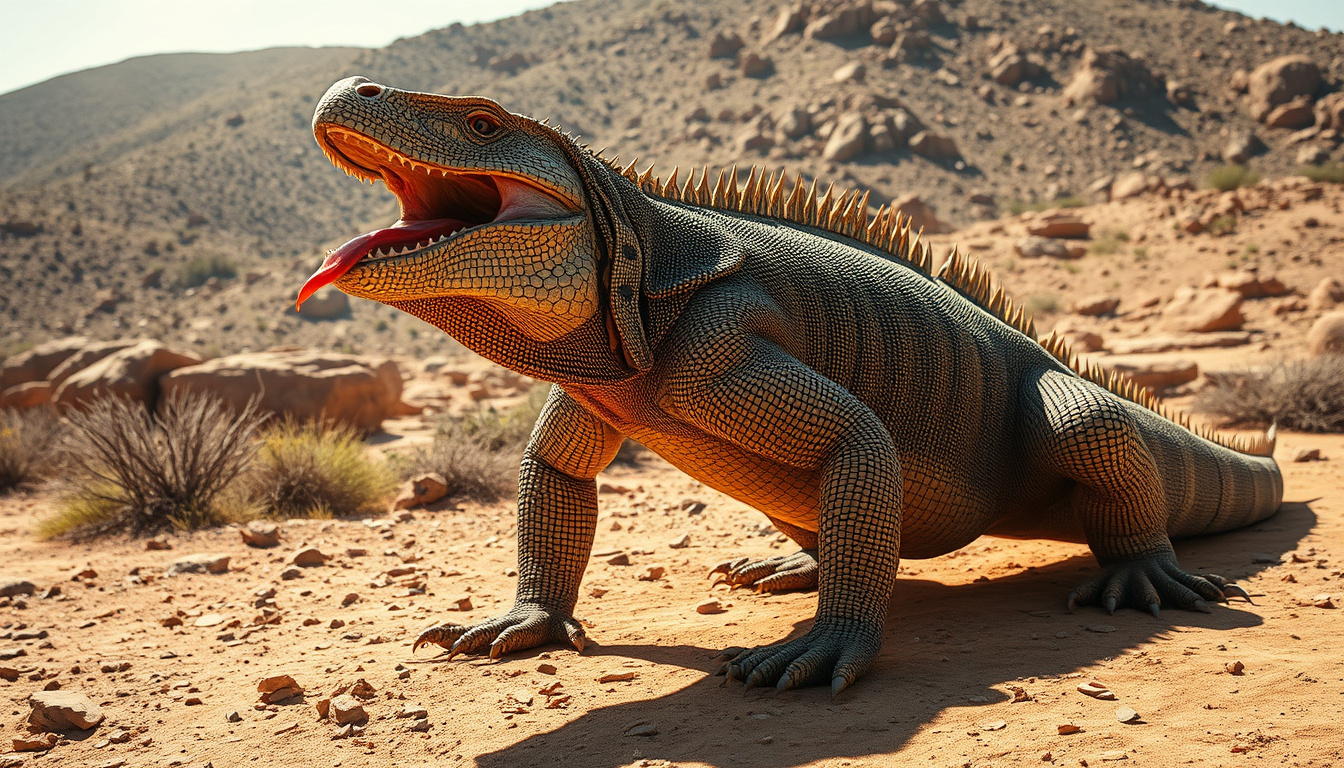
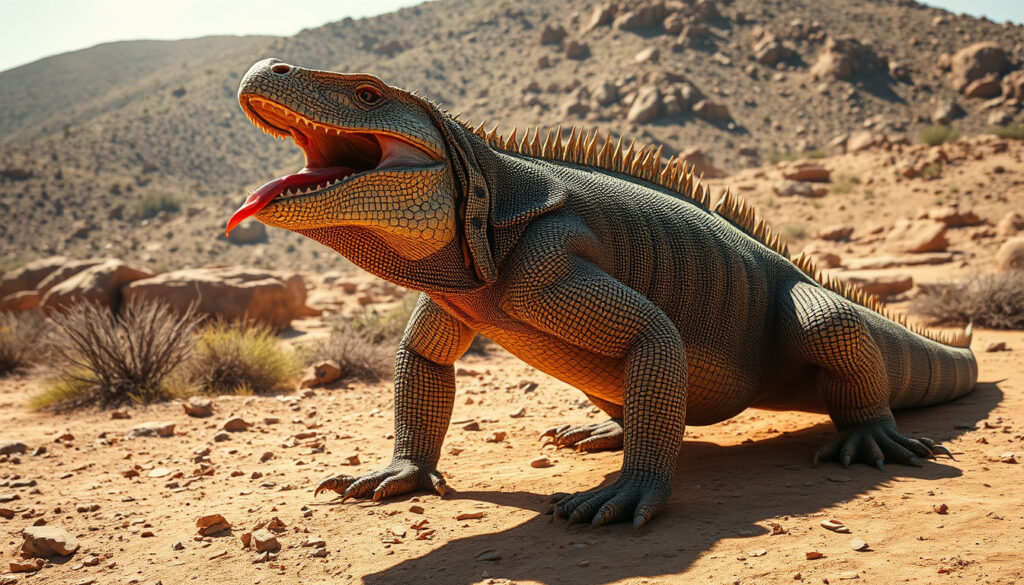
There’s a reason movies and myths keep returning to dragons — but the Komodo dragon is real, and it’s far more fascinating than fiction. This guide goes beyond the headlines to explore the sensory arsenal, the venomous bite, the conservation crisis, and the real danger to humans, all backed by the latest research.
Maximum length: 3 meters (10 feet) ·
Maximum weight: 150 kilograms (330 pounds) ·
Top speed: 20 km/h (12 mph) ·
Venomous bite: Yes, with anticoagulant and hypotensive effects ·
Lifespan in wild: 30 years ·
Population status: Endangered (IUCN)
Quick snapshot
- World’s largest living lizard (Smithsonian National Zoo)
- Endemic to a handful of Indonesian islands (Natural History Museum)
- Venomous bite with anticoagulant effects (Smithsonian National Zoo)
- Exact number of human fatalities due to lack of reporting
- Whether venom or mouth bacteria is primary kill mechanism
- Effectiveness of antivenom in humans is unproven
- 2021: IUCN reclassified to Endangered (Natural History Museum)
- 2009: Attack in Komodo National Park, victim survived (Natural History Museum)
- 2008: 8-year-old boy killed on Komodo Island (Natural History Museum)
- Climate change may shrink habitat by 30% in 45 years (Global Conservation)
- Ongoing conservation efforts in Komodo National Park (Global Conservation)
- Tourism disturbance at nesting sites is a growing concern (Global Conservation)
Six key specifications, one pattern: the Komodo dragon is built for dominance in its niche — size, speed, venom, and sensory power all converge into a single overwhelming predatory package.
| Attribute | Value |
|---|---|
| Scientific name | Varanus komodoensis |
| Maximum length | 3 m (10 ft) |
| Maximum weight | 150 kg (330 lb) |
| Average lifespan | 30 years |
| Top speed | 20 km/h (12 mph) |
| Population status | Endangered (IUCN) |
The pattern is clear: every specification serves the same purpose — making the Komodo dragon the undisputed apex predator of its island ecosystem.
Can a Komodo dragon harm a human?
The short answer is yes. The Smithsonian National Zoo (zoological authority) states that an attack from a Komodo dragon can be fatal, even to humans. These lizards are apex predators with a predatory toolkit that makes them dangerous to anything that moves.
How Komodo dragons hunt
- Ambush predators — they lie in wait along game trails and strike with explosive speed.
- A single bite delivers venom from glands in the lower jaw, causing hypotension and preventing blood clotting (Smithsonian National Zoo).
- They can run up to 20 km/h (12 mph) in short bursts, faster than most humans can sprint.
Recorded attacks on humans
- 2008: An 8-year-old boy was killed on Komodo Island.
- 2009: A man was severely injured in Komodo National Park but survived.
- 1974: Two Swiss tourists were killed on Rinca Island.
Venom and bacteria role
The venom contains toxins that induce shock and anticoagulation. Historically, scientists believed bacteria in the mouth caused fatal infections, but modern research — including work by venom researcher Dr. Bryan Fry (University of Queensland) — has shown that venom itself plays the primary role in incapacitating prey. The exact mechanism is still debated: venom versus bacteria being the chief cause of death in prey remains an open question in the literature.
How many humans have been killed by Komodo dragons?
Confirmed fatalities are rare, but they happen. According to historical records, fewer than 10 confirmed deaths have occurred in the last century.
Historical fatality counts
- 1974: Two Swiss tourists on Rinca Island.
- 2008: An 8-year-old boy on Komodo Island.
- Other documented cases involve local villagers who came too close.
The exact number of human fatalities is uncertain due to a lack of systematic reporting in remote areas.
Most recent incidents
In 2009, a Komodo dragon attacked a man inside Komodo National Park. The victim survived after being airlifted to a hospital, illustrating both the danger and the possibility of survival with prompt care.
Comparison with other large predators
While Komodo dragons are far less deadly to humans than crocodiles or big cats on a per-encounter basis, their venomous bite and the remote location of attacks make each incident particularly severe. A tiger or lion attack often draws immediate rescue resources; a Komodo dragon attack on a remote island can leave victims hours from medical help. The implication: the survival rate depends heavily on geography and infrastructure.
For a villager on a remote Indonesian island, a Komodo dragon bite is a far deadlier proposition than for a tourist in a national park with evacuation protocols, because the time to reach a hospital with antivenom and surgical care is measured in hours, not minutes.
What if a Komodo dragon licks you?
Licking is not an aggressive act, but it signals something important.
Why Komodo dragons lick
- They use their forked tongues to sample airborne scent particles.
- The tongue transfers particles to the Jacobson’s organ in the roof of the mouth, allowing them to “smell” in stereo.
- They can detect carrion from up to 9.5 km (5.9 miles) away.
Is licking dangerous?
There is no direct harm from the lick itself. But if a Komodo dragon is close enough to lick you, you are well within striking distance. The behavior indicates the animal is investigating whether you are food. A lick is a precursor to a potential bite. The pattern: a warning signal, not an attack.
For a hiker in Komodo National Park, a lick from a Komodo dragon is the point at which you should slowly back away. It means the animal has classified you as something worth investigating, and the next step could be a bite.
Can a person survive a Komodo dragon bite?
Yes — but survival depends entirely on how quickly medical care is reached.
Immediate first aid
- Stop the bleeding with direct pressure.
- Immobilize the limb to slow venom spread.
- Evacuate to a hospital immediately.
Medical treatment and antibiotics
The bite causes severe tissue damage, blood loss, and introduces venom and bacteria. Treatment includes wound cleaning, antibiotics, and in some cases, surgery to remove necrotic tissue. The Smithsonian National Zoo (zoological authority) emphasizes that bites merit serious medical concern due to the risk of sepsis and the anticoagulant effects of the venom.
Survival rates and case examples
- The 2009 attack victim survived after evacuation.
- Several other documented survivors exist, including some who did not require amputation.
- Fatalities typically occur when victims cannot reach a hospital within hours.
The trade-off: a survivor near a medical facility faces a long recovery; a victim in a remote area faces a far higher risk of death from blood loss and infection.
What are 5 interesting facts about Komodo dragons?
1. They are the largest lizards on Earth
Adult males reach up to 3 meters (10 feet) long and weigh up to 150 kilograms (330 pounds), according to the Smithsonian National Zoo (zoological authority).
2. They have a venomous bite
Venom glands in the lower jaw produce toxins that inhibit blood clotting and cause hypotension. The venom is a sophisticated weapon, not just a dirty mouth — research by Dr. Bryan Fry (venom researcher at University of Queensland) has documented its complexity.
3. They can eat up to 80% of their body weight in one meal
This remarkable capacity allows them to fast for weeks between kills, a survival adaptation in an environment where large prey is not always available.
4. They are found only on a few Indonesian islands
Endemic to Komodo, Rinca, Flores, Gili Motang, and Padar islands — five islands total — according to the Natural History Museum (London-based research institution).
5. They have a keen sense of smell that can detect carrion from miles away
Their forked tongues and Jacobson’s organ enable them to locate carrion from up to 9.5 km (5.9 miles) away.
Comparison: Komodo dragon vs other large reptiles
Three competitors, one question: how does the Komodo dragon stack up against other reptilian giants? The comparison reveals a creature built for endurance and venom, not brute force.
| Feature | Komodo dragon | Saltwater crocodile | Nile monitor |
|---|---|---|---|
| Maximum length | 3 m (10 ft) | 6 m (20 ft) | 2.1 m (7 ft) |
| Maximum weight | 150 kg (330 lb) | 1,000 kg (2,200 lb) | 20 kg (44 lb) |
| Venom | Yes (hypotensive, anticoagulant) | No | Mild venom, not significant |
| Bite force | Moderate (600 N) | Extreme (16,000 N) | Moderate |
| Land speed | 20 km/h (12 mph) | 16 km/h (10 mph) short bursts | 28 km/h (17 mph) |
| Conservation status | Endangered (IUCN) | Least Concern | Least Concern |
The catch: while the saltwater crocodile wins on raw power and size, the Komodo dragon’s venomous bite gives it a unique edge — it can wound prey and then track it until infection or blood loss finishes the job.
Conservation and the future
The Komodo dragon’s Endangered status, assigned by the IUCN (global conservation authority) in September 2021, reflects a stark reality: fewer than 1,400 adult dragons remain in the wild. Climate change, habitat loss, and poaching are the primary drivers.
The Global Conservation (international NGO focused on endangered species) warns that rising sea levels could shrink Komodo dragon habitat by at least 30% over the next 45 years, threatening nesting beaches that are essential for reproduction.
For the Indonesian government and Komodo National Park authorities, the choice is clear: expand protected zones, enforce anti-poaching laws, and manage tourism disturbance at nesting sites — or watch the world’s largest lizard inch closer to extinction.
komodoguide.org, en.wikipedia.org, globalconservation.org, komodoguide.org, fr.wikipedia.org, theconversation.com, discoverwildlife.com, rainforest-rescue.org, iucnredlist.org, theguardian.com, aussiemonitorly.org
For a deeper look at real-world encounters, this guide on Komodo dragon attack dangers separates myth from fact.
Frequently asked questions
Could a Komodo dragon be a pet?
No. Komodo dragons are wild, dangerous, protected under Indonesian law, and listed as Endangered. Keeping one as a pet is illegal in virtually every jurisdiction and extremely dangerous.
What famous person got bit by a Komodo dragon?
In 2007, British wildlife presenter and conservationist Steve Backshall was bitten on the leg by a Komodo dragon during a filming expedition. He survived after receiving medical treatment.
How fast can a Komodo dragon run?
They can reach speeds of up to 20 km/h (12 mph) in short bursts. That is faster than the average human can sprint over a short distance.
Are Komodo dragons endangered?
Yes. The IUCN reclassified them from Vulnerable to Endangered in 2021. Fewer than 1,400 adult dragons remain in the wild.
Do Komodo dragons eat humans?
Attacks on humans are rare but documented. They are opportunistic predators and will attack humans if they feel threatened or if the human is small and vulnerable.
How long do Komodo dragons live?
In the wild, they can live up to 30 years. In captivity, with veterinary care and reliable food sources, they may live even longer.
What is the difference between a Komodo dragon and a monitor lizard?
A Komodo dragon is a monitor lizard — the largest species in the monitor family (Varanidae). All Komodo dragons are monitor lizards, but not all monitor lizards are Komodo dragons.
Can a Komodo dragon kill a crocodile?
In water, a saltwater crocodile would overpower a Komodo dragon. On land, a Komodo dragon’s venom could potentially weaken a smaller crocodile, but an adult saltwater crocodile is far too large and powerful.
Related reading
- David Attenborough — the world’s most renowned natural historian has featured Komodo dragons in his acclaimed documentaries, including Life in Cold Blood and Planet Earth.
- John Smith: Explorer vs Labour Leader — the explorer angle provides a thematic connection to the discovery of Komodo dragons by Western science in the early 20th century.
For the Komodo dragon, the choice is stark: continued conservation investment and climate adaptation — or a slow retreat toward extinction on five shrinking islands. The data says the window is narrowing. For Indonesia and the global conservation community, the next 45 years will determine whether the world’s largest lizard remains a living reality or becomes just another legend.
Related stories





Craig Newton is Senior Reporter at ScopePress.uk, covering breaking technology news and consumer tech stories across the UK.