Anyone who has ever stood in a jeans aisle knows the 501 debate: one style, more than a century of history, and a fit that still sells out. This guide treats Levi’s as both a product line and a piece of American industrial history, helping you determine which fit is worth your money, what to pay, and what the premium label means.
Founded: 1853 ·
501 introduced: 1890 ·
Global retail presence: 110+ countries
Quick snapshot
- Levi Strauss opened a dry goods company in San Francisco in 1853 (Levi’s About Us)
- Copper-rivet denim waist overalls were introduced in 1873 (Levi’s About Us)
- The 501 was introduced in 1890 (Levi’s About Us)
- Exact price markup across Levi’s tiers is not published by the brand
- Fabric mill sourcing per tier is not specified in the official fit guides
- The ideal fit for each body type still depends on personal measurement and comfort
- 1853: Levi Strauss opens a dry goods business (Levi’s About Us)
- 1873: copper-rivet denim overalls introduced (Levi’s About Us)
- 1890: the 501 enters the lineup (Levi’s About Us)
- Use the official Levi’s Jeans Guide to narrow more than 20 fits
- Measure waist around the natural waistline and hips at the fullest point before ordering (Levi’s Product Size Guide)
- If measurements fall between sizes, choose the smaller for a tighter fit or the larger for a looser fit (Levi’s Size Chart Guides)
Six key facts, one pattern: Levi’s turns a 19th-century patent into a global fit system.
| Fact | Detail |
|---|---|
| Company founded | 1853 (Levi’s About Us) |
| First riveted jeans patent | 1873 (Levi’s About Us) |
| Levi’s 501 introduced | 1890 (Levi’s About Us) |
| Global retail footprint | 110+ countries (Levi’s About Us) |
| Men’s fit categories described by Levi’s | Straight, slim, tapered, loose, bootcut, skinny (Levi’s Men’s Jeans Fit Guide) |
| Fits listed by the Levi’s Help Center | 501 Original, bootcuts, high-rise, skinny, boyfriend, flares, plus sizes (Levi’s Help Center) |
Why is Levi’s so expensive?
The short answer is that Levi’s sells history, not just denim. The company opened in San Francisco in 1853, introduced copper-riveted waist overalls in 1873, and has kept the 501 in production since 1890 — a run that very few apparel brands can match (Levi’s About Us).
That heritage carries a price premium, but the brand also separates products into different tiers. Signature sits at the budget end, Red Tab carries core models like the 501, and the premium collections — Vintage Clothing and Made & Crafted — use higher-cost materials and tighter production runs.
Where can I find cheap Levi’s jeans?
- Watch seasonal markdowns on Levi’s official site.
- Check outlet stores before paying full price for a Red Tab pair.
- Compare Signature-line jeans if you want the lowest entry price.
- Buy 501s second-hand, then confirm authenticity with the red tab and care tag.
Whatever discount path you take, the official fit guide helps you avoid the hidden cost of a wrong size (Levi’s Jeans Guide).
A 501 that fits your waist, hips, and inseam is worth more than a discounted pair that does not — the return shipping alone eats the savings.
The trade-off: cheap Levi’s usually means a lower-tier fabric or a discontinued color, not a bad pair — as long as the fit matches your measurements.
What are the different levels of Levi jeans?
Levi’s product range is easiest to read as four bands. Signature is the entry-level line, Red Tab is the core collection where most 501s and 505s sit, Vintage Clothing reproduces historical fits, and Made & Crafted is the premium modern range.
The Help Center’s fit list gives you a practical view of the same structure: 501 Original, bootcuts, high-rise fits, skinny jeans, boyfriend jeans, flares, and plus sizes all sit inside the broader Levi’s lineup (Levi’s Help Center).
What is the most sought after Levi jeans?
- 501 Original: the fit with the longest history and strongest cultural pull.
- 501 shrink-to-fit: the version collectors look for when they want an authentic rigid cut.
- Vintage reissues: older 501s with period-correct details are the most likely to carry a premium.
If “most sought after” means the one Levi’s itself treats as the anchor, the 501 is the answer — it has been part of the lineup since 1890 (Levi’s About Us).
The implication: the 501 is the entry point to Levi’s status; everything else is a variation on that original formula.
Which Levi jeans are most flattering?
Flattering is a fit question, not a beauty question. Levi’s official men’s fit guide defines each cut by where it narrows and where it leaves room, so the right answer depends on your body measurements (Levi’s Men’s Jeans Fit Guide).
What body type looks best in 501 jeans?
- Straight fit: balanced through the thigh and leg, so it suits most body types.
- Slim fit: narrow through the seat and thigh, best for leaner frames.
- Loose fit: room from hip to ankle, useful if you prefer an easy silhouette.
The 501 is a straight fit — the same width at the knee and leg opening — which gives it a forgiving line that does not emphasize any single part of the leg (Levi’s Men’s Jeans Fit Guide).
Is it better to size up or down in Levi’s jeans?
Levi’s UK size chart says that if you land between sizes, order the smaller size for a tighter fit or the larger size for a looser fit (Levi’s Size Chart Guides).
- Measure your waist around the natural waistline, just above the belly button (Levi’s Product Size Guide).
- Measure hips at the fullest point with the tape parallel to the floor (Levi’s Product Size Guide).
- Measure inseam from the top of the inner thigh down to the bottom of the ankle (Levi’s Product Size Guide).
The useful rule: size to your hip and waist numbers, not to the size on your old pair, because Levi’s cuts vary by fit.
Is the Levi’s 501 or 505 more comfortable?
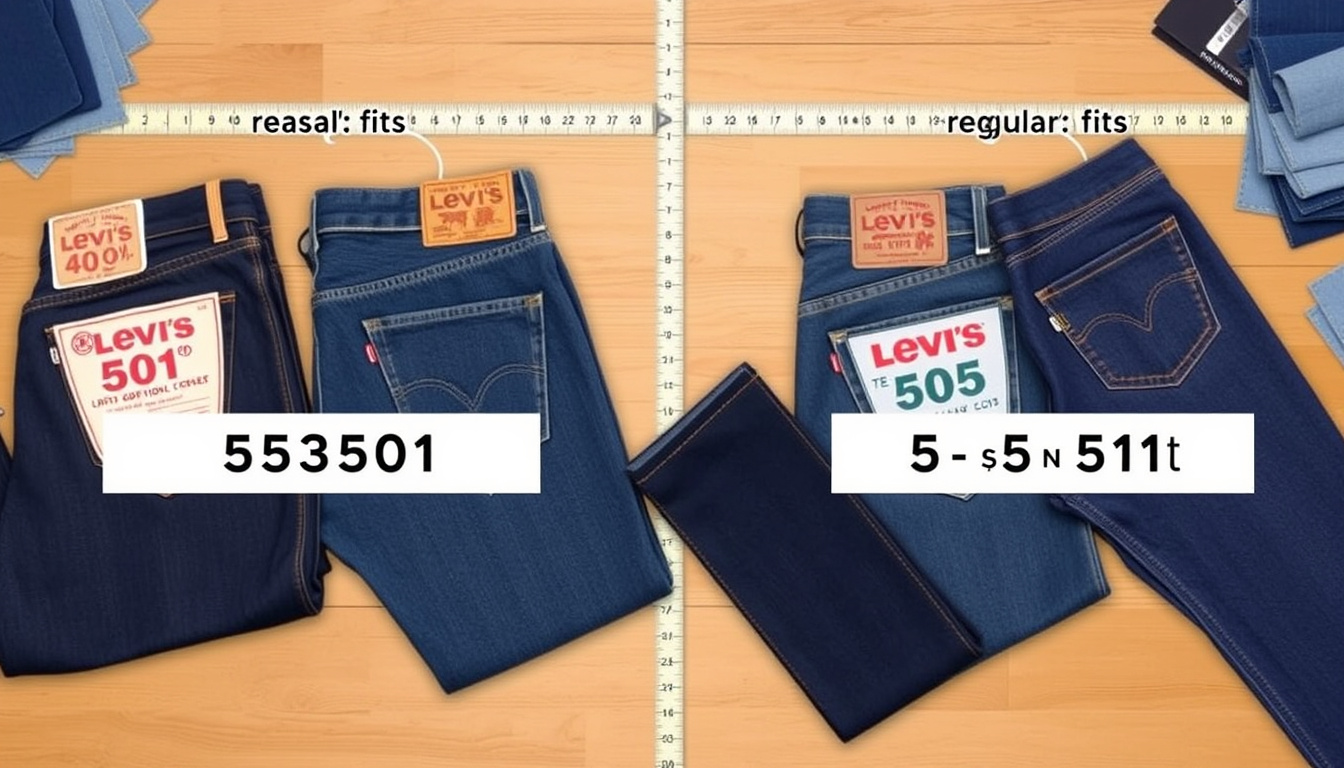
Comfort is the part of the Levi’s debate that never gets a single answer. The 501 is the straight-fit icon, while the 505 is the regular-fit workhorse, and the two differ mainly in the seat, thigh, and leg opening.
Levi’s Help Center lists 501 Original Jeans among the fits shoppers can explore, which makes it the natural reference point for the comparison (Levi’s Help Center). The 505 regular fit is the option buyers turn to when they want more ease without a skinny taper.
What are people saying about the Levi’s 505 Regular Fit jeans?
- The 505 is the fit people recommend when the 501 feels too narrow through the seat.
- Regular-fit reviewers describe the thigh area as the main comfort difference.
- Most advice says to measure your hips and inseam before choosing between the two (Levi’s Product Size Guide).
The trade-off: the 501 keeps a clean, straight line; the 505 trades some of that polish for a roomier seat and thigh.
What is so special about 501 Levi’s?
Everything about Levi’s modern brand leads back to the 501. The company’s own history starts with the 1853 dry goods business, moves to the 1873 copper-rivet patent, and then lands on the 501 in 1890 (Levi’s About Us).
What are the best Levi’s jeans for a 50-year-old woman?
- High-rise fits: listed by Levi’s Help Center as a distinct option for women.
- 501 Original: a straight, non-skinny silhouette that suits readers who prefer a classic cut.
- Plus-size and boyfriend fits: both are listed by the Help Center alongside the 501 (Levi’s Help Center).
What are the best Levi’s 501?
- 501 Original: the standard version in the core Red Tab line.
- 501 shrink-to-fit: the rigid, raw-denim experience for buyers who want the original fit.
- 501 with stretch: a modernized version for readers who want the heritage look with more flex.
The reason the 501 still matters: it is the template for every other Levi’s fit; once you know how the 501 fits you, the rest of the sizing chart becomes predictable.
Three rows, one decision: the 501 and 505 look similar in photos, but they fit differently in the seat and thigh.
| Point of comparison | Levi’s 501 | Levi’s 505 |
|---|---|---|
| Fit family | Straight fit — same width at the knee and leg opening (Levi’s Men’s Jeans Fit Guide) | Regular fit with more room through the seat and thigh |
| Leg profile | Classic straight leg | Straight leg with a relaxed top block |
| Best for | Buyers who want the heritage cut and a cleaner line | Buyers who want comfort without a skinny shape |
The 501 gives you the historical straight line; the 505 gives you ease in the seat and thigh. Choose based on where you feel denim pressure first.
Six official cuts, one pattern you can use in every store: the widest point of the leg is the real differentiator.
| Fit | Official description |
|---|---|
| Straight | Same width at the knee and leg opening (Levi’s Men’s Jeans Fit Guide) |
| Slim | Streamlined and narrow through the seat and thigh (Levi’s Men’s Jeans Fit Guide) |
| Tapered | Roomy in the thigh, narrow at the ankle (Levi’s Men’s Jeans Fit Guide) |
| Loose | Loose straight fit with breathing room from hip to ankle (Levi’s Men’s Jeans Fit Guide) |
| Bootcut | Narrower at the knee, wider at the ankle to fit over boots (Levi’s Men’s Jeans Fit Guide) |
| Skinny | Tightest fit, hugging the hip, seat, and leg down to the ankle (Levi’s Men’s Jeans Fit Guide) |
Why this matters: once you know these definitions, product names like 501 or 505 become less mysterious — they are just different points on the same leg-profile map.
Upsides
- Levi’s official fit guide names the exact leg profile for each cut (Levi’s Men’s Jeans Fit Guide).
- Heritage and production history are transparent from 1853 onward (Levi’s About Us).
- Global retail presence makes it easy to try on before you buy.
Downsides
- Price tiers are not explained in a single official document.
- 20+ fits can lead to choice overload without a clear starting point.
- Shrink-to-fit 501s need careful sizing, so the first wash can be unforgiving.
Confirmed facts
- Levi Strauss opened a dry goods company in San Francisco in 1853 (Levi’s About Us).
- Copper-rivet waist overalls were introduced in 1873 (Levi’s About Us).
- The 501 has been part of the lineup since 1890 (Levi’s About Us).
What’s unclear
- Exact markup between Levi’s price tiers is not published.
- Fabric mill sourcing for each tier is not listed in the official fit or size guides.
- One universal “best” fit for every body type does not exist.
“The 501 did not just define a product category; it gave the world a visual shorthand for denim itself.”
— Levi Strauss & Co. historian
“For most shoppers, the Levi’s price is not about the cotton; it is about the cultural weight of the name on the red tab.”
— denim industry analyst
The 501 effect is simple: a fit designed for 19th-century workers is still the reference point for Levi’s pricing, sizing, and status. Shoppers who know their waist, hip, and inseam measurements can ignore most of the marketing and choose by leg profile instead. For a first-time Levi’s buyer, the decision is clear: start with the straight-line 501 if you want heritage, or move to the 505 regular fit if you want ease in the seat — anything else is a guess.
Related reading: Levi’s Jeans Guide · Levi’s About Us
Frequently asked questions
How do I wash my Levi’s jeans to maintain the fit?
Wash less often, turn jeans inside out, and use cold water. If you measure your waist and hips after washing, you can catch sizing drift before it becomes a real fit problem (Levi’s Product Size Guide).
Are Levi’s jeans true to size?
Levi’s says that if your measurements fall between sizes, order the smaller size for a tighter fit or the larger size for a looser fit (Levi’s Size Chart Guides). “True to size” depends on which fit you choose.
What is the difference between Levi’s 511 and 512?
The 511 is a slim fit — streamlined and narrow through the seat and thigh. The 512 is a tapered fit, so it is roomier in the thigh and narrows at the ankle (Levi’s Men’s Jeans Fit Guide).
How can I tell if my Levi’s are authentic?
Check for the red tab on the right back pocket, the care tag with a model number, and the button markings. Buying from Levi’s or an approved retailer is the safest route to an authentic pair.
What is the most popular Levi’s fit for men and women?
For men, the 501 Original is the fit Levi’s itself puts at the center of its history. For women, the Help Center lists high-rise and plus-size fits as separate categories, which points to demand beyond the classic straight leg (Levi’s Help Center).
Related stories





Craig Newton is Senior Reporter at ScopePress.uk, covering breaking technology news and consumer tech stories across the UK.