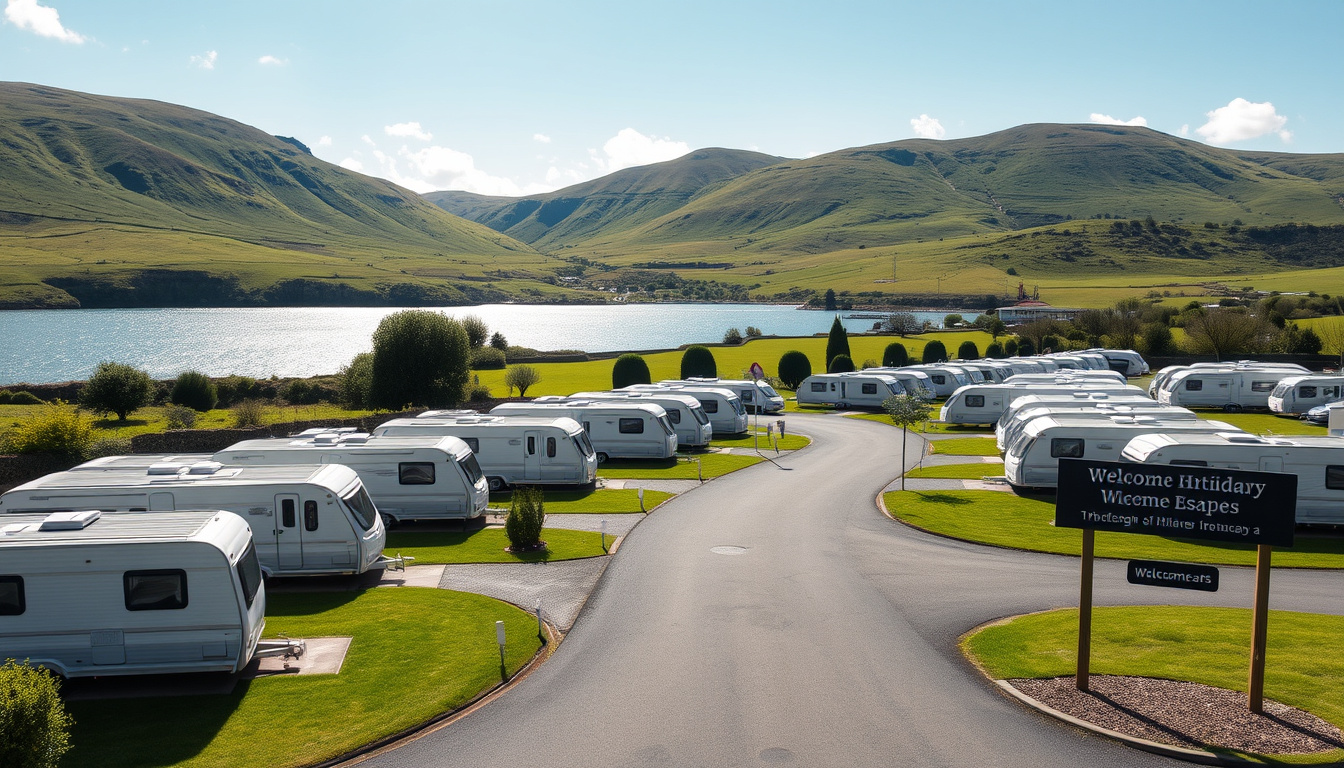
If you’ve been typing “caravan parks near me” into your phone, hoping for something more than a vague Google result, you’re in the right place. Ireland has a surprisingly active caravan and camping scene — and the rules vary significantly between the Republic and Northern Ireland, from council-run sites with strict five-night limits to family-run parks that welcome you well into autumn.
Top Parks Listed: 5 · Primary Region: Ireland · Key Rules Covered: 10-Year Rule · Park Types: Caravan & Camping
Quick snapshot
- Clare Glen enforces a hard 5-night maximum stay (Armagh Council / Get Active ABC)
- Republic of Ireland pitches start from €20/night on Pitchup.com (Pitchup.com)
- Garrettstown House Holiday Park in Kinsale accepts all unit types year-round (Garrettstown House)
- Exact enforcement of any “10-year rule” varies by local planning authority
- Specific long-term residential caravan rental prices are rarely published
- No single government registry of parks that allow permanent residency
- Clare Glen’s 2025–2026 pricing runs 1 April 2025 to 31 March 2026
- Several all-year parks adjust opening dates at short notice
- Year-round parks in the Republic remain the most practical option for extended stays (Camping Ireland)
- Static caravan ownership at parks like Edgewater bypasses short-stay limits entirely (Edgewater Holiday Park)
The parks below range from adventure-focused nature retreats to council-operated touring sites — and knowing which type you’re booking matters more than most visitors realise.
| Park | Key Detail |
|---|---|
| Hidden Valley Ireland | Adventure & glamping focus |
| Blarney Caravan & Camping Park | Four-star family-run |
| Wave Crest Caravan & Camping | Ring of Kerry location |
| Adare Caravan & Camping Park | County Limerick base |
| Clare Glen Caravan Park | Max 5 nights, £25.50 |
| Edgewater Holiday Park | Static-only, Co Down |
| Garrettstown House Holiday Park | Year-round, West Cork |
What is the 10 year rule for caravans?
The “10-year rule” is a phrase that surfaces frequently in caravan forums, but it’s worth being precise about what it actually means in practice. Under Irish planning law, a caravan or mobile home placed on land for more than 10 years can trigger a change-of-use consideration — essentially, it may no longer be treated as a temporary structure. That distinction matters because it affects site licence conditions and local authority enforcement.
Application to static caravans
Static caravans — privately owned units placed on a park long-term — sit in a grey area. The rule technically applies to the land use, not the caravan itself, which means enforcement varies significantly between local authorities. In Northern Ireland, parks like Edgewater Holiday Park in Minerstown, Co Down operate under council licensing frameworks that don’t explicitly reference a 10-year residential exemption. In practice, most static caravan parks are marketed as holiday ownership, not primary residences, which sidesteps the issue entirely.
“We are a short stay caravan park and therefore caravans and motorhomes are permitted to stay for a maximum of 5 nights.” — Clare Glen Caravan Park (Armagh City, Banbridge and Craigavon Borough Council)
Implications for park stays
For touring caravans and motorhomes, the 10-year rule has minimal direct impact — you’re renting a pitch, not owning a structure on the land. Clare Glen Caravan Park in Tandragee, Co Armagh, is explicit about its position: “We are a short stay caravan park and therefore caravans and motorhomes are permitted to stay for a maximum of 5 nights,” according to the Armagh City, Banbridge and Craigavon Borough Council. No park in the research explicitly confirmed a 10-year residency pathway.
“Clare Glen Caravan Park is a short-term recreational/leisure/tourism stays only & we do not accept Tent bookings.” — Armagh City, Banbridge and Craigavon Borough Council (Get Active ABC)
If you’re considering a static caravan purchase, ask the park operator directly whether their licence permits residential use — holiday parks typically do not, and attempting to use one as a primary residence can put both the park and the owner at risk of planning enforcement.
The implication is that the 10-year rule functions as a planning trigger rather than an outright ban: local authorities may investigate land use after a decade, but enforcement remains inconsistent and often depends on complaints or site-specific factors.
Where can I permanently live in a caravan?
Full permanent residency in a caravan or mobile home on a standard holiday park is rare in Ireland, and the research didn’t turn up parks explicitly licensed for it. What does exist is a spectrum: touring pitches for short-term leisure, static caravan pitches for holiday ownership, and a small number of sites with residential designations — though these typically fall under different regulatory categories entirely.
UK vs Ireland options
Northern Ireland parks operate under UK planning guidance, which allows for some residential caravan designations in specific circumstances. In the Republic, the situation is more restrictive — most caravan parks are classified as holiday accommodation under Fáilte Ireland standards, which explicitly exclude primary residence use. Dundonald Touring Caravan Park in Co Antrim appears on Camping Ireland’s all-year list, but it’s listed as a touring park, not a residential site.
Long-term park requirements
For those seeking extended stays, the practical options are: year-round parks with flexible booking (like Garrettstown House Holiday Park in Kinsale, which accommodates caravans, tents, and motorhomes all year), or static caravan ownership where you buy the unit outright and pay an annual pitch fee. Castle Archdale Holiday Park in Fermanagh offers fully serviced static and touring pitches on Lough Erne — useful for those who want a base without committing to a single park.
“Please check before travelling as dates may change at short notice.” — Camping Ireland (Camping Ireland)
Buying a static caravan doesn’t automatically give you residential rights — parks can change their terms, charge exit fees, or sell the land, and the long-term financial and legal security differs significantly from renting or owning a conventional property.
The pattern is clear: true year-round residency requires either a park explicitly licensed for residential use (rare and typically outside mainstream holiday park categories) or accepting the limitations of holiday-park ownership where your investment remains contingent on the operator’s continued licensing.
How much does it cost to park a caravan in Ireland?
Pricing varies considerably between Northern Ireland and the Republic, and between touring pitches versus static caravan pitches. Here’s what the data shows.
Seasonal rates
Clare Glen Caravan Park charges £25.50 per caravan per night for the 2025–2026 season, inclusive of VAT, with group rates available for bookings of 10 or more caravans. The park operates from 1 April 2025 to 31 March 2026, with office hours Monday to Friday 9am–9pm and Saturday 9am–5pm. Across the border in the Republic, Pitchup.com lists motorhome pitches open all year from €20–€25 per night for non-electric grass pitches. These figures represent the budget end of the market — serviced hard-standing pitches with full hook-ups typically cost more.
Examples from Wicklow parks
Camac Valley in Dublin appears on the all-year list maintained by Camping Ireland, but specific Wicklow pricing wasn’t available in the research. The pattern across the Republic is that winter pricing often requires direct enquiry because many parks adjust rates seasonally or offer discounted winter packages. Camping Ireland advises checking with parks directly, as “dates may change at short notice.”
Budget-conscious travellers should account for more than the headline pitch rate: hook-up upgrades, late checkout fees, and tourism levies routinely add 15–30% on top of the base cost at higher-rated parks.
The comparison shows Northern Ireland’s council-run Clare Glen at £25.50 is competitive with Republic pitches starting at €20–€25, but the Republic figure often excludes services that NI pitches bundle in — always confirm what’s included before comparing across jurisdictions.
Can you live in your caravan all year round?
Technically yes, in the sense that several parks are open 365 days a year. Practically, it depends on whether the park’s licence allows it, what your insurance covers, and whether you’re willing to navigate seasonal access restrictions.
Year-round park policies
Multiple sites in the Republic operate all year, according to Camping Ireland: Dundonald Touring Caravan Park (Co Antrim), Camac Valley (Dublin), Ferrybank Caravan & Camping Park (Co Wexford), and Lynders Holiday Park in Dublin are among those listed. In Northern Ireland, Clare Glen is open all year except three days over Christmas, though it explicitly prohibits residential or employment use. Bunk Campers also lists sites like Top of the Rock Pod Páirc (Co Cork) and Cong Caravan & Camping Park (Co Mayo) as open year-round.
Insurance considerations
Standard caravan insurance policies typically have exclusions for extended off-site stays, particularly over winter. If you’re planning to live in your touring caravan or motorhome year-round, you’ll need a specialist policy that covers continuous habitation — these exist but cost more and have stricter terms. Parks like Edgewater, which cater to static caravan owners, may have group insurance arrangements, but touring units are generally covered by the owner’s own policy.
The takeaway is that insurance and licensing are separate barriers: a park may welcome 365-day stays for leisure, but using that stay as your primary address requires both the right licence category and a policy that explicitly covers permanent habitation.
Where can you sleep in a campervan for free?
Free overnight parking for campervans is a contentious issue across Ireland, and the rules differ significantly between the Republic and Northern Ireland.
UK layby rules
In Northern Ireland and the wider UK, sleeping in a vehicle on a public layby is generally not permitted, even if the vehicle is self-contained. Police can move on campervans if they’re causing an obstruction or if local by-laws prohibit overnight parking. Clare Glen explicitly prohibits commercial vehicles and trading, but doesn’t address the layby question — because it operates as a managed site, not a public right-of-way.
Ireland alternatives
In the Republic of Ireland, wild camping is technically illegal on most public land, though enforcement varies. Some local authorities have designated Aires — informal stopover points — but comprehensive public campervan stopovers are less developed than in France or Germany. The practical alternatives are: Certificated Locations (CLs) in the UK and Ireland, which are private smallholdings that allow a few campervans overnight, often for a small fee; or paying for a night at an established park. Bunk Campers maintains a winter-access list of sites that require pre-booking, which is worth checking if you’re travelling off-season.
Free overnight options exist but carry real risk — fines, being moved on, or arriving at a spot already full. For peace of mind, a low-cost certified site or a night at a council-run park costs roughly the same as a takeaway coffee and a sandwich, and you won’t wake up to a parking ticket.
The reality is that genuinely free overnight options for campervans are scarce and legally ambiguous across both jurisdictions, making the modest cost of a certified location or park pitch a worthwhile trade-off for certainty and safety.
Upsides
- Year-round parks available in both NI and Republic
- Clear pricing from council-run sites like Clare Glen (£25.50)
- Static caravan ownership bypasses short-stay limits
- Family-run parks often offer more flexible terms
- Multiple all-year sites listed by Camping Ireland and Bunk Campers
Downsides
- Most parks prohibit residential use
- “10-year rule” enforcement is inconsistent and poorly documented
- Permanent residency parks are extremely rare in Ireland
- Free campervan options carry legal risk
- Winter access often requires pre-booking
- Long-term rental prices are not publicly listed
How to choose a caravan park for your stay
Five practical steps narrow down the options.
- Define your duration first. A 5-night weekend trip and a 3-month base have completely different park requirements. If you’re staying more than a week, filter for all-year parks immediately.
- Check the park’s licence category. Is it a touring park, a static holiday park, or a residential site? This is the single most important question, and many park websites state it directly.
- Call or email the park directly. Listings on aggregators like Pitchup.com and Camping Ireland are useful starting points, but prices, availability, and winter access policies often change. Garrettstown House and Dundonald both list themselves as open all year, but always confirm before driving across the country.
- Compare pitch types and costs. Clare Glen charges £25.50 for a fully serviced touring pitch with 25 hard-standing options. Republic pitches on Pitchup.com start at €20 for grass without hook-up. Weigh whether the extra cost of a hard-standing pitch is worth it for your unit type.
- Factor in your insurance and vehicle restrictions. Clare Glen prohibits commercial vehicles and more than one vehicle per pitch, with no engines allowed between 11pm and 6am. Edgewater targets static caravan owners, not touring visitors. Read the small print before you arrive.
Summary
Ireland’s caravan park landscape is more varied than it first appears — council-operated sites like Clare Glen enforce strict five-night limits and require pre-booking, while privately run parks like Garrettstown House in Kinsale offer genuine year-round access for touring units. The “10-year rule” remains a legal concept rather than a widely enforced park policy, and permanent residential caravan use is rare to nonexistent at mainstream holiday parks in either jurisdiction. For visitors seeking extended stays, the clearest paths are: booking into an all-year park in the Republic (from €20 per night), or purchasing a static caravan on a managed park like Edgewater, where ownership terms sidestep the short-stay limits entirely. Anyone considering a longer stay should verify the park’s licence category, check insurance covers continuous habitation, and call ahead — particularly for winter access, where pre-booking is often mandatory and policies change at short notice.
Related reading: Foot Massage Near Me Ireland
For year-round living in these parks, many consider static caravans for sale to align with Ireland’s 10-year rule and manage costs wisely.
Frequently asked questions
What is the 85 rule for caravans?
The “85 rule” typically refers to UK caravan site licensing requirements under the Caravan Sites and Control of Development Act 1960, which sets conditions for site licence conditions. It does not appear in Irish planning legislation in the same form.
Can I sleep in my motorhome in a layby?
In Northern Ireland and the Republic, sleeping in a motorhome on a public layby is generally not permitted under road traffic regulations. Enforcement varies, but the risk of a fine or being moved on is real. Certified Locations (small private sites) or low-cost park pitches are safer alternatives.
What are the best holiday parks in Ireland?
Based on the research, top options include: Garrettstown House Holiday Park (Kinsale, West Cork — year-round), Wave Crest Caravan & Camping (Ring of Kerry — four-star), Blarney Caravan & Camping Park (near Cork city — four-star family-run), and Castle Archdale Holiday Park (Fermanagh — fully serviced sites on Lough Erne).
Are there static caravan parks in Ireland?
Yes. Edgewater Holiday Park in Minerstown, Co Down, caters specifically to privately owned static caravans, offering pitches with sea views, free internet in designated areas, and private beach access. These are typically marketed as holiday ownership, not primary residences.
What are caravan parks Ireland prices?
Republic of Ireland touring pitches on Pitchup.com start from €20–€25 per night for basic grass pitches open all year. Council-operated Clare Glen in Northern Ireland charges £25.50 per caravan per night for the 2025–2026 season, inclusive of VAT. Hard-standing pitches with full hook-ups typically cost more at both sites.
Do Haven holiday parks operate in Ireland?
Haven is a UK holiday park brand with extensive operations in Britain. As of the research date, Haven does not have branded parks in the Republic of Ireland or Northern Ireland. The parks listed in this article are independently operated or part of smaller regional networks.
Can I live in a caravan year round?
You can stay at year-round parks throughout the year, but “open all year” does not equal “licensed for residential use.” Most Irish caravan parks are classified as holiday accommodation. Full-time habitation typically requires a residential-designated site, which are uncommon and fall under different planning categories.
Related stories





Samuel Hart is Devices & Reviews Editor at ScopePress.uk, covering smartphones, laptops, hardware and hands-on reviews.