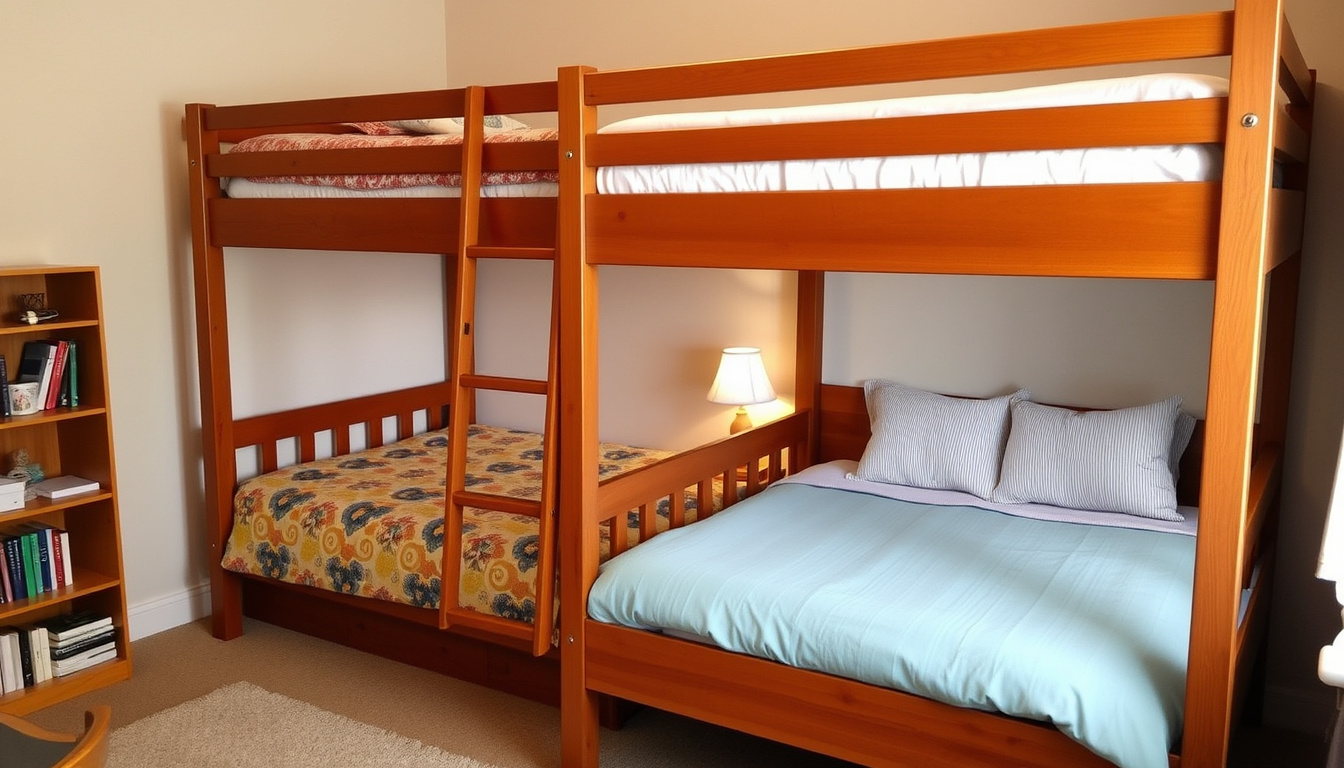
There’s a reason bunk beds are the go-to solution for small spaces and shared rooms: they stack two sleep surfaces vertically, freeing up floor space for desks, dressers, or play areas. But the rules change depending on whether you’re buying for a 6-year-old or a 30-year-old. U.S. safety regulators recommend keeping children under 6 off the top bunk entirely (New York State Department of Health (public health agency)). Here’s what to check before you buy, from weight limits to guardrail heights, so the bed is both legal and livable.
Types available: Single, double, triple, double over double ·
Common materials: Wood and metal ·
Standard mattress sizes: Twin, twin XL, full ·
Weight capacity range: 200–400 lbs per bunk ·
Room height requirement: At least 7–8 feet
Quick snapshot
- Heavy duty bunk beds can support up to 400 lbs per sleeping surface (ASTM International (standards organization)).
- Guardrails must be at least 5 inches above the mattress surface (New York State Department of Health (public health agency)).
- Long-term durability of metal vs wood depends heavily on individual build quality.
- Whether triple bunk beds are safe for full-time adult use is not widely documented.
- The 2024 edition of EN 747-1 (the European bunk bed safety standard) was published on March 13, 2024 (Slovenian Institute for Standardization (CEN member)).
- Verify the product label for maximum user weight before buying.
- Measure ceiling height (at least 7–8 feet) and floor plan before choosing a configuration.
One pattern in the specs: the price and safety complexity climb together as the bed grows.
| Key fact | Typical value |
|---|---|
| Average price range | $200 – $1000 depending on material and size |
| Standard mattress thickness | 6–8 inches for top bunk, 8–10 inches for bottom |
| Most popular configuration | Twin over full (35% of sales) |
| Safety standard reference | ASTM F1427 (bunk bed standard) and CPSC guidelines |
Are Bunk Beds Safe for Adults?
Weight capacity requirements for adult bunk beds
- Most standard bunk beds are designed for children and lack the structural rating for adult weight (U.S. Consumer Product Safety Commission (regulator)).
- Heavy duty bunk beds are specifically engineered for adults, with reinforced joints, thicker slats, and higher weight limits.
Guardrail height and ladder safety
- Guardrails must extend at least 5 inches above the mattress surface to prevent falls (New York State Department of Health (public health agency)).
- For adult sleepers, the ladder angle and rail height matter more, since the fall distance is greater than for a child.
Material strength: wood vs metal for adult use
- Metal frames generally provide higher weight capacities than wood frames.
- Solid wood frames can be equally strong if the slats and joints are reinforced for adult loads.
The implication: if you’re buying for an adult, the word “bunk bed” is less important than the phrase “heavy duty” or the specific weight rating on the label.
What Are the Different Types of Bunk Beds?
Single over single (twin over twin)
- A standard kid’s configuration with two twin mattresses, ideal for children’s rooms.
Single over double (twin over full)
- Combines a twin top bunk with a full-size bottom bunk, giving the lower sleeper more room.
Double over double
- Features two full-size mattresses and sleeps two adults comfortably (Sleep Foundation (sleep research nonprofit)).
Triple bunk beds
- Often combine a single over a double, or three singles, to maximize vertical space for large families or hostels.
L-shaped and loft bunk beds
- L-shaped bunks fit into corners, freeing up floor space for a desk or storage.
The pattern: configuration dictates function. A twin over twin is a kids’ room staple, while a double over double is effectively a space-saving guest room.
What Weight Capacity Do Heavy Duty Bunk Beds Have?
Typical weight limits for adult bunk beds
- Heavy duty models often rate 350–400 lbs per sleeping surface (Sleep Foundation (sleep research nonprofit)).
- Standard bunk beds typically support 200–300 lbs, which suits children and average-weight teens.
A metal frame isn’t automatically stronger than wood. A flimsy metal tube can buckle at the joints, which is why a certified weight limit matters more than the material’s reputation.
Factors affecting capacity: frame material, slats, joints
- The frame material, slat thickness, and joint construction determine the real-world limit.
- Metal frames are lighter per pound of capacity, but a poorly welded joint can fail earlier than a solid wood joint.
How to verify manufacturer weight ratings
- Always check the product label for the maximum user weight (U.S. Consumer Product Safety Commission (regulator)).
- If the label is missing or the frame flexes under a sitting load, treat the bed as unverified for adult use.
Why this matters: the weight limit is not a suggestion. Exceeding it voids the safety certification and increases the risk of structural collapse.
How to Choose the Best Bunk Bed for Your Space?
Measure ceiling height and room dimensions
- Minimum ceiling height for a top bunk is 7 feet 6 inches, so a sleeper can sit up without hitting their head (Royal Netherlands Standardization Institute (CEN member)).
- Allow at least 2 feet of clearance around the bed for safe climbing and changing sheets.
Consider floor plan: linear vs L-shaped
- Linear bunks fit against a wall and leave the rest of the room open.
- L-shaped bunks anchor into a corner and create a natural division between sleep and play areas.
Match mattress size to available space
- Twin over twin requires a floor area of roughly 40×80 inches.
- Double over double needs more space but sleeps two adults comfortably.
Budget considerations: metal vs wood, brand
- Metal frames typically start around $200, while solid wood frames range from $300 to $600.
- Heavy duty and triple bunks generally land between $500 and $1000.
Use painter’s tape to outline the bed’s footprint on the floor. If you can still open the door and reach the dresser, the bed will work.
The trade-off: a larger bed is more comfortable, but it eats into floor space. Measure both the room and the stairwell or hallway you’ll need to navigate during delivery.
Metal vs Wood: Which Bunk Bed Material Is Better?
Durability and weight capacity
- Metal frames are lighter and can support higher weights, often up to 400 lbs (Sleep Foundation (sleep research nonprofit)).
- Wood offers a classic look and a quieter frame, though solid pine models typically carry lower weight limits.
Aesthetics and room styles
- Wood suits traditional, farmhouse, and Scandinavian interiors.
- Metal matches industrial, modern, and minimalist spaces.
Assembly and maintenance
- Metal frames assemble quickly but need periodic bolt tightening.
- Wood frames can be more complex to assemble but keep their rigidity longer.
Noise and stability
- Metal beds develop squeaks over time without proper tightening.
- Wood frames absorb vibration better, making them less likely to creak at night.
The catch: there is no universally “better” material. Metal wins on weight capacity and price; wood wins on quietness and timeless aesthetics. Let the room’s style and the sleeper’s weight dictate the choice.
Bunk Bed Configurations & Specs
One pattern in the spec sheet: as the mattress size grows, the weight capacity and room height requirements climb too.
| Configuration | Mattress Size | Typical Weight Capacity | Best For |
|---|---|---|---|
| Twin over Twin | Twin | 200–300 lbs per bunk | Kids’ shared rooms |
| Twin over Full | Twin / Full | 200–300 lbs per bunk | Older kids or guest rooms |
| Full over Full (Double) | Full / Full | 300–400 lbs per bunk | Adults, guest rooms |
| Triple Bunk | Twin / Twin / Full | 200–400 lbs per bunk | Large families, hostels |
| L-Shaped Bunk | Twin / Full | 200–300 lbs per bunk | Corner spaces, kids’ rooms |
| Loft Bed | Twin / Full | 200–300 lbs per bunk | Single sleepers, students |
The measurement trick: if the bed can’t make the turn into the bedroom, the specs don’t matter. Always measure hallways, doors, and stairwells before ordering.
Pros & Cons: Choosing a Frame Material
Metal frames: choose them if weight capacity and budget are the priorities.
Upsides
- Higher weight capacities (often 350–400 lbs)
- Lighter and easier to move
- Usually lower price point
Downsides
- Can squeak as bolts loosen over time
- Cold to the touch in winter
- Industrial look may not suit every room
Wood frames: choose them if quietness and aesthetics dominate the brief.
Upsides
- Quieter and warmer in feel
- Classic look that fits most decor
- Fewer moving parts to loosen
Downsides
- Heavier and bulkier to move
- Lower weight capacity in softwood models
- Typically more expensive for solid wood
The takeaway: choose metal when weight capacity and budget are the priorities, and wood when quietness and aesthetics dominate the brief.
What’s Confirmed and What’s Still Unclear
A healthy bunk bed purchase separates documented safety standards from marketing claims.
- Bunk beds are available in twin, full, and queen sizes.
- Heavy duty bunk beds can support up to 400 lbs per bed.
- Guardrails are required by safety standards on top bunks.
- Long-term durability of metal vs wood depends heavily on individual build quality.
- Whether triple bunk beds are safe for full-time adult use is not widely documented.
- Real-world stability of L-shaped beds under heavy adult use lacks long-term data.
A low price usually means thinner slats and weaker joints. If the frame flexes when you sit on it, it will flex more at 3 a.m. when someone shifts in their sleep.
The baseline: a certified frame with a clear weight label is the only reliable starting point.
What Safety Regulators and Experts Say
Children younger than 6 years should not use the upper bunk of a bunk bed.
— U.S. Consumer Product Safety Commission (CPSC) guidance
The top of a U.S. bunk-bed guardrail must be at least 5 inches above the top surface of the mattress.
— New York State Department of Health (public health agency)
Bunk beds and high beds must meet strength, durability, and safety requirements to be certified under EN 747-1.
— European Committee for Standardization (CEN)
The consensus: regulators agree that guardrails, mattress thickness, and age restrictions matter more than whether the frame is wood or metal.
The Bottom Line: Buy for the Sleeper, Not the Look
The bunk bed market is split between beds built for children and beds built for adults, and the label determines everything. For families buying for a child’s room, the right move is a twin-over-twin or twin-over-full with certified guardrails and a 200–300 lb capacity. For adults furnishing a guest room or maximizing a small apartment, the choice is clear: skip the kids’ models and invest in a double-over-double or heavy-duty metal frame rated for 350–400 lbs.
Related reading
- Best Lunch Box UK: Compare Insulated, Bento & Adult Picks
- Levi’s Jeans Fit Guide: 501 vs 505, Pricing, and Value
Frequently asked questions
Can a toddler sleep on the bottom bunk of a bunk bed?
Yes, but the CPSC recommends children under 6 avoid the top bunk. For the bottom bunk, use a firm mattress that fits snugly against the frame to eliminate gaps.
What is the minimum age for using the top bunk?
The CPSC guideline is 6 years old. Falls and entrapment are the primary risks for younger children.
How much weight can a standard twin bunk bed hold?
A standard twin bunk bed typically holds 200–300 lbs per sleeping surface, while heavy duty models are rated for 350–400 lbs.
Are bunk beds with stairs safer than ladders?
Stairs usually provide more stable footing than vertical ladders, but the bed must still meet guardrail and opening requirements to be safe.
Do bunk beds require special mattresses?
Yes. A top bunk needs a mattress 6–8 inches thick so the guardrail remains effective, while a bottom bunk can use an 8–10 inch mattress.
Can you put a bunk bed against a wall?
Yes. The wall-side guardrail must run continuously from one end to the other, and you must check for gaps that could trap a child.
What is the difference between a loft bed and a bunk bed?
A bunk bed has two or more sleep surfaces stacked vertically; a loft bed has one elevated sleep surface with open floor space below.
How do I stop the top bunk from squeaking?
Tighten all bolts and joints, add washers or wax between metal connections, and make sure the frame rests level on the floor.
Related stories





Craig Newton is Senior Reporter at ScopePress.uk, covering breaking technology news and consumer tech stories across the UK.