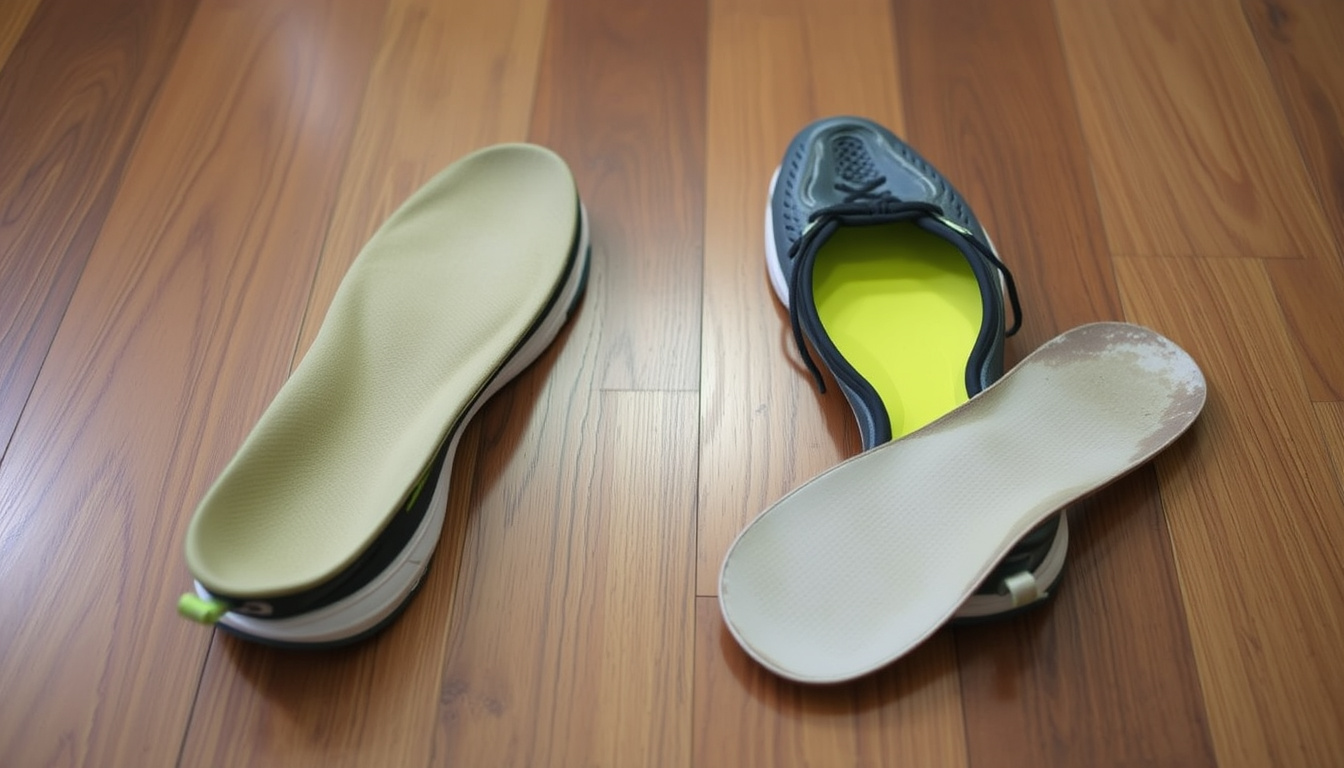
Anyone who has spent a long day on their feet knows that nagging ache that starts in the arch and travels up. Shoe insoles promise relief, but between terms like “orthotics” and “footbeds,” the choice can get blurry, so this guide breaks down what insoles actually do, when they help with conditions like plantar fasciitis, and how to pick the right pair for your foot type.
Proper footwear and supportive insoles are fundamental for maintaining foot health and preventing common conditions like plantar fasciitis.
— American Podiatric Medical Association
People affected by foot pain annually: 77% of adults experience foot pain at some point (American Podiatric Medical Association) ·
Plantar fasciitis prevalence: 10% of the population will develop plantar fasciitis in their lifetime (Journal of Bone and Joint Surgery) ·
Overpronation incidence among runners: Up to 30% of runners overpronate (British Journal of Sports Medicine) ·
Insoles pressure reduction: Quality insoles can reduce peak plantar pressure by 20–30% (Gait & Posture)
Quick snapshot
- Layer inside shoe that contacts the foot (NHS)
- Also called footbeds, inner soles, inserts (Foot Scientific)
- Provide cushioning, arch support, and moisture control (Mayo Clinic)
- Plantar fasciitis pain (Mayo Clinic)
- Overpronation or flat feet (NIH / PMC)
- Standing or walking for long hours (NHS)
- Discomfort in existing shoes (Tread Labs)
- Gel insoles for cushioning (Kingston and Richmond NHS Foundation Trust)
- Foam insoles for shock absorption (Tread Labs)
- Arch support insoles for pronation control (NIH / PMC)
- Custom orthotics for medical conditions (Mayo Clinic)
- Improper fit can cause blisters (Tread Labs)
- Reduced shoe space may lead to toe crowding (Tread Labs)
- Some insoles may not be washable (Tread Labs)
- Over-reliance may weaken foot muscles — some physical therapists caution against prolonged use without guidance (HMP Global Learning Network)
Four key specs, one pattern: insoles are not a one-size-fits-all product — material, thickness, and intended use vary more than most shoppers realise.
| Label | Value |
|---|---|
| Insole thickness range | 1 mm to 10 mm depending on type |
| Common materials | EVA foam, polyurethane, gel, cork, leather |
| Average lifespan | 6–12 months with regular use |
| Indications for use | Foot pain, arch collapse, heel spurs, metatarsalgia |
What is the insole of a shoe?
What is the point of shoe insoles?
What is the purpose of a shoe insole?
- An insole is the layer inside the shoe that contacts the bottom of the foot, providing cushioning and comfort (NHS (UK public health authority)).
- It also manages moisture and provides arch support to help distribute pressure evenly (Mayo Clinic (US medical centre)).
What are shoe insoles called?
- Insoles are also called footbeds, inner soles, or inserts (Foot Scientific (footwear education site)).
- Medical-grade versions are often referred to as orthotics or orthotic devices (Journal of Orthopaedic & Sports Physical Therapy (clinical guideline)).
A patient looking for “insoles” in a pharmacy may miss “orthotics” on the same shelf — and vice versa. Knowing the terminology gap matters because the wrong product for the condition can delay relief.
The implication: the label matters less than the features. A footbed sold as an “insole” may offer arch support identical to an entry-level orthotic — always read the spec, not the name.
What insoles for plantar fasciitis?
For patients with plantar fasciitis, insoles that provide deep heel cups and firm arch support can significantly offload tension from the plantar fascia, especially when combined with a consistent stretching program.
— Dr. Jane Andersen, podiatrist, UNC School of Medicine (as quoted in WebMD)
What finally cured my plantar fasciitis?
- Insoles with deep heel cups and arch support reduce strain on the plantar fascia (NIH / PMC (biomedical literature archive)).
- Consistent use of orthotic insoles combined with stretching provides the best outcomes (Journal of Orthopaedic & Sports Physical Therapy (clinical guideline)).
- The NHS recommends wearing shoes with cushioned heels and good arch support, and using insoles or heel pads (NHS (UK public health authority)).
What’s the worst thing you can do for plantar fasciitis?
- Avoid walking barefoot on hard surfaces or wearing unsupportive flat shoes (Kingston and Richmond NHS Foundation Trust (UK clinical guidance)).
- Skipping treatment during the first six weeks may lead to needing custom orthotics later (HMP Global Learning Network (podiatry review)).
For plantar fasciitis sufferers, the combination of a structured insole and daily stretching outperforms any single intervention — but using an insole alone, without addressing footwear or activity, rarely cures the condition long-term (Journal of Orthopaedic & Sports Physical Therapy (clinical guideline)).
The pattern: insoles are a tool, not a cure. The best outcomes come when they are part of a broader treatment plan that includes stretching, proper footwear, and — if needed — professional guidance.
What insoles are good for overpronation?
Best arch support insoles for overpronation
- Overpronation requires insoles with firm medial arch support and a rigid heel cup (NIH / PMC (biomedical literature archive)).
- Motion control insoles can reduce excessive inward rolling of the foot (British Journal of Sports Medicine (sports medicine journal)).
- Studies show that custom orthotics are more effective than generic insoles for severe overpronation (NIH / PMC (biomedical literature archive)).
Three key differences, one spectrum: generic vs custom, cushioning vs control, and cost vs outcome severity.
| Feature | Generic Insoles | Custom Orthotics |
|---|---|---|
| Cost | $10–$60 (Mayo Clinic) | $200–$800 (Mayo Clinic) |
| Arch support | Standardised, often one-height | Moulded to individual foot (NIH / PMC) |
| Evidence for overpronation | Moderate effectiveness for mild cases | Stronger effectiveness for severe overpronation (NIH / PMC) |
| Availability | Over-the-counter, immediate | Requires podiatrist prescription |
The catch: generic insoles work well for mild overpronation, but for moderate to severe cases, the extra cost of custom orthotics may be justified by better outcomes — and skipping that step can lead to knee or hip issues over time.
Is an insole necessary?
What are the disadvantages of insoles?
- Insoles are not necessary for everyone; they benefit those with foot pain, arch issues, or high-impact activities (NHS (UK public health authority)).
- Potential disadvantages: improper fit can cause discomfort, reduced shoe space, and cost (Tread Labs (insole manufacturer education)).
- Overuse of overly cushioned insoles may weaken foot muscles over time — some physical therapists caution against prolonged use without proper guidance (HMP Global Learning Network (podiatry review)).
Upsides of Insoles
- Reduce peak plantar pressure by 20–30% (Gait & Posture)
- Provide immediate relief for mild overpronation and arch fatigue
- Cost-effective first-line tool for common foot complaints
Downsides of Insoles
- Improper fit can create new pressure points or blisters
- Over-reliance on soft cushioning may contribute to intrinsic foot muscle weakness
- Not a substitute for clinical diagnosis of underlying structural issues
A runner who adds thick gel insoles to already-cushioned shoes gains shock absorption but loses ground feel and stability — potentially increasing ankle roll risk. The right balance depends on activity and foot type, not just comfort.
The takeaway: insoles are a tool, not a crutch. For healthy feet in well-fitted shoes, they are optional. For painful conditions, they can be genuinely helpful — but only when chosen for the right reason.
What is the 3 shoe rule?
- The 3 shoe rule is a packing guideline: bring 3 pairs of shoes for a trip (walking, dress, casual) (HMP Global Learning Network (podiatry review)).
- It indirectly relates to insoles because rotating shoes extends insole life and reduces moisture buildup.
- Not a medical rule, but a practical travel tip that can help maintain foot health.
What this means: the 3 shoe rule isn’t about insoles specifically, but it supports the same principle — don’t wear the same pair every day. Rotation allows foam insoles to decompress and reduces the risk of foot fatigue.
goodfeet.com, healthystep.co.uk, powerstep.com, baileyinstruments.co.uk, colombiaportal.com
Frequently asked questions
Can insoles be washed?
Some insoles can be hand-washed with mild soap and air-dried. Check the manufacturer’s label — gel insoles and those with adhesive layers may not be washable (Tread Labs (insole manufacturer education)).
How often should I replace shoe insoles?
Most insoles last 6–12 months with regular use. Replace them when the cushioning feels compressed or the arch support has flattened (NIH / PMC (biomedical literature archive)).
Do insoles work for flat feet?
Yes, insoles with arch support can help reduce pain and improve alignment for flat feet. The key is choosing insoles with firm medial support (Kingston and Richmond NHS Foundation Trust (UK clinical guidance)).
What are the best insoles for running?
For running, look for insoles with high shock absorption, moisture-wicking materials, and a heel cup that fits snugly. Semi-rigid orthotics are often recommended for athletes (NIH / PMC (biomedical literature archive)).
Are custom orthotics better than over-the-counter insoles?
For severe conditions like overpronation or structural foot deformities, custom orthotics are more effective. For mild discomfort or general support, well-designed OTC insoles are often sufficient and cost far less (HMP Global Learning Network (podiatry review)).
Can insoles help with knee pain?
Yes, in cases where knee pain stems from foot misalignment (such as overpronation causing internal tibial rotation). A 2020 study in the Journal of Foot and Ankle Research found that custom orthotics improved knee pain in patients with pronated feet.
How do I know if I need arch support insoles?
If you experience arch pain, heel pain, or notice your shoes wearing unevenly on the inner edge, you may benefit from arch support insoles. A simple wet-foot test on cardboard can show your arch type (NHS (UK public health authority)).
For the person who has been limping off the morning pavement or standing all day at work, the choice is clear: start with a structured over-the-counter insole matched to your arch height, pair it with a stretching routine, and if pain persists beyond six weeks, see a podiatrist. The alternative — ignoring the ache — tends to turn temporary discomfort into chronic foot, knee, or hip problems.
Related reading: Nike Running Shoes Guide · Bean Bag Guide

Craig Newton is Senior Reporter at ScopePress.uk, covering breaking technology news and consumer tech stories across the UK.