There’s a mix-up that has confused people for generations, and it usually starts with a picture. You see a majestic, black-and-white bird on an iceberg and a furry white bear on the other side, and your brain screams “Same place!” Yet, if you’ve ever asked, “Why don’t polar bears eat penguins?” you already know the punchline: they’ve never met. This isn’t a case of a wily predator outsmarting its prey; it’s a simple matter of geography. But the deeper story is even more fascinating, involving the unique pressures of Arctic survival and the specific, ice-dependent life of Antarctic penguins. In this guide, we’ll untangle these common myths and clarify exactly how these species live, where they come from, and why one of them nearly avoided the other entirely.
Polar Bears
Native to the Arctic, top marine predator, never encounters penguins.
Emperor Penguins
Native to Antarctica, largest penguin species, breeds in winter.
Geographic Separation
Opposite poles, ~12,000 km of ocean between them — no natural overlap.
Conservation Status
Emperor penguin threatened by climate-driven sea-ice loss; polar bear similarly vulnerable.
Key Facts at a Glance
Here are the essential specifications for the emperor penguin, the species at the heart of this discussion.
| Attribute | Emperor Penguin |
|---|---|
| Scientific Name | Aptenodytes forsteri |
| Height | Up to 122 cm (48 in) |
| Weight | 22–45 kg (49–99 lb) |
| Population | Approximately 600,000 individuals |
| Lifespan | 20 years in the wild |
| Breeding Cycle | Annual, winter breeding |
This table gives you the base specs of the emperor penguin, but the numbers only hint at the extremes these birds endure to survive.
Why Don’t Polar Bears Eat Penguins?
Polar bears and penguins have inhabited opposite poles for millions of years, so they never share a habitat. To understand why the polar bear doesn’t eat penguins, you have to look at the predator and prey in their own worlds.
- Polar Bears: Live in the Arctic (the North Pole region) and are the top land predator. They hunt seals on sea ice.
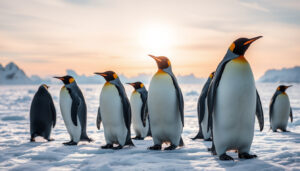
- Emperor Penguins: Live in the Antarctic (the South Pole region). They nest on sea ice and raise their chicks in one of the most hostile environments on Earth.
The Polar Bear Specialist Group and the IUCN confirm this, but there’s an even simpler way to see it: the ice at the North Pole is over the open Arctic Ocean, while the ice at the South Pole is a vast continent. Because they live on opposite ends of the Earth, the two species simply cannot meet. A polar bear would need to wander far beyond its hunting grounds to find a penguin, and a penguin cannot survive the tropical waters that separate the poles.
The key takeaway here is that the absence of polar bears in Antarctica is one of the main reasons penguin colonies can be so large and why they are so vulnerable to different threats like sea-ice loss, rather than predation. This geographic isolation is the fundamental, immutable fact that answers the question.
Do Polar Bears Eat Penguins? The Scientific Reality
This follow-up question is where the myth gets a hard reality check. It’s not that polar bears wouldn’t eat a penguin; if a polar bear were suddenly placed in a penguin colony, it would likely be curious, but it has no evolutionary history with these birds. The IUCN Red List indicates that the emperor penguin’s primary threats are climate change and the specific sea-ice conditions of the Antarctic, not any kind of land-based predator.
If you could magically transport a polar bear to the Antarctic, it might actually harm the bear. It’s a top predator, but it has no defense against the brutal Antarctic winter, and it has no idea what a penguin’s habitat is like.
Beyond the simple geography, there is a deeper biological reality: each species has evolved in isolation, with zero interspecies interaction shaping their behaviors or defenses. Penguins have evolved to fear leopard seals and skuas, not bears, while polar bears have evolved to hunt seals, not flightless birds. This mutual unfamiliarity makes the “polar bear eats penguin” question one of the most common, yet easily disproven, misconceptions in the animal kingdom.
Penguin colonies don’t have to worry about a polar bear’s predation, which is why they can congregate in the open, but they have to deal with the sea-ice dynamics in a way a polar bear never would. The environmental pressures are entirely distinct, shaping two very different survival strategies.
The Emperor’s Unique Physiology & Antarctic Survival
The emperor penguin is a master of survival in the cold, but it has partly adapted to avoid predators by relying on its location. However, they face unique physiological demands that make them the focus of many “sad facts” about penguins.
Life on the Fast Ice
Emperor penguins have a very specific habitat requirement: they breed on stable pack ice (fast ice) attached to the Antarctic coastline. They also need this ice to moult (shed feathers) in a place where they can be safe from predators and conserve energy, as they cannot swim during this period.
- Breeding: They breed during the harsh Antarctic winter, with males incubating eggs on their feet for about 65 days.
- Moulting: They rely on stable ice to shed feathers safely, a period during which they fast and cannot enter the water.
This dependency on fast ice makes them particularly vulnerable to climate change. If the sea ice breaks up too early or thaws too late, they cannot breed or moult successfully.
This unique reliance on a fragile habitat is a consequence of where they live, which also leads to another common confusion about penguins and their supposed relationship with the cold.
iucn.org, asoc.org, en.wikipedia.org, phys.org, nc.iucnredlist.org, birdlife.org, iucnredlist.org, wwf.org.uk, scar.org, wwf.org.uk, britannica.com, nytimes.com
Frequently Asked Questions
Why do polar bears not eat penguins?
Because they live on opposite sides of the planet. Polar bears are native to the Arctic, and penguins are native to the Antarctic. This geographic isolation means they never encounter each other. A polar bear would have to cross thousands of miles of ocean to find a penguin, which is impossible for it to do in the wild.
What do penguins do every 20 minutes?
Penguins have a very fast metabolism, which means they defecate frequently—roughly every 20 minutes. While they don’t do this on a precise timer, they do have frequent, small bowel movements. It’s a practical adaptation to their high-energy lifestyle, not a quirk, but it does highlight how extreme their environment is.
Are emperor penguins friendly to humans?
Absolutely not, and it’s not just for the penguin’s safety. In the case of penguins, physical contact is prohibited in most regions, including Antarctica under the Antarctic Treaty. Instead of a hug, they may look at you with curiosity, but that’s where it should end. Even if you are a researcher, you are asked to keep a distance. They are not cuddly toys; they are wild animals protected by international law.
How high is a penguin’s IQ?
Penguin intelligence is not measured by IQ as we do for humans. IQ tests are designed for human cognition, not for animals that navigate by the ocean and sky. Instead, researchers measure penguin cognition through problem-solving experiments and social behavior studies. They are highly adapted for survival in extreme conditions, with sophisticated navigation skills, but comparing their intelligence to a human IQ score is misleading.
How do penguins say ‘I love you’?
Penguins don’t say “I love you” the way humans do, but they have evolved elaborate courtship rituals. A male emperor penguin will offer a pebble to a female as a gift, and both partners engage in synchronized vocalizations and bowing displays. These behaviors help pairs bond and recognize each other among thousands of individuals in a colony. It’s a beautiful, practical form of communication, not romantic love as we understand it.
The North-South Divide
The polar bear and the penguin are both icons of their respective poles, but their stories are separate tales of survival against the cold. The polar bear’s fate is tied to Arctic sea ice, where it hunts seals. The penguin’s fate is tied to Antarctic fast ice, where it breeds and raises chicks. When you strip away the legend, you’re left with a simple biological fact: they will never share a meal, a battle, or even a glance because they live in two different worlds, divided by an entire ocean.
What this means for the future is that the penguin’s fate is tied to the Antarctic’s sea ice, and the polar bear’s to the Arctic’s—and how we act on climate change will determine both of their futures. The geographic divide that has kept them apart for millions of years may also be what saves them, if we can preserve the distinct habitats they each depend on.
Related stories



Craig Newton is Senior Reporter at ScopePress.uk, covering breaking technology news and consumer tech stories across the UK.