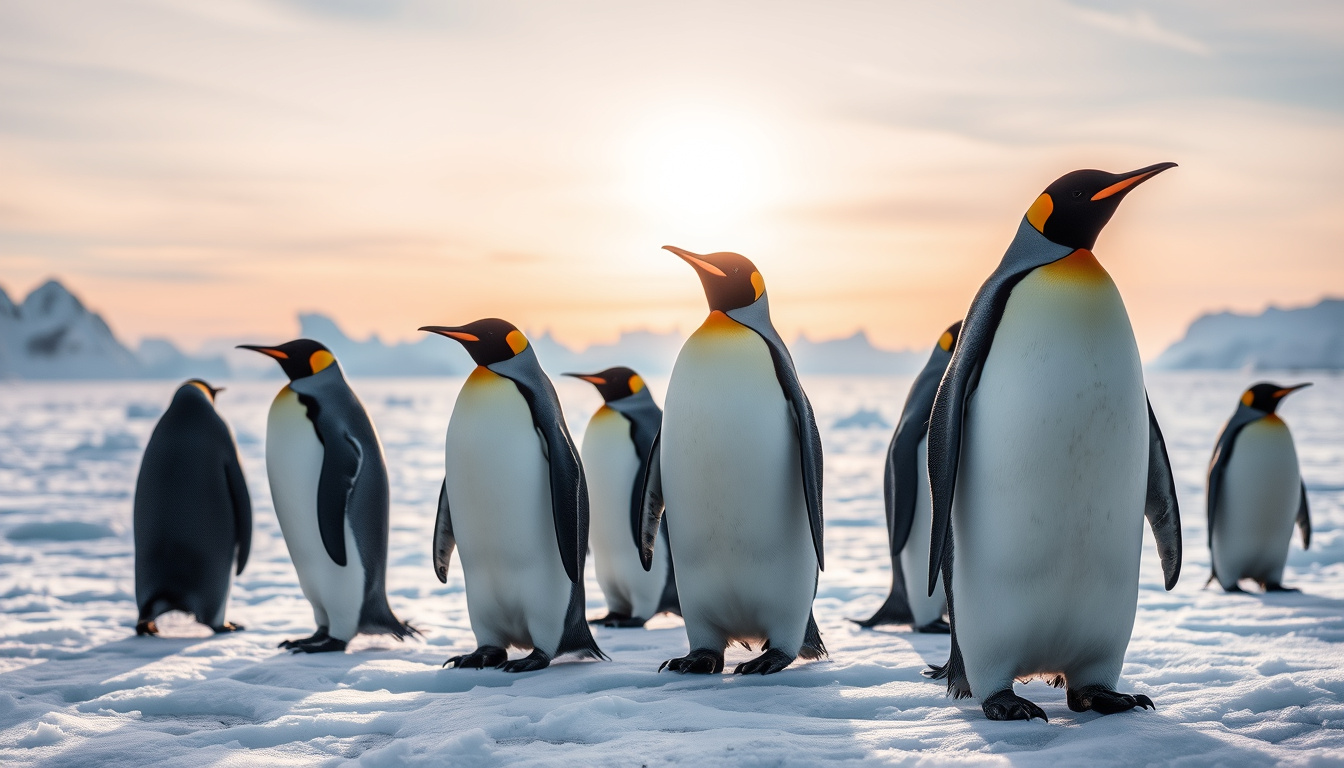
There’s something almost mythic about an animal that chooses to breed in the darkest, coldest months on Earth. Emperor penguins don’t just survive the Antarctic winter; they build their entire reproductive cycle around it, a feat of biology that still feels improbable. In this guide, you’ll get a fact-checkable field guide to the emperor penguin (Aptenodytes forsteri), from its scientific classification and extreme adaptations to its precarious conservation status. We’ll cut through the cute-factor to look at the real data—including the stark fact that these sea-ice obligates are now listed as Near Threatened, with the U.S. Fish and Wildlife Service projecting a dramatic decline in their primary habitat by 2100.
They are the tallest and heaviest of all penguins, but their story is less about size than about specialization. Emperor penguins are locked into a life dependent on sea ice, a habitat that is literally melting beneath their feet. This guide covers their scientific classification, ecology, breeding biology, adaptations, and conservation, drawing on sources like the Wikipedia species overview, the U.S. Fish and Wildlife Service species status assessment, and the Global Penguin Society. You’ll find answers to common questions—like whether penguins feel sadness or how they recognize each other—grounded in what the research actually says, not what a nature documentary implies.
Scientific name: Aptenodytes forsteri · IUCN Status: Near Threatened · Breeding season: Winter (March–December) · Dive depth: Up to 500 m (1,640 ft)
Before we dive into the ice, here’s a quick orientation. This isn’t a sentimental tribute; it’s a research-backed look at what makes this species tick and what threatens its future. We’ll start with the basics of classification and size, then move through their unique breeding cycle, their role in the Antarctic ecosystem, and the specific conservation challenges they face. By the end, you’ll have a solid, source-anchored understanding of why the emperor penguin is considered the canary in the coal mine for climate change in the Southern Ocean.
Key Facts at a Glance
- Largest living penguin species by both height and weight — per U.S. Fish and Wildlife Service.
- Endemic to Antarctica, with a circumpolar distribution — per IUCN Red List.
- Classified in the family Spheniscidae, order Sphenisciformes — per Wikipedia.
- Breed during the Antarctic winter, on sea ice — per Antarctic and Southern Ocean Coalition.
- Females lay a single egg in May or June — per Australian Antarctic Program.
- Incubation lasts ~65–75 days, done mostly by the male — per PubMed Central.
- Bare skin on the bill and flippers allows heat dissipation — per Encyclopedia Britannica.
- Breeding season is timed to finish molting before the brief polar summer — per PubMed Central.
- Dive depth exceeds 500 m, requiring extreme pressure tolerance — per Animal Diversity Web.
- Listed as Near Threatened by the IUCN.
- Primary threat is sea ice loss from climate change — per U.S. Fish and Wildlife Service.
- U.S. Fish and Wildlife Service projects an 80% decline in breeding habitat by 2100 — per their species status assessment.
Scientific Classification and Physical Stats
The emperor penguin holds the title of the largest and heaviest of all living penguins. According to the U.S. Fish and Wildlife Service’s Species Status Assessment, they are the tallest and heaviest penguin species, standing up to 120 cm tall and weighing as much as 45 kg. Their robust build is an adaptation to the extreme cold and pressure of deep dives.
Here’s a breakdown of the key physical and biological metrics:
| Metric | Value |
|---|---|
| Scientific name | Aptenodytes forsteri |
| Height | 100–120 cm (47 in) |
| Weight | 20–45 kg (99 lb) |
| Life expectancy | 15–20 years |
| Dive depth | Up to 500 m (1,640 ft) |
| Diet | Fish, krill, squid |
| Breeding season | Winter (March–December) |
The implication: the emperor penguin’s physical size is not just a curiosity but a functional necessity, where mass-to-surface-area ratio allows months of sub-zero incubation.
Taxonomically, they belong to the family Spheniscidae and the order Sphenisciformes, per Wikipedia, a lineage that evolved to master the cold, nutrient-rich waters of the Antarctic. Their anatomy is a study in extremes, from a thick layer of blubber to a compact body shape that minimizes heat loss.
The upshot: The emperor penguin’s physical size isn’t just a curiosity; it’s a functional necessity. Their mass-to-surface-area ratio is a biological trade-off that allows them to endure months of sub-zero temperatures while incubating eggs and raising chicks.
Habitat and Distribution: The Ice Obligate
Emperor penguins are Antarctic endemics, found nowhere else on Earth. Their lives are intrinsically tied to the presence of sea ice, earning them the label of “sea-ice obligate.” They breed on fast ice locked between islands or grounded icebergs, and they forage in the waters of the Antarctic Circumpolar Current.
The U.S. Fish and Wildlife Service notes that most colonies are situated on fast ice locked between islands or grounded icebergs. The Australian Antarctic Program adds that they are found in a circumpolar Antarctic distribution, generally between about 66° and 77° south latitude.
Their dependence on ice is not arbitrary: sea ice provides a stable platform for breeding and molting, and it also supports the food web—krill and fish—that emperor penguins depend on. Without ice, there is no colony.
The distribution is intricately linked to sea ice concentration. As the ice changes, so does the location and success of colonies. This tight coupling is what makes them so vulnerable to climate change, as they have no alternative habitat to retreat to.
Why this matters: The emperor’s reliance on sea ice is both its strength and its Achilles’ heel. It has allowed them to dominate an extreme niche, but it also means they have no backup plan if the ice disappears. Conservation efforts are essentially efforts to preserve their icy platform for survival.
Winter Breeding: The Miracle of the Dark Season
Perhaps the most famous aspect of emperor penguin biology is their breeding cycle, which occurs during the brutal Antarctic winter. Unlike most birds, they don’t breed in the spring; they breed in the dark, with temperatures dropping to -60°C. The U.S. Fish and Wildlife Service notes that breeding begins in late March and continues through December.
Here’s a simplified timeline of the journey:
- March–April: Adults leave the sea ice edge and walk up to 120 km inland to their breeding colonies.
- May–June: The female lays a single egg after about two months without feeding. She then transfers the egg to the male.
- June–July: The male incubates the egg on his feet, covering it with a brood pouch for ~65–75 days. He does not eat during this time, living off fat reserves.
- July–August: The female returns from the sea to relieve the male and feed the newly hatched chick.
- December: The chick fledges and heads to the sea with its parents.
Research from the Australian Antarctic Program notes that females leave to forage after laying, returning after incubation.
The paradox: The very stability that allows winter breeding is the stability that is being lost. As winter sea ice forms later and melts earlier, the timing of breeding may no longer align with the availability of food, creating a phenological mismatch that threatens the colony’s viability.
What is special about emperor penguins?
What is the emperor penguin’s scientific name?
The emperor penguin’s scientific name is Aptenodytes forsteri, as confirmed by the IUCN Red List. It belongs to the family Spheniscidae and the order Sphenisciformes, a classification that places it among the true penguins.
How do emperor penguins survive the Antarctic winter?
They survive through a suite of adaptations: a thick layer of insulating blubber, overlapping feathers that trap air, and a unique huddling behavior that conserves warmth. The Encyclopedia Britannica notes that emperor penguins are highly cold-adapted, with a thick layer of blubber and dense plumage. By huddling in tightly packed groups, they reduce exposed surface area by up to 50%.
What is the emperor penguin’s role in the ecosystem?
Emperor penguins are apex predators in the Antarctic ecosystem. The U.S. Fish and Wildlife Service confirms their diet consists primarily of Antarctic silverfish, Antarctic krill, and squid. They serve as a keystone species, transferring energy from small fish and krill to top predators like leopard seals and orcas.
Which penguin is bigger, king or emperor?
Emperor penguins are taller and heavier than king penguins. The U.S. Fish and Wildlife Service states emperor penguins stand up to 120 cm and weigh up to 45 kg, while king penguins typically reach about 90 cm and 15 kg.
What are the weight differences between king and emperor penguins?
King penguins weigh approximately 11–16 kg, compared to emperor penguins’ 20–45 kg range. The Animal Diversity Web notes these differences are reflected in their respective builds.
How do their physical builds differ?
Emperor penguins have a more robust build with a thicker blubber layer for extreme cold, while king penguins have a longer, slender build adapted to sub-Antarctic climates.
Where do each species live?
Emperor penguins live exclusively in Antarctica, generally between 66° and 77° south latitude, per the Australian Antarctic Program. King penguins inhabit sub-Antarctic islands north of the ice edge.
What is a sad fact about penguins?
A genuinely concerning fact is that emperor penguins are struggling due to climate change. The U.S. Fish and Wildlife Service projects an 80% decline in their breeding habitat by 2100, a species-wide threat rather than an individual’s mood.
What is the main threat to emperor penguin colonies?
The primary threat is sea ice loss from climate change, as detailed in the IUCN Red List. Sea ice provides the stable platform they need for breeding and molting.
How does climate change affect sea ice used by penguins?
Warmer temperatures cause sea ice to form later and melt earlier, shortening the breeding window. The U.S. Fish and Wildlife Service projects a 50% or more reduction in breeding habitat availability by 2100.
What is the typical chick mortality rate in a breeding season?
Chick mortality is high, especially in harsh winters or when sea ice breaks up early. Some colonies may lose entire cohorts if ice conditions are unfavorable, according to PubMed Central research.
How do penguins say “I love you”?
Emperor penguins don’t express human-style love, but they do have elaborate bonding behaviors. Pairs use unique vocal calls to identify mates and chicks, according to the Australian Antarctic Program. They also engage in mutual preening and bowing rituals.
What are the courtship displays of emperor penguins?
Courtship includes mutual preening, bowing, and specific postures that signal pair bonds. These behaviors reinforce the bond between mates during the breeding season.
How do penguin pairs recognize each other?
They rely on vocalizations, not looks. A returning parent will call out, and its mate or chick will recognize its unique call among the cacophony of the colony.
What is the role of vocalizations in bonding?
Vocalizations are the primary mechanism for individual recognition, allowing mates to find each other and parents to locate their chicks among thousands of birds.
Why can’t we hug penguins?
Harassing or touching penguins is illegal under the Antarctic Treaty. Human scent can transfer diseases to penguins, and close approach can elevate stress hormones, disrupting their breeding and foraging behaviors. Observers must maintain a minimum distance in protected areas.
Are emperor penguins protected by law?
Yes, they are protected under the Antarctic Treaty and the U.S. Endangered Species Act proposal. The U.S. Fish and Wildlife Service has proposed listing them as threatened.
Why is human contact harmful to penguins?
Human scent can transfer diseases to penguins, and close approach can elevate stress hormones, disrupting their natural breeding and foraging behaviors.
What is the correct way to observe penguins in the wild?
Observers must maintain a minimum distance (usually 5–10 meters) and avoid sudden movements. The Australian Antarctic Program provides guidelines for responsible wildlife viewing.
Ecology and Diet: A Delicate Food Web
Emperor penguins are apex predators in their Antarctic ecosystem, but their position is precarious. Their diet consists primarily of Antarctic silverfish, Antarctic krill, and squid. The U.S. Fish and Wildlife Service SSA confirms this, listing these as key prey. The Global Penguin Society adds that they consume these species as their main prey.
Here are the core elements of their dietary and ecological role:
- Primary Prey: Antarctic silverfish (Pleuragramma antarcticum), krill, and squid.
- Foraging Depth: They dive to depths of over 500 meters in search of food.
- Predators: Adult penguins are hunted by leopard seals and orcas. Chicks are vulnerable to skuas and giant petrels.
- Role: They serve as a keystone species, transferring energy from small fish and krill to top predators.
Despite their hunting prowess, they are not invincible. The health of their populations is directly tied to the abundance of krill, which itself depends on sea ice algae. This creates a linear chain: ice → algae → krill → penguins. A disruption in any part of this chain has cascading effects.
The takeaway: The emperor penguin’s diet is a mirror of their environment. Their reliance on ice-dependent prey means that their future is not just about protecting the birds, but about protecting the entire Antarctic food web.
Adaptations for the Extreme: Why They Survive (For Now)
Their survival is due to a suite of remarkable physical and behavioral adaptations. They have a thick layer of insulating blubber, overlapping feathers that trap air, and a unique huddling behavior that conserves warmth. The Encyclopedia Britannica notes that Emperor penguins are highly cold-adapted, with a thick layer of blubber and dense plumage.
Consider these evolutionary solutions to extreme cold:
- Countercurrent heat exchange: Blood vessels in the bill and flippers circulate warm blood alongside cold, reducing heat loss at the extremities.
- Social huddling: By huddling in tightly packed groups, they reduce their exposed surface area by up to 50%, minimizing heat loss.
- Molting: They have a fast, intense molting period in the summer before the sea ice breaks up, allowing them to be water-tight and clean.
- Diving physiology: They can withstand pressures of up to 40 atmospheres, with adaptations like flexible ribs and the ability to shut down non-essential organs.
These adaptations are not just about comfort; they are about survival. They allow the emperor penguin to exploit a niche that almost no other animal can tolerate, breeding in the coldest, windiest place on Earth.
The trade-off: These evolutionary marvels are now their liability. The very features that allow them to thrive in extreme cold are useless in the face of rapid warming. Their deep-dive ability is useless if the ice they depend on for breeding is unavailable.
Conservation: A Species on the Edge of a Precipice
The emperor penguin is listed as Near Threatened, but the trend is stark. The U.S. Fish and Wildlife Service projects an 80% decline in breeding habitat by 2100 if current warming trends continue. The IUCN notes that sea ice loss is a primary threat.
Key conservation data points:
- IUCN Status: Near Threatened.
- Population: Estimated at ~600,000 individuals globally.
- Primary Threat: Climate change-induced sea ice loss.
- Legal Protection: The U.S. Fish and Wildlife Service has proposed listing them as threatened under the Endangered Species Act, citing the need to reduce greenhouse gas emissions.
Conservation efforts are complex. On the one hand, protecting them requires global action on carbon emissions. On the other, it requires local efforts to minimize disturbance from research and tourism. The U.S. Fish and Wildlife Service SSA specifically states that “sea ice loss is the primary threat” and that it “is projected to reduce the availability of breeding habitat by 50 percent or more in parts of the species’ range by 2100.”
What to watch: The upcoming listing decision will be a pivotal moment. It will determine whether the emperor penguin gets the full protection of the U.S. Endangered Species Act, which could force major industries to reduce their emissions. This is a test case for how we handle climate-induced extinction.
Do Penguins Get Sad? The Myth of ‘Divorce’
It’s a common trope: animals that mate for life, like penguins, are models of fidelity. The reality is more nuanced. While penguins do form long-term pair bonds, they don’t feel human-like sadness. The “sad” labels we attach to a penguin standing alone are anthropomorphism. They don’t have the emotional complexity for that.
What is true is that penguins have elaborate vocalizations. Instead, research shows that penguin pairs recognize each other primarily through their unique calls. The Australian Antarctic Program suggests that vocalizations are the primary means of individual recognition. This allows a parent returning from a foraging trip to find its chick among thousands.
While a penguin might not feel “sad,” it can experience stress. Human disturbance, such as tourism or research, can cause a spike in stress hormones, which in turn can reduce breeding success. This is why there are strict guidelines about how close observers can get.
The catch: We project our emotions onto animals to understand them, but real empathy requires us to respect their differences. The emperor penguin’s survival depends less on us seeing it as ‘sad’ and more on us seeing it as fragile, intertwined with a habitat we are altering.
The terms “sad” or “divorce” are human constructs. When a penguin loses its mate, it doesn’t grieve in the human sense; it simply seeks a new partner next season. The real “sadness” is the potential loss of an entire species, a tragedy in which we have a direct hand.
seaworld.org, documents.ats.aq, knownanimals.com, research.unipd.it
Frequently Asked Questions
What is a sad fact about penguins?
A genuinely concerning fact is that emperor penguins are struggling due to climate change. The U.S. Fish and Wildlife Service projects an 80% decline in their breeding habitat by 2100, which would make their future uncertain. That’s more significant than a single animal’s mood; it’s a species-wide threat.
How do penguin pairs recognize each other?
They rely on vocalizations, not looks. A returning parent will call out, and its mate or chick will recognize its unique call among the cacophony of the colony.
Is Emperor penguin a true penguin?
Yes, the emperor penguin is a true penguin, classified under the Spheniscidae family. They are the largest of all penguin species.
What is the role of vocalizations in bonding?
Vocalizations are the primary mechanism for individual recognition in emperor penguins, allowing mates to find each other and parents to locate their chicks.
Why is human contact harmful to penguins?
Human scent can transfer diseases to penguins, and close approach can elevate stress hormones, disrupting their natural breeding and foraging behaviors.
How deep can an emperor penguin dive?
Penguins are known to dive to depths of over 500 meters (1,640 ft) in search of food, making them one of the deepest-diving seabirds.
Final thought: The future of the emperor penguin is a direct reflection of our own priorities. Climate change will determine whether this species survives.
Related Reading
For more in-depth information on the emperor penguin’s habitat, the U.S. Fish and Wildlife Service offers a detailed species status assessment.
To understand the broader context of penguin diversity and conservation, the Global Penguin Society has a directory of species.
For a scholarly perspective on Antarctic ecosystems, the Australian Antarctic Program is a primary research hub.
Related articles on this site: Emperor Penguins: Facts, Habitat, Diet, and Conservation and Emperor Penguins: Size, Habitat, Behavior, Conservation.
Related stories



Craig Newton is Senior Reporter at ScopePress.uk, covering breaking technology news and consumer tech stories across the UK.