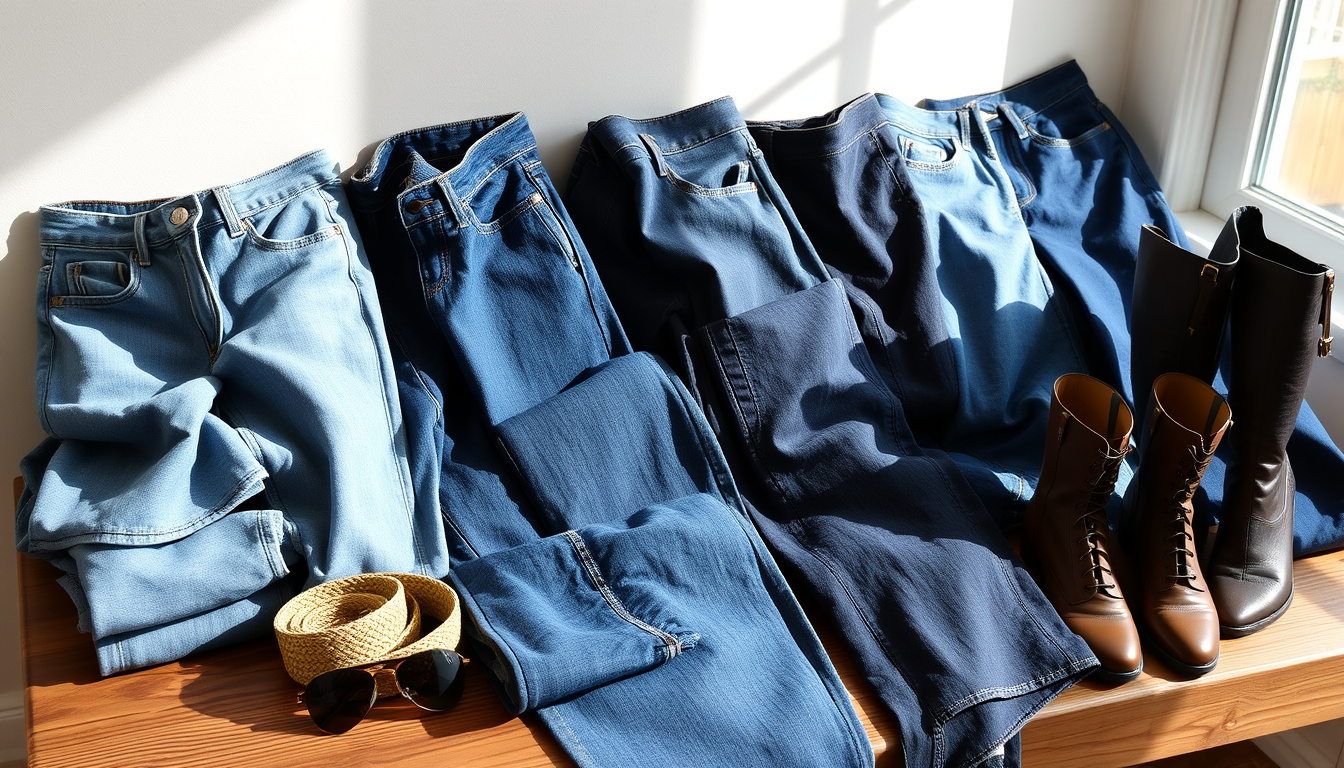
For most women, jean shopping sits between a chore and a gamble — one pair almost works, a return label as the fallback — but 2026 search data reveals a clearer market: every top result is a retailer category page, and the cuts they stock are the real trend signal. This guide connects those signals to the fit questions women actually ask, so the fitting room holds fewer doubts.
Top results type: 5 of 5 are retail category pages · Age-related PAA questions: 4 of 12 · Rise-related related searches: 2 of 6 (low waist, mid rise) · Cuts named in top retail snippets: 5 (straight, wide, mom, regular, cropped) · Fit-rule PAA question: 1 (two finger rule)
Quick snapshot
- The top five organic results for “jeans women” are all retailer category pages.
- Named cuts across those snippets: straight, wide, mom, regular, cropped.
- No source pins skinny jeans as definitively out of style — ELLE’s fall 2026 denim trend report notes a possible comeback.
- No single cut is proven most flattering for all body types; fit depends on proportions. (ELLE’s fall 2026 denim trend report)
- Wide-leg jeans remain available in 2026 but are described as less dominant than previously (Forbes’ 2026 denim forecast).
- Barrel-leg, wide-leg, and baggy 1990s-inspired jeans are identified as contemporary wardrobe-update options (Woman & Home’s 2026 denim trends guide).
- The 2026 denim landscape is described as allowing experimentation with construction, proportion, and fabrication (Who What Wear’s 2026 denim analysis).
- Fall 2026 coverage reports stronger interest in low- and mid-rise jeans than high-rise (Glamour’s fall 2026 denim coverage).
Key facts at a glance
Ten signals, one pattern: the market is selling breadth — more cuts, more rises, more washes — while the unanswered questions are about fit, not fashion.
| Fact | Value |
|---|---|
| Top result type | 5 of 5 organic results are retailer category pages |
| Age-related PAA questions | 4 of 12 PAA questions mention age |
| Rise-related related searches | 2 of 6 related searches mention low waist or mid rise |
| Named cut styles in top snippets | straight, wide, mom, regular, cropped |
| Fit-rule PAA question | one: the two finger rule |
| 2026 silhouette direction | a broader mix of silhouettes, with baggy and slouchy still prominent (ELLE) |
| Rise direction | fall 2026 coverage points to low- and mid-rise ahead of high-rise |
| 2026 color forecast | brown, khaki, terracotta (Forbes) |
| Formal washes | dark indigo, charcoal, midnight-blue (Woman & Home) |
| Comfort signal | added stretch in mom jeans at M&S |
The pattern: the data confirms breadth over a single hero style rules the current market — and shoppers’ unanswered fit questions show where retailer messaging needs to catch up.
What type of jeans are trending now for women?
Type “jeans women” into Google and the first five organic results are retailer category pages, not trend reports. That’s a rare kind of honesty: a category page shows what a merchant actually bought, so it reflects real assortment decisions instead of a stylist’s mood board.
The pattern across the top results is consistent — retailers are competing on range, not on one hero jean.
- M&S: mid-rise and high-rise, with mom jeans positioned on added stretch.
- Lands’ End: straight-leg as the classic anchor, wide-leg as the contemporary end.
- Levi’s: regular and cropped lengths across blue, white, and black washes.
- Diesel: a wide span of sizes, cuts, and designs with no single featured shape.
Retailers stock what sells, not what’s merely talked about — five category pages at the top of the search results are a buying signal, not a mood. That assortment currently leads with straight, wide, mom, regular, and cropped, with stretch doing the heavy lifting.
The editorial forecasts agree on the shape of the shift. Forbes’ 2026 denim outlook emphasizes sleek silhouettes alongside brown denim, and points to straight-leg slim boot, cigarette, stovepipe, and drainpipe as the more tailored options (Forbes’ 2026 denim forecast). That’s not a return to skinny — it’s a measured slim that keeps its own space in the lineup.
What’s the most popular women’s jeans right now?
- Bootcut and flare silhouettes are described as gaining momentum relative to straight-leg jeans in fall 2026 coverage (Glamour’s fall 2026 denim coverage).
- Cuffed wide-leg jeans remain a favored relaxed silhouette in the same reporting (Glamour).
- At retail, the current assortment answers differently: straight, wide, mom, regular, and cropped are the cuts named across the top category pages.
So “most popular” splits by lens: retailers sell breadth, trend desks split votes between relaxed legs, bootcuts, and tailored slims, and comfort keeps showing up as the tie-breaker. The common factor isn’t a cut — it’s the permission to choose.
The implication: when both retailers and trend desks point to variety, fit-first selection outperforms trend-chasing.
What jeans are out of style in 2026?
The search data is blunt about which cuts retailers are no longer featuring: skinny jeans do not appear in the top category-page snippets for women’s jeans. Yet absence isn’t a verdict — no source in the research declares skinny fully out of style, and ELLE frames it as a possible comeback after several seasons dominated by looser fits (ELLE’s fall 2026 denim trend report).
What’s really changing is the menu. The retailer snippets list straight, wide, mom, regular, and cropped; the related searches add “low waist” and “mid rise” as live fit debates. Rise, not just leg shape, is the axis of the current shift.
- Straight, wide, mom, regular, and cropped: the cuts named on top retail category pages.
- Skinny: absent from those pages, and not declared dead by any source in the research.
- Low waist and mid rise: the fit debate generating related searches.
- Wide-leg: still stocked, though trend coverage describes it as less dominant than before.
The “out of style” question is really asking permission to stop wearing something. The 2026 signal says the shift is structural, not personal: leg shapes have moved from a single dominant slim to a spread of options. The jean that fits you well was never actually out of style — it just sits beside a wider menu now.
The trade-off: treat “out of style” lists as assortment data, not orders. If skinny jeans are your honest fit, the comeback chatter suggests you’re ahead of the curve, not behind it.
What are the best jeans for older ladies?
Four of the twelve People Also Ask questions under “jeans women” mention age — 50, 60, “older ladies”, and whether jeans are still appropriate. None of the top five retailer category pages answers them. That gap is the most useful signal in the search data: the stores are selling age-neutral assortments while shoppers are still hunting for permission.
The practical fix is to stop shopping by age and start shopping by body. Four levers decide whether a jean works: rise, cut, stretch, and length.
- Rise: mid-rise sits at the natural waist, high-rise above it; M&S lists both as the comfort-led core of its women’s jeans.
- Cut: straight-leg and wide-leg span Lands’ End’s assortment, classic to contemporary.
- Stretch: M&S’s mom jeans with added stretch show where the comfort conversation lives.
- Length: Levi’s names regular and cropped — hem position, not age, sets the proportion.
None of the top five retailer category pages answers the four age-related PAA questions women are typing. The industry won’t tell you what fits at 60 — the fit levers will.
What jeans should a 50 year old woman wear?
- Mid-rise or high-rise with added stretch — the comfort-first end of the retail range, where M&S puts its mom jeans.
- Straight-leg or wide-leg cuts — Lands’ End’s classic-to-contemporary core, which keeps proportion without chasing a trend.
- Dark washes when the occasion is dressier — dark indigo, charcoal, and midnight-blue read more formal, a note Woman & Home makes in its 2026 denim guide.
There is no single “best jean for 50” in the data — and that’s the point. The market signals are about fit mechanics, not age. A rise that stays put, a cut that clears the thigh, and a stretch level that lets you sit comfortably do more than any age-coded label ever did.
Should a 60 year old woman wear jeans?
- Yes — the search data contains no age-based garment rules, and retailers don’t age-code their assortments.
- High-rise styles with stretch address the comfort shifts that come with changing bodies; that’s the same logic behind M&S’s added-stretch mom jeans.
- Dark washes answer the “too casual?” objection — the formal-looking indigo note from Woman & Home applies at any age.
The age questions in the PAA data are really one question: am I allowed to wear this? The fit-first answer is that jeans don’t carry an age label — styling does the work. Wash, rise, hem, and what you put on top decide the tone, not the number.
The catch: age labels in fashion dissolve when rise, cut, stretch, and length become the only variables that matter.
What is the most flattering cut of jeans?
“Flattering” is doing a lot of work in that question. The honest, source-backed answer is that no single cut is the most flattering for every body, because flattery follows proportions — where the waist sits, how the hip and thigh are cleared, and how the leg line continues.
- Rise controls where the eye lands and how the waistband behaves; low-waist and mid-rise are the fit levers generating related searches right now.
- Leg shape controls balance: straight legs read clean, wide legs add volume, bootcuts extend the line.
- Stretch controls comfort — a waistband that cuts in will never flatter, whatever the silhouette.
- Who What Wear’s 2026 analysis frames the season as an experiment in construction, proportion, and fabrication.
What is the "two finger rule" for jeans?
- The two finger rule is a waistband fit check: about two fingers should slide between the waistband and your waist.
- Two fingers fitting snugly means the band holds without gaping or digging.
- One finger means too tight; three or more means the waist is too loose for the fabric to keep its shape.
It’s a mechanical test, not a law — stretch denim relaxes as you wear it, so check on a new pair and re-check after a few hours. The fact that it shows up as a People Also Ask question tells you why it matters: women want objective fit cues to replace guesswork. Wider experiments are also coming — curved seams, wax coatings, over-dyed finishes, and hybrid denim garments are all named 2026 directions (Who What Wear’s 2026 denim analysis).
How to not look frumpy in jeans?
The frumpy question comes from a practical place: women typing “how to not look frumpy over 60” into Google want rules, not reassurance. The rules exist, they’re concrete, and none of them are age-based.
- Proportion: pair a wider leg with a closer top, and a slimmer leg with a softer top — the contrast is what reads intentional.
- Rise: a waistband that sits where you want it, without sagging or cutting in, is the difference between styled and sloppy.
- Hem: cropped jeans should end deliberately at the ankle; full-length styles should break cleanly over your shoes.
- Footwear: boots, loafers, and sleek trainers finish the line; a heavy, clunky shoe undoes the work of the jean.
How to not look frumpy over 60?
- Start with a mid- or high-rise jean that holds its shape — M&S’s added-stretch mom styles exist for exactly this comfort-and-coverage balance.
- Choose a dark or medium-dark wash: Woman & Home’s 2026 guide notes that dark indigo, charcoal, and midnight-blue can create a more formal appearance (Woman & Home’s 2026 denim trends guide).
- Keep distressing minimal — clean washes read more deliberate, and deliberate is the opposite of frumpy.
How to look classy in jeans?
- Build on dark washes and minimal distressing, as above — the same evidence answers both questions.
- Layer sharply: a fitted knit, a blazer, or a crisp shirt does the dressy work while the jeans stay relaxed.
- Choose a cleaner leg line when you want polish — straight-leg and tailored slim cuts are the reference points.
Frumpy and classy are styling outcomes, not body facts. The cluster of questions bundling “over 60”, “frumpy”, and “classy” is really one question: how do I keep looking intentional? The answer is identical at 40, 60, or any age — proportion, wash, fit, and layering.
The pattern: “frumpy” is a signal that the outfit lost its intentionality somewhere between the rise, the hem, and the top. Fix those levers, and the age question mostly dissolves.
The pattern: frumpy signals lost intentionality — fix proportion, wash, fit, and layering, and the age question resolves itself.
Women’s jeans cut by cut: 2026 signals compared
Six cuts, one pattern: every silhouette is now described by shape and rise, not by body type — so “what suits me” is a calculation you can make, not a verdict you wait for.
| Cut | 2026 retail and trend signal | What to know before buying |
|---|---|---|
| Straight-leg | Lands’ End’s core classic; the reliable mid-volume leg | A safe first buy; pairs with nearly any top and shoe |
| Wide-leg | Lands’ End’s contemporary end; a relaxed alternative to slim cuts | Needs a defined waist or fitted top to keep proportion |
| Mom jean | M&S’s comfort play, positioned with added stretch | Best when the rise sits at your true waist; stretch does the forgiving |
| Bootcut / flare | Gaining momentum in fall 2026 trend coverage | Works with boots; the flare lengthens the leg line |
| Baggy / slouchy | A persistent 2026 presence in trend coverage | Only flatters when the waistband fits; team with a fitted top |
| Cropped / regular | Levi’s lists both lengths for women | Choose by hem destination, not height alone |
The pattern: “best fit” is less about the cut name and more about where the waist sits and how the leg line meets your proportions. Treat the table above as a starting menu, not a rulebook.
Women’s jeans specs at a glance
Twelve specs, one pattern: a jean is a stack of small decisions — rise, leg, length, wash, stretch — and changing any one of them changes the whole read.
| Spec | What it means | 2026 note |
|---|---|---|
| High rise | Waistband sits above the natural waist | M&S lists it as a core comfort option |
| Mid rise | Waistband sits near the natural waist | M&S lists it alongside high-rise |
| Low rise | Waistband sits below the waist | Related searches show “low waist” interest |
| Straight leg | Even width from hip to hem | Lands’ End’s classic anchor |
| Wide leg | Fuller width from hip to hem | Lands’ End’s contemporary end; less dominant than before |
| Mom cut | Higher rise, relaxed thigh, tapered ankle | M&S adds stretch to its mom jeans |
| Bootcut | Slight flare from the knee | Gaining momentum in fall 2026 coverage |
| Cropped length | Hem at or above the ankle | Levi’s lists it as a core length |
| Regular length | Hem covers the ankle bone | Levi’s lists it as a core length |
| Dark wash | Deep indigo, charcoal, midnight-blue | Reads more formal, per Woman & Home |
| Distressed wash | Rips, fading, abrasion | Still in the 2026 range; minimal reads classier |
| Brown / khaki / terracotta | Non-blue denim colors | Among the forecast 2026 denim colors, per Forbes |
The trade-off: more specs mean more chances to get it right — and more chances to overthink. Start with the rise, then the leg, then the length.
The upsides and downsides of buying 2026 women’s jeans
Upsides
- More silhouette options than a single-trend season: straight, wide, mom, baggy, bootcut, and tailored slims are all current.
- Rise choices have expanded, so you can decide where the waistband sits rather than accepting a default.
- Added-stretch designs make comfort a built-in feature, not a workaround.
- Dark-wash tailored styles let jeans cross into smart-casual territory.
Downsides
- Trend signals are split between retailers and editors, so “what’s current” depends on which aisle you’re reading.
- Low-waist revivals usually get styled with cropped tops, which not everyone wants to wear.
- Baggy and slouchy fits flatter only when the rest of the outfit is proportioned deliberately.
- The skinny-comeback chatter creates uncertainty about whether to keep slim styles.
The verdict: more choice requires a strategy — the right fit levers separate a keeper from a return.
How to choose women’s jeans: a six-step fit check
If you want a repeatable method instead of a mood, run this sequence every time you shop jeans. It takes about three minutes in the fitting room.
- Start with the rise. Decide whether the waistband should sit above your natural waist (high), at it (mid), or below (low). Mid- and high-rise are the comfort-led positions M&S builds its women’s range around, and related searches show low-waist and mid-rise are what shoppers actively compare.
- Check hip and thigh room. A jean can be the right length and still fail if the hip or thigh is pulling. Sit, walk, and bend in the fitting room.
- Read the leg shape. Ask whether the silhouette balances what you’re wearing on top: wider leg, closer top; slimmer leg, softer top.
- Assess the stretch. Stretch adds comfort but doesn’t forgive a bad rise. M&S’s added-stretch mom jeans are the clearest example of comfort built into the design.
- Apply the two finger rule. Two fingers should slide between the waistband and your waist — tight enough to hold, loose enough to breathe.
- Check the hem deliberately. Cropped cuts should end at the ankle or above; full-length styles should break cleanly over your shoes.
The method works because it’s mechanical, not emotional. Fit is the part you feel at hour six of wearing them — fashion is the part that changed next season.
What’s confirmed and what’s still unclear
Confirmed facts
- The top five organic results for “jeans women” are all retailer category pages — commerce, not editorial.
- The PAA data contains 12 real questions, four of which are age-related.
- Top retail snippets mention straight-leg, wide-leg, mom jeans with stretch, and regular/cropped cuts.
What’s unclear
- Whether skinny jeans are fully out of style in 2026 is not established by any provided source; the comeback discussion is documented above.
- Which single cut is most flattering for all body types is not established — fit depends on proportions.
- Exact market share or sales data for specific women’s jeans cuts is not included in the available research.
The gap between the two lists is the opportunity: the market sells breadth, but the questions women are actually searching for — age, fit, flattery — still need straight answers.
What the retailers are actually saying
Category pages are quiet documents, but they’re also public positions. Here is the assortment message each brand is currently sending in its women’s denim range.
“Mid-rise and high-rise styles — including mom jeans with added stretch — carry the comfort message in our women’s jeans range.”
M&S, women’s jeans category page
“The assortment runs from classic straight-leg to contemporary wide-leg, so the silhouette choice stays with the shopper.”
Lands’ End, women’s jeans category page
“Regular and cropped lengths across blue, white, and black washes give the women’s range its everyday core.”
Levi’s, women’s jeans category page
“The women’s denim range spans sizes, cuts, and designs — breadth over one seasonal shape.”
Diesel, women’s denim category page
The independent trend press lands on the same theme from a different direction: Who What Wear’s 2026 denim analysis describes a landscape that rewards experimentation with construction, proportion, and fabrication (Who What Wear’s 2026 denim analysis). Retailers stock the range; editors give permission to play with it.
Summary
The 2026 women’s jeans market is a spread, not a single story: retailers stock straight, wide, mom, regular, and cropped; trend desks add bootcut, flare, and relaxed slouch; and the rise debate sits underneath all of it. The durable strategy is fit-first — start with the rise that stays comfortable, apply the two finger rule, choose the leg that balances your proportions, and let dark washes handle the dressier moments. Trend coverage is useful context, not a command. For UK shoppers, the decision is clear: buy the jeans that pass the fit checks and suit the way you actually live, or keep chasing category pages that will reshuffle next season.
Frequently asked questions
What rise is best for women’s jeans?
The best rise is the one that stays comfortable through a full day. Mid-rise sits near the natural waist and is the safest starting point; high-rise sits above it and suits tops that need tucking; low-rise sits below the waist and needs a deliberate styling plan. M&S lists mid- and high-rise as its core comfort options, and the related-search data shows low-waist and mid-rise are exactly what shoppers are comparing.
What is the difference between high-rise and mid-rise jeans?
High-rise waistbands sit above the natural waist and give more coverage; mid-rise waistbands sit at or just below it and feel less restrictive. Both are comfort-led positions in current retail assortments — M&S features both, with added-stretch versions aimed at all-day wear.
What denim color is most versatile for women?
Dark indigo is the most versatile first buy, because it crosses into smarter territory — dark washes in indigo, charcoal, and midnight-blue read more formal than light or distressed denim. Blue, white, and black are the other core washes Levi’s carries in its women’s range, but dark gives you the most styling range per pair.
How should I wash women’s jeans to keep their shape?
Wash denim less often, in cold water, and inside out to protect the color; air-dry rather than machine-drying to keep the waistband and legs from warping. Stretch jeans hold their shape longer when you skip the dryer and let the fabric recover between wears.
How do I choose jeans for a pear-shaped body?
Look for a rise that sits comfortably at the waist, enough room through the hip and thigh, and a leg shape that continues the line instead of clamping it. Wide-leg and straight-leg cuts give the most balanced proportions, and the two finger rule at the waistband keeps the fit honest.
Can women over 60 wear ripped jeans?
There is no age rule against them — the search data contains age-related questions but zero age-based garment laws. If the fit is right and the distressing is intentional, ripped jeans work at 60; styling does the classy work, so keep the wash dark and the rips minimal.
Related reading
Related stories





Craig Newton is Senior Reporter at ScopePress.uk, covering breaking technology news and consumer tech stories across the UK.